By Jeff Gates * | Sabbah Report | www.sabbah.biz
What is Tel Aviv to do now that it's known Israelis and pro-Israelis ‘fixed' the intelligence that induced the U.S. to war in Iraq?
Fool me once, shame on you. Fool me twice, shame on me. Con me consistently for six decades and the relationship is over, as is Israel's credibility as a legitimate nation state.
Tel Aviv knows this. But what can the Zionist state do about it?
Answer: Wikileaks.
Why now? Misdirection.
Shine the spotlight on Washington to take it off Tel Aviv. That's good old-fashioned psy-ops. And challenge the credibility of the U.S. That's Wikileaks.
Any credible forensics would start by asking: to whose benefit? Then look to means, motive and opportunity plus the presence of stable nation-state intelligence inside the U.S.
Other than Israel, who else is a credible candidate? Notice how quickly Israel's role in the peace process vanished from the news. Now it's Iran, Iran and more Iran. To whose benefit?
Tel Aviv knows that the phony intelligence on Iraq leads to those skilled at waging war "by way of deception"-the motto of the Israeli Mossad.
Wikileaks are noteworthy for what's missing: the absence of any material damaging to Israeli goals.
But still Tel Aviv faces an unprecedented peril: transparency. Americans know they were duped. And Israel rightly fears that Americans will soon realize by whom.
Tepid Support will not Suffice
Obama has behaved as anticipated by those who produced his presidency. Anyone surprised at the lack of change in U.S. policy in the Middle East fails to grasp the power of the Israel lobby.
Did he hesitate to support their latest Israeli strategy for scuttling peace negotiations? Absent peace, the U.S. will continue to be the target of those outraged at America's unflinching support for Israel's thuggish behavior in pursuit of its expansionist goals.
Confirming the lobby's influence, Netanyahu announced he would not agree to halt settlements on Palestinian land until Obama reduced to writing a $3 billion bribe.
In return for a proposed 90-day freeze, what form of bribe will America provide? Twenty F-35 jets at $150 million each plus parts, maintenance, training and armaments.
That's $231 million per week or $1,373,626 per hour. What will the U.S. receive in return? A temporary partial freeze on settlements. How many more times can this ruse work?
Israel has evaded a peace agreement since it drove Palestinians from their land in 1948 and seized more land in 1967 to shape today's geopolitics.
Should Israel reach an agreement with the Palestinians, Secretary of State Hillary Clinton proposes a "comprehensive security agreement." At what cost no one knows. The U.S. Congress has already budgeted $30 billion for Israel over 10 years. This latest $3 billion is on top of that.
That doesn't include the cost to American credibility posed by an offer to veto U.N. recognition of Palestine as a state. And a pledge Never Again to pressure Israel on settlements. Plus the freeze omits East Jerusalem where Tel Aviv insists on moving ahead with new housing starts.
Timing Is Everything
By scheduling its latest incursion into Gaza between Christmas 2008 and the January 2009 Obama inaugural, Tel Aviv ensured only muted opposition during political down time in the U.S. Thus it came as no surprise to see an agent provocateur operation on Thanksgiving Day 2010 as Israel demolished a West Bank Mosque and a Palestinian village.
After seven hours of nonstop talks, Hillary Clinton praised Netanyahu as a "peacemaker." In return, he agreed only to "continue the process." Meanwhile, U.S. elections marked a major victory for Israel when incoming Republican Majority Leader Eric Cantor, a Jewish Zionist, announced that the new majority would "serve as a check on the Obama administration."
The Israel lobby has good reason to gloat. Confirming ongoing duplicity, Israeli Foreign Minister Avigdor Lieberman proclaimed: "a permanent agreement is impossible."
Wikileaks' release of confidential diplomatic cables provides Israel an opportunity to undermine U.S. relations worldwide while also inflicting lasting damage on U.S. interests in the Middle East. After this, what nation would trust the U.S. to maintain a confidence?
In October, Turkey asked that the U.S. not share intelligence with Israel. Now who dares share intelligence with the U.S.?
This may signal the beginning of the end for the Obama presidency his domestic policy failures are eclipsed by his failures in foreign policy.
This may also signal pre-staging for the 2012 presidential primary with a weakened Obama forced to name Clinton as his running mate or stepping aside so she can lead the ballot.
Her 2008 presidential campaign promised recognition of Israel as a "Jewish state" and promised an "undivided Jerusalem as the capital." Tel Aviv was elated. A second Clinton presidency would ensure another victory for Israel-and no peace.
Israeli psy-ops typically serve multiple purposes. Wikileaks is no exception.
http://sabbah.biz/mt/archives/2010/11/30/wikileaks-and-tel-aviv-connection/#more-9396
Showing posts with label Obama. Show all posts
Wednesday, December 1, 2010
Tariq Shadid – Wikileaks leaks toxic acid in every direction, except to Israel
Let us ponder for a second about the meaning of 'leaking'. When something is leaking, it is usually understood that some fluid substance that is supposed to be flowing in a certain direction, is escaping from its designed route because of a defect in the structure that was built to guide it. Usually, if you have a leaking pipe in your water system, your main problem is that you are unable to control the flow of it, and water goes into directions where you don't want it to be going.
However, the definition of 'Wikileaking' seems to be following entirely different laws of nature. Indeed, the information is flowing away from the secret pipelines it was originally guided into. However, the strange thing about 'Wikileaking' is that Israel, a country widely known for its secret dealings and cunning intelligence service, is managing to keep dry feet in spite of the massive political flooding allegedly caused by Wikileaks' founding father, Julian Assange.
The lack of control that is so typical of other forms of 'leaking', certainly does not seem to apply to 'Wikileaking' – instead it looks like it is under perfect control, and carefully guided in such a way that it only serves the interests of one state, namely that of Israel.
Assange takes a leak, the world jumps up
Barely a country in the world that is actively involved in Middle East and other international affairs, either by choice or by geographical location, has been spared by Assange's latest opening of his Pandora's box of revelations. It is hard to visit a news source these days, without the word 'Wikileaks' jumping into your view at least once, and revealing some scandalous backdoor deal, secret agreement or embarrassing hidden relationship between governments who on the surface seem to be diametrically opposed to each other in the political spectrum.
Since the list of countries that have faced these embarrassments includes Obama's United States, many anti-imperialist activists around the world have been anxiously awaiting the latest leaks, and are now engaging in discussions about the implications of many of these so-called astounding revelations. Julian Assange is being hailed worldwide by people who are critical of their governments as the activist who was able to embarrass governments, helped only by a small group of independent supporters. His star is rising rapidly, and although sounds of cynicism can be heard here and there, the overwhelming noise resounding in progressive circles is one of loud cheers for this long-awaited 'champion of the ordinary man'.
What many seem to fail to be noticing however, is that although the list of countries that were painfully embarrassed by the publication of their secret cables, memo's and meetings, includes the Palestinian Authority, Saudi Arabia and other Gulf states, Egypt and the United States – where Obama is suffering from serious problems from a 'Tea Party' he was not invited to – one of the main actors in the dirty political game of Middle East animosities and alliances is remaining completely unharmed: Israel.
Much ado about old news
What are Wikileaks telling us? That Saudi Arabia poured oil on the flames against Iran? We already knew that. That Abbas' administration as well as the Egyptian government were very well informed about Israel's genocidal military assault on Gaza in the winter of 2009? There is nothing new about that either. The list goes on and on, and the main victims of embarrassment are leaders of Arab governments. But what is so new about that? Doesn't almost every Arab in the world who reads newspapers, watches Al Jazeera and has a certain degree of understanding of Middle East politics, already know about the extent and scope of secret relations in the region? Even many people living outside of the Arab world are largely aware of this.
Oana Lungescu, spokeswoman for NATO, called Wikileaks' revelations about the presence of American nuclear missiles in Europe – mainly the Netherlands, Belgium and Germany – 'dangerous' on November 29. Why exactly would something be dangerous, if it is a commonly known fact that has now only been confirmed yet again? Didn't earlier revelations have no effect, so why would these new ones do that? Does the fact that Obama, Sarkozy, and the Chinese leadership all have condemned Wikileaks and its founder, make any significant difference?
The answer to these questions is: yes, these revelations are indeed causing unpleasant domestic situations all around the world, and creating electoral problems and other political embarrassments for governments everywhere – except in one place, namely Israel.
No worries: Assange will tell you who to trust
Julian Assange, 'master revealer' of international conspiracies, apparently also is highly irritated by people questioning the events of 9/11. In an interview in the Belfast Telegraph on July 19, 2010, he was asked about the 9/11 attack, and answered: "I'm constantly annoyed that people are distracted by false conspiracies such as 9/11, when all around we provide evidence of real conspiracies, for war or mass financial fraud."
Apparently Julian 'Robin Hood' Assange finds the story of pilots who fly an airplane full of people straight into a humongous skyscraper full of unsuspecting citizens, just because some hysterical hijacker is holding a box-cutter against their jugular veins, perfectly believable. He apparently also believes that when you fly an airplane into the top floors of one of the world's largest buildings, in a horizontal direction, the building will not only spontaneously collapse all the way down to its basement in a vertical direction, but will indeed be transformed into a powdery dust, not leaving behind even one piece of debris that is larger than a ballpoint pen – except of course the completely undamaged passport of one of the alleged hijackers, that was miraculously found among the ruins of the World Trade Center.
Unless you, dear reader, also believe in fairy tales, this should certainly make you wonder. So much for your credibility, mr Assange.
Cui Bono?
In politics there is a golden rule for understanding what may be the driving force behind unexpected mysterious events. This rule is known as 'Cui Bono', which is Latin for: 'who benefits?'
Browse through all the news sources available on the latest Wikileaks revelation, and try to find even only one revelation that actually damages Israel, even though so many of the revealed documents are directly or indirectly connected to Middle East politics, and to a large extent to Israeli affairs. Did you find any document among them that either creates difficulties for the government of the zionist entity, or even slightly embarrasses it? Think about it well, you will find that the answer is a very simple "No".
Does it not strike you as interesting or remarkable, that many of the revelations about Middle East affairs are of direct benefit to Israel? If it hasn't, read them again, and give it some thought.
Cui bono? Israel. Therefore, who is the prime suspect behind the phenomenon 'Julian Assange'? You tell me, or just prove me wrong by showing me one Wikileaks document that would make Binjamin Netanyahu and his rogue companions scratch their heads, or even become only slightly uncomfortable. My suspicion grows stronger every day, and is not deterred by Interpol's announcement on December 1 that Julian Assange is wanted for an alleged sexual harassment case in Sweden. It is obvious that he is a man who has angered many people of power, regardless of whether he is actually guilty in that harassment case or not. The problem however is that none of these people of power are Israeli, and that says a lot. You never bite the hand that feeds you, do you, Julian?
http://palestinethinktank.com/2010/12/01/tariq-shadid-wikileaks-leaks-toxic-acid-in-every-direction-except-to-israel/
However, the definition of 'Wikileaking' seems to be following entirely different laws of nature. Indeed, the information is flowing away from the secret pipelines it was originally guided into. However, the strange thing about 'Wikileaking' is that Israel, a country widely known for its secret dealings and cunning intelligence service, is managing to keep dry feet in spite of the massive political flooding allegedly caused by Wikileaks' founding father, Julian Assange.
The lack of control that is so typical of other forms of 'leaking', certainly does not seem to apply to 'Wikileaking' – instead it looks like it is under perfect control, and carefully guided in such a way that it only serves the interests of one state, namely that of Israel.
Assange takes a leak, the world jumps up
Barely a country in the world that is actively involved in Middle East and other international affairs, either by choice or by geographical location, has been spared by Assange's latest opening of his Pandora's box of revelations. It is hard to visit a news source these days, without the word 'Wikileaks' jumping into your view at least once, and revealing some scandalous backdoor deal, secret agreement or embarrassing hidden relationship between governments who on the surface seem to be diametrically opposed to each other in the political spectrum.
Since the list of countries that have faced these embarrassments includes Obama's United States, many anti-imperialist activists around the world have been anxiously awaiting the latest leaks, and are now engaging in discussions about the implications of many of these so-called astounding revelations. Julian Assange is being hailed worldwide by people who are critical of their governments as the activist who was able to embarrass governments, helped only by a small group of independent supporters. His star is rising rapidly, and although sounds of cynicism can be heard here and there, the overwhelming noise resounding in progressive circles is one of loud cheers for this long-awaited 'champion of the ordinary man'.
What many seem to fail to be noticing however, is that although the list of countries that were painfully embarrassed by the publication of their secret cables, memo's and meetings, includes the Palestinian Authority, Saudi Arabia and other Gulf states, Egypt and the United States – where Obama is suffering from serious problems from a 'Tea Party' he was not invited to – one of the main actors in the dirty political game of Middle East animosities and alliances is remaining completely unharmed: Israel.
Much ado about old news
What are Wikileaks telling us? That Saudi Arabia poured oil on the flames against Iran? We already knew that. That Abbas' administration as well as the Egyptian government were very well informed about Israel's genocidal military assault on Gaza in the winter of 2009? There is nothing new about that either. The list goes on and on, and the main victims of embarrassment are leaders of Arab governments. But what is so new about that? Doesn't almost every Arab in the world who reads newspapers, watches Al Jazeera and has a certain degree of understanding of Middle East politics, already know about the extent and scope of secret relations in the region? Even many people living outside of the Arab world are largely aware of this.
Oana Lungescu, spokeswoman for NATO, called Wikileaks' revelations about the presence of American nuclear missiles in Europe – mainly the Netherlands, Belgium and Germany – 'dangerous' on November 29. Why exactly would something be dangerous, if it is a commonly known fact that has now only been confirmed yet again? Didn't earlier revelations have no effect, so why would these new ones do that? Does the fact that Obama, Sarkozy, and the Chinese leadership all have condemned Wikileaks and its founder, make any significant difference?
The answer to these questions is: yes, these revelations are indeed causing unpleasant domestic situations all around the world, and creating electoral problems and other political embarrassments for governments everywhere – except in one place, namely Israel.
No worries: Assange will tell you who to trust
Julian Assange, 'master revealer' of international conspiracies, apparently also is highly irritated by people questioning the events of 9/11. In an interview in the Belfast Telegraph on July 19, 2010, he was asked about the 9/11 attack, and answered: "I'm constantly annoyed that people are distracted by false conspiracies such as 9/11, when all around we provide evidence of real conspiracies, for war or mass financial fraud."
Apparently Julian 'Robin Hood' Assange finds the story of pilots who fly an airplane full of people straight into a humongous skyscraper full of unsuspecting citizens, just because some hysterical hijacker is holding a box-cutter against their jugular veins, perfectly believable. He apparently also believes that when you fly an airplane into the top floors of one of the world's largest buildings, in a horizontal direction, the building will not only spontaneously collapse all the way down to its basement in a vertical direction, but will indeed be transformed into a powdery dust, not leaving behind even one piece of debris that is larger than a ballpoint pen – except of course the completely undamaged passport of one of the alleged hijackers, that was miraculously found among the ruins of the World Trade Center.
Unless you, dear reader, also believe in fairy tales, this should certainly make you wonder. So much for your credibility, mr Assange.
Cui Bono?
In politics there is a golden rule for understanding what may be the driving force behind unexpected mysterious events. This rule is known as 'Cui Bono', which is Latin for: 'who benefits?'
Browse through all the news sources available on the latest Wikileaks revelation, and try to find even only one revelation that actually damages Israel, even though so many of the revealed documents are directly or indirectly connected to Middle East politics, and to a large extent to Israeli affairs. Did you find any document among them that either creates difficulties for the government of the zionist entity, or even slightly embarrasses it? Think about it well, you will find that the answer is a very simple "No".
Does it not strike you as interesting or remarkable, that many of the revelations about Middle East affairs are of direct benefit to Israel? If it hasn't, read them again, and give it some thought.
Cui bono? Israel. Therefore, who is the prime suspect behind the phenomenon 'Julian Assange'? You tell me, or just prove me wrong by showing me one Wikileaks document that would make Binjamin Netanyahu and his rogue companions scratch their heads, or even become only slightly uncomfortable. My suspicion grows stronger every day, and is not deterred by Interpol's announcement on December 1 that Julian Assange is wanted for an alleged sexual harassment case in Sweden. It is obvious that he is a man who has angered many people of power, regardless of whether he is actually guilty in that harassment case or not. The problem however is that none of these people of power are Israeli, and that says a lot. You never bite the hand that feeds you, do you, Julian?
http://palestinethinktank.com/2010/12/01/tariq-shadid-wikileaks-leaks-toxic-acid-in-every-direction-except-to-israel/
Sunday, November 28, 2010
Obama Plays the Fox
On Saturday, 20 December a State Department spokesperson announced that the United States government is actively negotiating with Israel the price of a proposed 90 day cessation of settlement activity on the West Bank (excluding East Jerusalem). It is reported that the Israelis are demanding two things be given them free of charge: twenty stealth fighters (worth $3 billion dollars)and the release of the spy, Jonathan Pollard. On this latter demand it is to be noted that in a letter to President Obama, 39 Democratic members of Congress asked that the President grant Pollard clemency. These are the things that Israel has asked for. Then there are the things that the White House has offered voluntarily: among them is a promise to veto any Security Council resolutions hostile to Israel which is, after all, standard operating procedure for Washington and, more significantly, not to ask the Israelis for any further settlement freezes.
The question that immediately comes to mind is, if the U.S. has not been able to broker an Israeli-Palestinian peace in the past 43 years (counting from 1967), what does this president think he can get done in 90 days? A lot of observers think that his offer to Israel is just another craven act of submission by a weak president. But I am not so sure. So here is my take on the situation.
The official line set down by the Palestinian "leader" Mahmud Abbas is that the Palestinian National Authority will not renew negotiations with Israel until there is a halt to settlement construction in the West Bank and East Jerusalem. Obama is obviously gambling that he can get Abbas back to the table without a freeze in East Jerusalem and that 90 days is enough time for the two parties to set down a preliminary border that would then smooth the way to a final settlement. How does he plan to do this?
Playing the Fox
It is not so hard to see what is going on here. The President of the United States (playing Machiavelli’s fox) is setting out to ensnare the ersatz President of Palestine who, as usual, has been completely cut out of the present discussions between the U.S. and Israel. As to the near future, here is scenario for which Obama may aim:
First: The price of this brief settlement moratorium will be finalized in a written document. The Israelis will probably get their stealth fighters but are unlikely to get Pollard. The aircraft are traditional, if expensive, give aways. But giving up Pollard has always been adamantly opposed by the American intelligence services and no previous president has risked the serious demoralization of those agencies by doing so. Obama will probably not take that risk either, but then, I would be hesitant to bet on this.
Second: Netanyahu will get his security cabinet to approve the U.S. incentive package by negotiating abstentions from those, such as the representatives of Shas, who do not want to vote for the deal.
Third: The Americans will go to Abbas (who is already feeling the walls closing in on him) and demand that he come back to the table. Abbas is so dependent on Washington for everything from the salaries of his bureaucrats to the guns used by his militia that he would have to dig pretty deep into his soul to find any principle to stand on. Maybe he too will ask for an incentive package to ease the way around a principled stand, and perhaps he will be thrown some sort of bone.
Fourth: Having been dragged kicking and screaming (at least for public appearance sake) back to the table, Abbas and his negotiators will then be trapped. They will be officially tied to a 90 day clock. They will agree to a deal within that time period or, having seriously embarrassed President of the United States (who has pledged himself to seek no further delays in settlement activity), they will be abandoned, which has always been the threat from Washington. It is a lose-lose deal and Abbas probably knows it. But he is not Yasser Arafat and, in the end, despite loud protests, he is unlikely to have the courage to just walk away.
Legacies
In this scenario President Obama is motivated by an obsessive drive to be the man who settles the Israeli-Palestinian conflict. Of course, if accomplished, it will be a very messy sort of settlement considering that Hamas is out of the loop and Abbas really does not represent most of the Palestinians. Indeed, Abbas’s probable fate is not to die in bed. Nonetheless, the settlement, such as it is, will be Obama’s legacy and simultaneously it may allow him, as Juan Cole has suggested, to outmaneuver the unscrupulous Republican opposition in the House. Also, he certainly believes it will help him become a two term president.
If Obama can accomplish this (and many things can go wrong with this scenario) there will be an "official agreement" under cover of which the United States and Europe can abandon those Palestinians not confined to the Palestinian "state." They will declare the problem solved and treat in a ferocious manner any party, such as Hamas and Palestinian refugee groups, who say otherwise. Thus, the West Bank Palestinians will "officially" get bantustans which the West will call a state. And then a long war of attrition will be waged against the "terrorists" and "spoilers" who would upset the "peace" settlement. This too will be part of Obama’s legacy.
Who Am I?
What are we to make of this possible strategy? Well, it is a testimony to where political "realism" can take you. And, that is most likely how President Obama sees himself, as a realist. The New York Times editorial writer Paul Krugman has quoted Obama’s political adviser, David Axelrod, as describing the president’s present state of mind, "We have to deal with the world as we find it." This, of course, is a mask behind which stands a president who has never really been a fighter. Rather, he has always been a "realist" following on the maxim that politics is the art of the possible. Obama seems not to realize that what is possible has something to do with where he decides to draw the line, lay down a principled stand beyond which he will not go. As Krugman observed, the president has always believed in the magical possibilities of consensus building. Alas, he does not seem to care very much with whom he builds consensus or what it gives us once arrived at.
So President Obama is not a visionary. That sort of rhetoric he leaves to his speech writers. He is a rather naive fox. He sets snares for others and perhaps he senses the snares laid out for him by his adversaries. However, he does not have the lion-like qualities that Machiavelli tells us a leader must have to fend off the wolves. Rather than fight wolves he prefers to bargain with them. The wolves in this case are the Israelis and those who now lead the Republican party. So this is Obama’s problem, he is an articulate and clever man, but not a courageous one. Such men do not usually win against the wolves. They do not achieve real answers to our problems. They only produce feeble, short-lived consensus. That is a road that can only circle back upon itself.
By Lawrence Davidson * | Sabbah Report | www.sabbah.biz
The question that immediately comes to mind is, if the U.S. has not been able to broker an Israeli-Palestinian peace in the past 43 years (counting from 1967), what does this president think he can get done in 90 days? A lot of observers think that his offer to Israel is just another craven act of submission by a weak president. But I am not so sure. So here is my take on the situation.
The official line set down by the Palestinian "leader" Mahmud Abbas is that the Palestinian National Authority will not renew negotiations with Israel until there is a halt to settlement construction in the West Bank and East Jerusalem. Obama is obviously gambling that he can get Abbas back to the table without a freeze in East Jerusalem and that 90 days is enough time for the two parties to set down a preliminary border that would then smooth the way to a final settlement. How does he plan to do this?
Playing the Fox
It is not so hard to see what is going on here. The President of the United States (playing Machiavelli’s fox) is setting out to ensnare the ersatz President of Palestine who, as usual, has been completely cut out of the present discussions between the U.S. and Israel. As to the near future, here is scenario for which Obama may aim:
First: The price of this brief settlement moratorium will be finalized in a written document. The Israelis will probably get their stealth fighters but are unlikely to get Pollard. The aircraft are traditional, if expensive, give aways. But giving up Pollard has always been adamantly opposed by the American intelligence services and no previous president has risked the serious demoralization of those agencies by doing so. Obama will probably not take that risk either, but then, I would be hesitant to bet on this.
Second: Netanyahu will get his security cabinet to approve the U.S. incentive package by negotiating abstentions from those, such as the representatives of Shas, who do not want to vote for the deal.
Third: The Americans will go to Abbas (who is already feeling the walls closing in on him) and demand that he come back to the table. Abbas is so dependent on Washington for everything from the salaries of his bureaucrats to the guns used by his militia that he would have to dig pretty deep into his soul to find any principle to stand on. Maybe he too will ask for an incentive package to ease the way around a principled stand, and perhaps he will be thrown some sort of bone.
Fourth: Having been dragged kicking and screaming (at least for public appearance sake) back to the table, Abbas and his negotiators will then be trapped. They will be officially tied to a 90 day clock. They will agree to a deal within that time period or, having seriously embarrassed President of the United States (who has pledged himself to seek no further delays in settlement activity), they will be abandoned, which has always been the threat from Washington. It is a lose-lose deal and Abbas probably knows it. But he is not Yasser Arafat and, in the end, despite loud protests, he is unlikely to have the courage to just walk away.
Legacies
In this scenario President Obama is motivated by an obsessive drive to be the man who settles the Israeli-Palestinian conflict. Of course, if accomplished, it will be a very messy sort of settlement considering that Hamas is out of the loop and Abbas really does not represent most of the Palestinians. Indeed, Abbas’s probable fate is not to die in bed. Nonetheless, the settlement, such as it is, will be Obama’s legacy and simultaneously it may allow him, as Juan Cole has suggested, to outmaneuver the unscrupulous Republican opposition in the House. Also, he certainly believes it will help him become a two term president.
If Obama can accomplish this (and many things can go wrong with this scenario) there will be an "official agreement" under cover of which the United States and Europe can abandon those Palestinians not confined to the Palestinian "state." They will declare the problem solved and treat in a ferocious manner any party, such as Hamas and Palestinian refugee groups, who say otherwise. Thus, the West Bank Palestinians will "officially" get bantustans which the West will call a state. And then a long war of attrition will be waged against the "terrorists" and "spoilers" who would upset the "peace" settlement. This too will be part of Obama’s legacy.
Who Am I?
What are we to make of this possible strategy? Well, it is a testimony to where political "realism" can take you. And, that is most likely how President Obama sees himself, as a realist. The New York Times editorial writer Paul Krugman has quoted Obama’s political adviser, David Axelrod, as describing the president’s present state of mind, "We have to deal with the world as we find it." This, of course, is a mask behind which stands a president who has never really been a fighter. Rather, he has always been a "realist" following on the maxim that politics is the art of the possible. Obama seems not to realize that what is possible has something to do with where he decides to draw the line, lay down a principled stand beyond which he will not go. As Krugman observed, the president has always believed in the magical possibilities of consensus building. Alas, he does not seem to care very much with whom he builds consensus or what it gives us once arrived at.
So President Obama is not a visionary. That sort of rhetoric he leaves to his speech writers. He is a rather naive fox. He sets snares for others and perhaps he senses the snares laid out for him by his adversaries. However, he does not have the lion-like qualities that Machiavelli tells us a leader must have to fend off the wolves. Rather than fight wolves he prefers to bargain with them. The wolves in this case are the Israelis and those who now lead the Republican party. So this is Obama’s problem, he is an articulate and clever man, but not a courageous one. Such men do not usually win against the wolves. They do not achieve real answers to our problems. They only produce feeble, short-lived consensus. That is a road that can only circle back upon itself.
By Lawrence Davidson * | Sabbah Report | www.sabbah.biz
Thursday, October 7, 2010
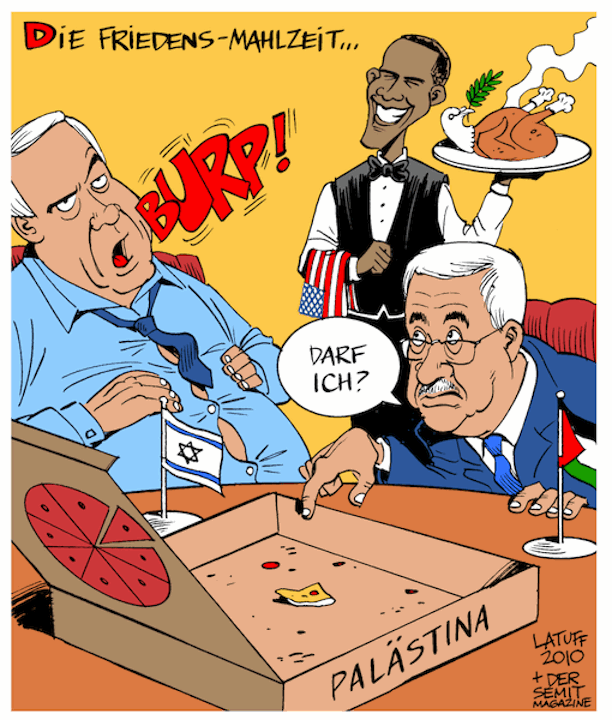
Peace Dinner, by Carlos Latuff
http://gaza.haimbresheeth.com/wp-content/uploads/2010/09/Peace-dinner-with-Netanyahu-Abbas-and-Obama3.gif
Saturday, September 25, 2010
Empty Promises: Obama takes his Middle East peace plan to the UN
"International law is not an empty promise" – except for Palestinians
President Obama's General Assembly speech called on the international community to mobilize behind the U.S.-led "peace process." He called on the Palestinians to "reconcile with a secure Israel" and waxed eloquent on the illegality of killing Israeli civilians. He called on the Palestinians' friends to implement the Arab Peace Plan's proposed normalization with Israel without ever mentioning the plan's clear understanding that ending Israel's 1967 occupation must come first. And he called on Israel to – talk nicely.
Obama did say that Israel's partial settlement moratorium "should" be extended, but carefully went on to urge that the talks "press on until completed" with no linkage between the two goals. Not to mention that what he calls a "moratorium" has consistently allowed continued building throughout Arab East Jerusalem, continued construction on homes already approved or begun, and work on huge infrastructure projects throughout the settlements.
Obama pretty much ignored any substantive role for the United Nations in the "peace process," but he lectured the General Assembly, noting that "many in this hall count themselves as friends of the Palestinians." (He didn't, apparently, include himself in that category.) From those friends, he demanded "tangible steps towards normalization" with Israel, ignoring the fundamental basis of the Arab Peace Initiative that makes clear normalization comes after, not before, an end to Israel's occupation.
And he condemned the "slaughter of innocent Israelis," but said not one word about Israel's 2008-09 assault, which used U.S. arms to kill 1,400 Gazans–more than 900 of them civilians and more than 300 of them children. Let alone any mention of the nine killed (including a U.S. citizen) and 50+ injured in the Israeli assault on the Turkish ship in the international humanitarian flotilla a few months ago.
The speech made clear that support for the moment, the endless "peace process" is, for Washington, a perfectly appropriate alternative to holding Israel accountable for any violations of human rights or international law. The Goldstone Report, UN and other efforts to hold Israel accountable for the illegalities inherent in its occupation and apartheid policies, or even the extreme violations like the Gaza war or the flotilla assault, must be sidelined or squashed entirely – because they could undermine the peace talks, whether or not those peace talks have any hope of succeeding. It is the exact opposite position as that taken by Obama's UN Ambassador Susan Rice regarding Darfur. Rice was one of the strongest voices insisting on full implementation of the International Criminal Court indictment of Sudanese President Omar al-Bashir regardless of the dangers it posed to the fragile Sudanese ceasefire because accountability must come first, insisting that justice comes before peace.
But not, apparently, when it comes to Israel-Palestine.
Obama made a vitally important point when he said that "international law is not an empty promise." Unfortunately he said that only in regard to imposing sanctions on Iran. After that, when he began to speak of Palestine and Israel, the phrase "international law" was never seen again.
In all his discussions of the peace talks and their importance, and even in his description of the arguments of "the cynics," Obama never acknowledged the most important reason why this round of talks will almost certainly fail to bring about a just, comprehensive and lasting peace: because they are not based on international law and the UN Charter and resolutions. The president said that the cynics' view is that Israelis and Palestinians don't trust each other, that both parties are divided internally, that "the gaps between the parties are too great." But he never acknowledged that "the parties" do not come to the table as equals, that this is not a border dispute between Peru and Ecuador. These are talks between an Occupying Power, which happens to be the 23rd wealthiest country in the world and by far the strongest military and nuclear weapons power in the region, backed by the strongest and most powerful country on the globe, facing an impoverished and dispossessed occupied population. When talks are based on accepting that inequality as a given, when the arbiter of the talks is the main backer of the stronger party, and when international law is ignored, the talks cannot succeed.
So far, the Obama administration seems to be saying that "no change" is the only change we can believe in when it comes to U.S. policy on Israel-Palestine.
By Phyllis Bennis* | Sabbah Report | www.sabbah.biz
President Obama's General Assembly speech called on the international community to mobilize behind the U.S.-led "peace process." He called on the Palestinians to "reconcile with a secure Israel" and waxed eloquent on the illegality of killing Israeli civilians. He called on the Palestinians' friends to implement the Arab Peace Plan's proposed normalization with Israel without ever mentioning the plan's clear understanding that ending Israel's 1967 occupation must come first. And he called on Israel to – talk nicely.
Obama did say that Israel's partial settlement moratorium "should" be extended, but carefully went on to urge that the talks "press on until completed" with no linkage between the two goals. Not to mention that what he calls a "moratorium" has consistently allowed continued building throughout Arab East Jerusalem, continued construction on homes already approved or begun, and work on huge infrastructure projects throughout the settlements.
Obama pretty much ignored any substantive role for the United Nations in the "peace process," but he lectured the General Assembly, noting that "many in this hall count themselves as friends of the Palestinians." (He didn't, apparently, include himself in that category.) From those friends, he demanded "tangible steps towards normalization" with Israel, ignoring the fundamental basis of the Arab Peace Initiative that makes clear normalization comes after, not before, an end to Israel's occupation.
And he condemned the "slaughter of innocent Israelis," but said not one word about Israel's 2008-09 assault, which used U.S. arms to kill 1,400 Gazans–more than 900 of them civilians and more than 300 of them children. Let alone any mention of the nine killed (including a U.S. citizen) and 50+ injured in the Israeli assault on the Turkish ship in the international humanitarian flotilla a few months ago.
The speech made clear that support for the moment, the endless "peace process" is, for Washington, a perfectly appropriate alternative to holding Israel accountable for any violations of human rights or international law. The Goldstone Report, UN and other efforts to hold Israel accountable for the illegalities inherent in its occupation and apartheid policies, or even the extreme violations like the Gaza war or the flotilla assault, must be sidelined or squashed entirely – because they could undermine the peace talks, whether or not those peace talks have any hope of succeeding. It is the exact opposite position as that taken by Obama's UN Ambassador Susan Rice regarding Darfur. Rice was one of the strongest voices insisting on full implementation of the International Criminal Court indictment of Sudanese President Omar al-Bashir regardless of the dangers it posed to the fragile Sudanese ceasefire because accountability must come first, insisting that justice comes before peace.
But not, apparently, when it comes to Israel-Palestine.
Obama made a vitally important point when he said that "international law is not an empty promise." Unfortunately he said that only in regard to imposing sanctions on Iran. After that, when he began to speak of Palestine and Israel, the phrase "international law" was never seen again.
In all his discussions of the peace talks and their importance, and even in his description of the arguments of "the cynics," Obama never acknowledged the most important reason why this round of talks will almost certainly fail to bring about a just, comprehensive and lasting peace: because they are not based on international law and the UN Charter and resolutions. The president said that the cynics' view is that Israelis and Palestinians don't trust each other, that both parties are divided internally, that "the gaps between the parties are too great." But he never acknowledged that "the parties" do not come to the table as equals, that this is not a border dispute between Peru and Ecuador. These are talks between an Occupying Power, which happens to be the 23rd wealthiest country in the world and by far the strongest military and nuclear weapons power in the region, backed by the strongest and most powerful country on the globe, facing an impoverished and dispossessed occupied population. When talks are based on accepting that inequality as a given, when the arbiter of the talks is the main backer of the stronger party, and when international law is ignored, the talks cannot succeed.
So far, the Obama administration seems to be saying that "no change" is the only change we can believe in when it comes to U.S. policy on Israel-Palestine.
By Phyllis Bennis* | Sabbah Report | www.sabbah.biz
Saturday, September 4, 2010
Obama has signalled his coming complete surrender to Zionism and its lobby
By Alan Hart* | Sabbah Report | www.sabbah.bizHe did it with seven words. "Ultimately the U.S. cannot impose a solution."
He was speaking at the White House the day before the start of the new round of direct talks between Israeli Prime Minister Benjamin Netanyahu and Palestinian leader Mahmoud Abbas, after he had met with them and Egypt's President Hosni Mubarak and Jordan's King Abdullah II. (In my last post I anticipated Obama saying at the point of his complete surrender that "America can't want peace more than the parties." He also said that – ahead of schedule!)
Today there is a growing number of seriously well informed people of all faiths and none (including me) who believe there will only be peace if it is imposed.
Among those who have dared to say so in public is one of the most eminent Jewish gentlemen of our time, Henry Siegman. A former national director of the American Jewish Congress, he is president of the U.S./Middle East Project, which was part of the Council on Foreign Relations from 1994 until 2006 when it was established as an independent policy institute. He is also a research professor at the Sir Joseph Hotung Middle East Programme of the School of Oriental and African Studies at the University of London. During his more than 30 years of involvement in the Middle East peace process, he has published extensively on the subject and has been consulted by governments, international agencies and non-governmental organizations involved in the peace process. In a comment piece for the Financial Times on 23 February 2010, (quoted in Conflict Without End? the Epilogue to Volume 3 of the American edition of my book Zionism: The Real Enemy of the Jews), he wrote this:
"The Middle East peace process and its quest for a two-state solution to the Israel-Palestine conflict that got under way nearly 20 years ago with the Oslo accords has undergone two fundamental transformations. It is now on the brink of a third.
"The first was the crossing of a threshold by Israel's settlement project in the West Bank; there is no longer any prospect of its removal by this or any future Israeli government, which was the precise goal of the settlements' relentless expansion all along. The previous prime minister, Ehud Olmert, who declared that a peace accord requires Israel to withdraw 'from most, if not all' of the occupied territories, 'including East Jerusalem,' was unable even to remove any of the 20 hilltop outposts Israel had solemnly promised to dismantle.
"A two-state solution could therefore come about only if Israel were compelled to withdraw to the pre-1967 border by an outside power whose wishes an Israeli government could not defy – the US. The assumption has always been that at the point where Israel's colonial ambitions collide with critical US national interests, an American president would draw on the massive credit the US has accumulated with Israel to insist it dismantle its illegal settlements, which successive US administrations held to be the main obstacle to a peace accord.
"The second transformation resulted from the shattering of that assumption when President Barack Obama – who took a more forceful stand against Israel's settlements than any of his predecessors, and did so at a time when the damage this unending conflict was causing American interests could not have been more obvious – backed off ignominiously in the face of Prime Minister Benjamin Netanyahu's rejection of his demand. This left prospects for a two-state accord dead in the water."
On 16 August in a piece for the Huffington Post which was originally published by Ha'aretz in Hebrew, Siegman added this:
"Most Israelis, particularly the present government, have been blithely indifferent to repeated international condemnations of Israel's systematic theft of Palestinian territory on which it has been settling its own Jewish population in blatant violation of international law. Yet their reaction to what they see as an attack on the "legitimacy" of the State of Israel, a concept foreign to international law, seems to bring them to the edge of hysteria.
"In fact, Israel's legitimacy within its 1967 borders has never been challenged by the international community. It is its behavior on territory beyond its own borders to which the international community – including every U.S. administration – has objected. To construe the condemnation of violations of international law as anti-Semitism is absurd.
"It was not an anti-Semite seeking to delegitimize the Jewish state, but Theodore Meron, an internationally respected jurist and the legal advisor to Israel's Foreign Ministry, who following the war of 1967 conveyed the following legal opinion to Israel's Foreign Minister Abba Eban: 'Civilian settlement in the administered territories contravenes explicit provisions of the Fourth Geneva Convention,' to which Israel is a signatory. That Convention's ban on population transfer is 'categorical and not conditional upon the motives for the transfer or its objectives. The Convention's purpose is to prevent settlement in occupied territory of citizens of the occupying state.'"
So yes, Israel's leaders knew that settlements on Arab land occupied in 1967 are illegal. They simply didn't give (and still today don't give) a damn about international law. But this attitude, a mixture of extreme arrogance and insufferable self-righteousness, does not make them the main villains in the story of what happened after June 1967. The main villains were (and still are) the governments of the major powers and the one in Washington DC above all.
What they should have said to Israel in the immediate aftermarth of the 1967 war is: "You are not to build any settlements on occupied Arab land. If you do, you'll be demonstrating your contempt for international law. In this event the international community will declare Israel to be an outlaw state and subject it to sanctions."
If something like that riot act had been read to Israel there would have been peace many, many years ago. The pragmatic Arafat was reluctantly reconciled to the reality of Israel's existence inside its pre-1967 borders as far back as 1968. In his gun and olive branch address to the UN General Assembly on 13 November 1974 he said so by obvious implication. Thereafter he put his credibility with his leadership colleagues and his people, and his life, on the line to get a mandate for unthinkable compromise with Israel. He got it at the end of 1979 when the Palestine National Council voted by 296 votes to 4 to endorse his two-state policy. What he needed thereafter was an Israeli partner for peace. He eventually got a probable one, Yitzhak Rabin, but he was assassinated by a Zionist fanatic. The more it became clear that Israel's leaders were not interested in a genuine two-state solution for which Arafat had prepared the ground on his side, the more his credibility with his own people suffered.
It is in the context briefly sketched above that Obama's seven words have their real meaning.
At the time of writing it seems reasonably clear that Obama is hoping that Abbas and his equally discredited Fatah leadership colleagues can be bribed and bullied into accepting what Netanyahu will eventually offer – crumbs from Zionism's table. (My guess is that Abbas at a point will resign rather than trigger a Palestinian civil war). THE question is what will Obama do when Israel refuses to give enough to satisfy the demands and needs of the Palestinian people for a just about acceptable measure of justice?
We already know the answer. "Ultimately the U.S. cannot impose a solution."
Effectively those seven words tell Israel's leaders that they can go on imposing their will on the occupied and oppressed Palestinians with the comfort of knowing that Obama is not going to use the leverage he has, and every American president has had, to cause them, or try to cause them, to be serious about peace on terms virtually all Palestinians and most other Arabs and Muslims everywhere could accept, and which a rational Israeli government and people would accept with relief.
Put another way, those seven words are effectively a green light for Zionism alone to determine the future of the Palestinians, a future which at some point will most likely see the final ethnic cleansing of Palestine, followed by another great turning against the Jews (provoked by the Zionist state's behaviour) and a Clash of Civilizations, Judeo-Christian v Islamic.
In his analysis on the day Obama delivered his seven words, Jeremy Bowen, the BBC's admirable Middle East Editor, offered this thought. "There might not be room for many more failures. The conflict is changing. A religious war is now being grafted on what used to be fundamentally a competition for territory between two national movements. You can make deals with nationalists. It's much harder with people who believe they're doing God's work."
The next question asks itself. Why won't Obama be the president to call and hold the Zionist state to account for its crimes, even when doing so is necessary for the best protection of America's own interests?
Part of the answer is, of course, that he is no more willing than any of his predecessors to have a showdown with the Zionist lobby and its stooges in Congress and the mainstream media.
But there might be more to it.
In the privacy of his own mind Obama probably understands better than any of his predecessors how the conflict was created and what has sustained it. If that is the case, he will also know there's no guarantee that real American-led pressure on Israel to be serious about peace would work and that it could be counter-productive.
I am a supporter in principle of the case and the need for the Zionist state of Israel to be totally isolated, boycotted and sanctioned as Apartheid South Africa was, eventually. But… The danger is that even the credible threat of a real boycott and sanctions could play into the hands of those Israeli leaders – Netanyahu has long been their standard bearer – who have brainwashed Israelis, most if not quite all, into believing that the world hates Jews, always has and always will, and that Israeli Jews have no choice but to tell the world to go to hell. In this context (and as I note in the Epilogue of the American edition of my book), I think it could and should be said that Zionism succeeded, probably beyond its own best expectations, in transforming the obscenity of the Nazi holocaust from a lesson against racism and fascism and all the evils associated with them into an ideology that seeks to justify anything and everything the Zionist state does. War crimes and all.
So it could be that in the privacy of his own mind, Obama knows it is already too late (not to mention too dangerous) to try to push Israel's leaders much further than they are willing to go.
What, I wonder, will honest historians of the future make of what is happening right now? My guess is that they will conclude that when Obama launched his push for peace, the Zionist state was already a monster beyond control.
Tuesday, August 3, 2010
Wednesday, July 7, 2010
Bibi Back at the White House – The Consistency of Israeli Duplicity Comes Ever More Clearly into Focus – by Jeff Gates
U.S. military leaders will be watching this meeting very closely, as will the veterans community.
For me, confirmation of Israel's strategic duplicity came in a meeting with Harry McPherson who served as counsel and speechwriter for Lyndon B. Johnson. LBJ entered the Senate in 1948 with Louisiana Senator Russell Long for whom I served as counsel and speechwriter.
At his law offices in Washington, Harry described his arrival in Tel Aviv the night that the 1967 War began. That war typifies the consistency of this ongoing deceit.
He flew in the night before from Vietnam through Hong Kong. He knew on arrival that something was amiss because the airport lights were off. He checked into his hotel and was awakened early on June 5th by Wally Barbour, the U.S. ambassador to Israel.
A pear-shaped diplomat with a penchant for yellowing Palm Beach suits, Barbour called to tell Harry that the war had just broken out-to which he replied, "But I just come from the war."
Barbour picked him up at the hotel and they hurried to the foreign ministry for a brief meeting before conferring with the Israeli chief of military intelligence. In response to their repeated question, "Did the Egyptians attack?" McPherson and Barbour received only evasive answers. As air raid sirens wailed, McPherson recalls in A Political Education:
Barbour suggested that we might continue the discussion in the underground bunker. The general studied his watch. "No, that won't be necessary. We can stay here." Barbour and I looked at each other. If it wasn't necessary, the Egyptian air force had been destroyed. That could only have happened so quickly if it had been surprised on the ground. We did not need to ask for confirmation, but left at once to cable the news to Washington.
Israel was neither under attack nor under threat of attack as its leadership has since conceded. Air raid sirens were just props in the stagecraft of waging war by way of deception.
The Israel-as-victim storyline was stage-managed by Zionist extremists to make both Israeli citizens and foreign observers believe that the Jewish state was endangered. As with the phony intelligence that induced the U.S. to war in Iraq in March 2003, the facts in June 1967 differed dramatically from the geopolitical narrative.
Under cover of that false attack, Tel Aviv occupied land belonging to its neighbors. The bulk of that property is still held by force 43 years later with the support of the U.S. as its oft-duped ally.
Servicing the Commander-in-Chief
In the lead-up to Israel's Six-Day Land Grab, Johnson was lobbied by U.N. Ambassador Arthur Goldberg. LBJ had moved Goldberg from the Supreme Court to the U.N. so he could be replaced with Abe Fortas, Johnson's personal lawyer. Fortas was a senior operative in a network of Zionists who helped produce the Johnson presidency and shaped its policies.
When Goldberg used heart-rending rhetoric to weave for Johnson a storyline about Israeli vulnerability and the pending victimization of hapless Jews at the hostile hands of an Arab "ring of steel," LBJ waved a Central Intelligence Agency report predicting that Israel could win any war in the region in two weeks.
When Goldberg persisted, Johnson ordered the CIA to revisit their analysis. The agency returned with a revised report concluding that Israel could win any war in the region in one week.
On June 4th, at a Fortas-hosted dinner for Johnson, Defense Secretary Robert McNamara and New York investment banker John Loeb, Fortas cautioned Johnson that war might soon erupt in the Middle East.
When the president turned to McNamara for his opinion, the Pentagon chief agreed with Johnson that there would be no war. Johnson then confirmed that U.S. intelligence agencies agreed with McNamara's assessment. Johnson left for the White House at 10:58 p.m.
Less than six hours later, at 4:30 a.m. on June 5th, National Security Adviser Walt Rostow called LBJ to announce that Israel had attacked Egypt. Mathilde Krim, a former Irgun operative, was Johnson's guest at the White House that night. Before informing anyone else, LBJ stopped by the blonde beauty's bedroom to tell her, "The war has started."
Not until 7:45 a.m. did Johnson speak with Soviet Premier Aleksi Kosygin who expressed his hope and expectation that the U.S., as Israel's closest ally, would restrain Tel Aviv.
Mathilde Krim was the wife of Arthur Krim, chairman of the Finance Committee for the Democratic Party and president of United Artists. While Johnson was in the Senate, Krim bought land near the LBJ Ranch in Texas where he built "Mathilde's House." When Arthur was away on business, Johnson routinely took Marine One, the presidential helicopter, to visit Mathilde.
An Inside Job
In the war's first few hours, the "victimized" Israelis destroyed the Egyptian Air Force while its aircraft were still on the ground. Walt Rostow sent Johnson a memo describing the success of Tel Aviv's "vulnerable" military as "the first day's turkey shoot." By evening, the Jordanian air force was also largely destroyed.
Johnson also received a memo from Arthur Krim that read, "Many arms shipments are packed and ready to go to Israel, but are being held up. It would be helpful if these could be released." Johnson ordered them released.
By evening of the second day, two-thirds of the Syrian air force had been destroyed. The glee in the State Department Operations Room was palpable, leading Under Secretary of State Eugene Rostow to caution, "Gentlemen, gentlemen, do not forget that we are neutral in word, thought and deed."
At the State Department's mid-day press briefing, spokesman Robert McCloskey repeated Rostow's official "neutrality" lie. Zionist advisers surrounded Johnson in the decision-making that lent U.S. support to the 1967 war. "Everyone around me, without exception was pro-Israel," recalls Johnson speechwriter Grace Halsell. She identified more than a dozen close advisers to Johnson, including Walt Rostow, his brother Eugene and Arthur Goldberg.
White House counsels Leo White and Jake Jacobsen were likewise pro-Israel as were two key speechwriters: Richard Goodwin, husband of biographer Doris Kearns Goodwin, and Ben Wattenberg whose parents moved to the U.S. from Palestine. Likewise domestic affairs adviser Larry Levinson and John Roche, an avid Zionist and Johnson's intellectual-in-residence.
The Non-Separation of Powers
In the lead-up to this Israeli aggression, Fortas served as an enabling back channel between the Israeli embassy and the White House. Fortas had known Israeli Ambassador Avraham Harman since the ambassador's arrival in Washington in 1959. During the March 1960 visit to Washngton of Prime Minister David Ben-Gurion, Fortas sponsored a breakfast at his home attended by Harman and Johnson who was then Senate Majority Leader.
Fortas' biographer conceded: "For several weeks before the crisis erupted into war, the Israeli ambassador was ‘in very frequent contact' with Fortas and regularly visited the justice at his chambers or his house." An outspoken Zionist, Fortas also attended a critical White House strategy meeting on the Middle East on May 26th, ten days before the land grab began.
When it came to Israel, Fortas was never neutral. "When they get back from Egypt," a law clerk in his Supreme Court chambers overheard Justice Fortas say, "I'm going to decorate my office with Arab foreskins."
Throughout the six days of carnage that Israel inflicted on its neighbors, Near East experts met daily with Johnson in the Cabinet Room. Fortas attended each meeting. Reflecting on comments by Fortas to Johnson at their June 4th dinner party, John Loeb wrote to Fortas on June 6th: "You were prophetic about the Middle East. Thank the Lord the President has you as a friend and counselor."
In 1968, Johnson failed in his attempt to elevate Fortas to Chief Justice of the Supreme Court. Fortas resigned in May 1969 in the wake of a series of scandals. In the summer of 1970, The New York Times reported his registration as a lobbyist for Kuhn, Loeb & Company.
Fortas cemented his relationship with Johnson in 1948 when, in LBJ's first Senate race in Texas, the Washington lawyer finessed the extensive vote fraud apparent in the Democratic primary in which Johnson claimed an 87-vote victory, including 200 votes tallied in alphabetical order.
A Fortas-devised legal strategy led to Johnson's name appearing on the November ballot as the Democratic Party nominee. In a strongly Democratic state, that primary victory assured the ambitious Texan a victory in the general election and a seat in the U.S. Senate. Decades later, those familiar with this political history continued to refer to him as "Landslide Lyndon."
A Strategic Provocation
The Six-Day Slaughter of 1967 pre-staged the geopolitical dynamics for all that has followed-not only in the Middle East but also in the U.S. as Israel's violent taking of land outraged everyone in the region and set American foreign policy on today's ruinous course.
The periodic carnage visited on Palestinians ensures that this strategic provocation remains fresh in the minds of Muslims worldwide. Reactions to these serial provocations, in turn, fuel the plausibility of the latest storyline, The Clash of Civilizations and its corrosive counterpart: the Global War on Terrorism with "Islamo fascism" the essential Evil Doer branding.
Israel has performed with reliable consistency every act required to provoke and sustain extremism in the Muslim world. Only by duplicity has the Zionist state sustained a U.S. alliance whose main effect has been to make America appear guilty by association.
On August 9, 2000 in a White House ceremony, President Bill Clinton presented Johnson paramour Mathilde Krim with the Medal of Freedom. By then this former Irgun terrorist had been rebranded as a high-profile medical researcher and AIDS activist adored and promoted to political prominence by her pro-Israeli supporters in Hollywood.
It's not expected that Israeli-American Rahm Israel Emanuel, White House Chief of Staff to Barack Obama, will urge that Monica Lewinsky receive the nation's highest civilian honor. It's not yet known what role Emanuel and White House political strategist David Axelrod have played in sustaining our costly "special relationship" with the Jewish state.
As yet another Israeli Prime Minister arrives in Washington with yet another rationalization for continuing this entangled alliance, a nomination is pending for the appointment to our highest court of a third Jewish Zionist for a court with just nine jurists. In time, historians will identify the role played by the Israel lobby (and Emanuel/Axelrod) in the nomination of Elena Kagan.
Based on the consistency of "Bibi" Netanyahu's duplicitous conduct over decades, Barack Obama needs to know when an Israeli Prime Minister is once again deceiving a U.S. president. History suggests a reliable test: are his lips moving?
The End of History
Though the U.S. has been deceived with stunning consistency for more than six decades, a mid-course correction remains possible. If this latest president can concede to himself that his political career is a product of those complicit at this deceit, he may yet emerge as the transformative leader that his supporters once hoped he could be.
If Barack Obama can be honest with himself, he will speak candidly to the American people and explain why this long-running deceit must be brought to a speedy close. If on July 6th he announces support for a one state solution, that will start to unwind this perilous alliance.
Senior military leaders have confirmed the common source undermining U.S. national security. Should the current commander-in-chief fail to act consistent with the known facts, this latest political product of the Chicago Outfit may risk their continued allegiance.
To advance peace, he needs only declare U.S. support for the designation of Jerusalem as an international cultural site under the protection of U.N. troops. To end the multi-decade cycle of provocation/reaction, he needs only reassign 30,000 U.S. troops to Palestine to rebuild a destroyed society, resettle its ousted people on occupied land and secure Israel's nuclear arsenal.
The Zionist experiment was a failure before it began. An overdue end to this apartheid regime can begin July 6th. Or this perilous alliance can continue-at untold cost in blood and treasure.
July 6th could be a defining moment for a president in need of such a moment. That date could also mark the restoration of American values to U.S. foreign policy and grant solace to those moderate and secular Jews long appalled at the conduct of Zionists who in 1948 deceived a U.S. president to recognize as a legitimate state their extremist enclave in the Middle East.
http://sabbah.biz/mt/archives/2010/07/06/bibi-back-at-the-white-house/
Monday, July 5, 2010
Obama, Netanyahu, and Middle East Peace
Now being the smart man that he is (and I’m actually not being sarcastic here), Obama must realize that Netanyahu has no intention of compromising on these issues. Yes, Netanyahu has proposed granting the Palestinians a “state,” but it turns out that this “state” isn’t really a state at all. Under Netanyahu’s plan, the Palestinians would not be permitted to have an army, and Israel would retrain control of the area’s borders and airspace. Netanyahu has also made it clear that Israel will never relinquish East Jerusalem, the Jordan Valley, and other parts of the West Bank.[2]
Although this non-state might sound reasonable to the likes of Avigdor Lieberman (provided, of course, that Netanyahu also agrees to “transfer” a good number of Israeli Arabs out of Israel), Obama—who, we’ve already established, is a smart man—must realize that it’s not reasonable to the Palestinians. Nor, for that matter, to the rest of the world, which has repeatedly voted in the UN General Assembly that Israel must (1) withdraw from “the Palestinian territory occupied since 1967, including East Jerusalem,” (2) acknowledge that the Palestinians have “the right to self-determination and the right to their independent State,” and (3) resolve the refugee crisis in conformity with Resolution 194.[3]
So, assuming that he really wants to resolve the Israel-Palestine conflict, Obama’s task will be to persuade Netanyahu to do what Netanyahu obviously has no intention of doing. Now how, you might be wondering, how oh how, can Obama accomplish this?
Martin Indyk, who served as US ambassador to Israel during the Clinton years, writes that the president must find a way to “overcome the mistrust” that has “permeated and poisoned their personal relationship and build a partnership for peace.” In order to accomplish this, Indyk writes, “Obama should invite [Netanyahu] alone to Camp David for an afternoon walk in the woods. For his part, since he models himself on Winston Churchill, Netanyahu needs to make a real effort to take Obama into his confidence, much as Churchill wooed Roosevelt in the run-up to America’s entry into World War II.”[4]
Such a touching scene there: Barry and Bibi walking alone in the woods. Perhaps, if time allows, they could even go for a picnic, maybe even find a nice spot on the green and watch the sun set.
Of course, such actions will do absolutely nothing to resolve the Israel-Palestine conflict. If Obama is really serious about doing this, then he would do well to listen to James Baker, who, in March, suggested how the president could curb Israeli settlement expansion: “I would…stress United States taxpayers are giving Israel roughly $3 billion each year, which amounts to something like $1,000 for every Israeli citizen, at a time when our own economy is in bad shape and a lot of Americans would appreciate that kind of helping hand from their own government. Given that fact, it is not unreasonable to ask the Israeli leadership to respect U.S. policy on settlements.”[5]
Baker, of course, has the right to dole out such advice. In early 1992, he and President Bush I. told Israel’s Prime Minister Yitzhak Shamir that they would freeze a $10 billion loan guarantee until Israel halted its settlement construction. “Israeli leaders told us they would just get the money from the U.S. Congress,” Baker recalls. “Our reply was, ‘We’ll see you on Capitol Hill.’” Baker and Bush ended up prevailing, as “[t]he Israeli public rejected Shamir’s ideological hard line” and in the June elections voted in Yitzhak Rabin’s Labor Party, which had “pledged to restore friendly relations with the United States.”[6]
If Obama applied enough pressure, he might be able to bring an end to Netanyahu’s coalition government, which in turn might pave the way for a Kadima-Labor government, which itself might be willing to make a reasonable offer to the Palestinians. Yes, there are a lot of mights there, and I’m not holding my breath. But if Obama really does want to resolve the conflict (and I think he does), and if he really is such a smart man (and we’ve agreed that he is), then perhaps—perhaps—it’s possible.
Notes
[1] Ali Weinberg, “Obama, Netanyahu meeting to avoid specifics, settlements,” First Read from NBC News, 2 July 2010.
[2] “PM’s Speech at the Begin-Sadat Center at Bar-Ilan University,” Prime Minister’s Office, 14 June 2009; Barak Ravid and Agencies, “Netanyahu: Israel will never share Jerusalem with Palestinians,” Haaretz, 12 January 2010; Jonathan Lis, “Netanyahu: Israel will never cede Jordan Valley,” Haaretz, 3 February 2010; “Netanyahu: Israel must have West Bank presence after peace deal,” Associated Press, 20 January 2010.
[3] “Responding to Avigdor Lieberman,” 29 June 2010; “Peaceful settlement of the question of Palestine (A/64/L.23),” United Nations General Assembly, 23 November 2009; “Following Two-Day Debate, General Assembly Adopts Six Draft Resolutions On Question of Palestine, Middle East,” United Nations General Assembly, 2 December 2009.
[4] “A quiet diplomacy on the Mideast peace path,” Washington Post, 2 July 2010.
[5] Akiva Eldar, “James Baker’s Advice for Obama on Forging Middle East Peace,” Haaretz, 23 March 2010.
[6] Ibid.; William L. Cleveland, A History of the Modern Middle East, 2004, p. 501.
http://donemmerich.blogspot.com/
Sunday, May 23, 2010
As Obama Retreats, Palestinians Renew Their Struggle
AMERICAN Middle East policy has been weighted in favor of Israel ever since President Harry Truman rejected the advice of Secretary of State George C. Marshall and pushed through a resolution at the U.N. General Assembly giving most of Palestine to the Jews, who were then a minority of the population. As the new state of Israel proceeded to expel the original inhabitants and seize more of their land, Washington turned a blind eye—and footed the bill.
At a Feb. 19 protest marking the fifth anniversary of weekly demonstrations against Israel’s separation barrier in the West Bank village of Bil’in, Palestinian and foreign peace activists tear down a section of the barrier. Some 2,000 people attended the demonstration, including Palestinian Prime Minister Salam Fayyad and Geneva Mayor Remy Pagani. (AFP photo/Abbas Momani)
This lopsided relationship has continued under almost every president, kept in place by a powerful Israel lobby and an unrelenting disinformation campaign. The one exception was President Dwight D. Eisenhower, who in 1956 ordered Israel, France and England to turn back from their attempted invasion of the Sinai. Israel’s current prime minister, Binyamin Netanyahu, has stretched the relationship to the point of mockery, not only thwarting every effort by President Barack Obama to broker an Israeli-Palestinian peace but doing so with almost gleeful defiance.
Obama’s response has been a full retreat to the failed policy of urging the two sides to resume negotiations, which means letting the Palestinians go it alone while Israel takes more and more of their land. Instead of supporting Palestinian President Mahmoud Abbas in his demand that Israel stop all settlement construction before he will take part in peace talks, Obama sent his special Middle East envoy George J. Mitchell to urge Abbas back to the negotiating table.
In the tradition of his predecessors, Netanyahu made sure the mission would fail. While Mitchell was in Ramallah in late January trying to persuade Palestinian leaders to resume peace talks, Netanyahu announced that the huge settlement blocs of Ma’ale Adumim and Ariel that extend deep into the West Bank would belong permanently to Israel. Two days later the prime minister spoke at a tree-planting ceremony in the Ezion settlement bloc south of Jerusalem and declared, “This place will be an inseparable part of the State of Israel. We are planting here, we will stay here, we will build here.” Ezion was part of the West Bank until 1967, when Israel illegally annexed Jerusalem and extended its boundaries to include the town.
Mitchell was still in Israel when Netanyahu stipulated that any future Palestinian state must be demilitarized, with Israel continuing to control its borders and air space as well as the Jordan Valley. In a recent article in the Nation, Henry Siegman recalled that shortly after 1967, while he was head of the American Jewish Congress, Israeli officials showed him maps of the captured West Bank on which future settlements were strategically placed to assure Israel’s permanent hold on the territory. Those settlements are now a reality, Siegman writes, and Netanyahu’s conditions for Palestinian statehood would leave Israel’s occupation in place. Under these circumstances Abbas had no option but to refuse to resume negotiations.
Following Mitchell’s humiliating trip, the Obama administration not only threw in the towel but laid half the blame on the Palestinians. Obama told a reporter for the Los Angeles Times that he had doubts whether Israeli and Palestinian leaders were “prepared to make the kind of compromises needed to engage in a meaningful conversation.” He did not say what compromises the Palestinians should make. Secretary of State Hillary Clinton added that efforts to revive peace talks would continue but stressed that “the next step will be up to Israelis and Palestinians.” In other words, let the occupied bargain with the occupiers.
In a speech to the U.S.-Islamic World Forum in Qatar in mid-February, Clinton called on the Arab nations to give up “stereotypes and outdated views” and take more responsibility for restarting peace talks between the Palestinians and Israelis. She could have been reminded that the Arab peace proposal of 2002, which was based on U.N. Security Council Resolution 242 and endorsed by every Arab nation, was ignored by Israel and the U.S. At a meeting afterwards with Qatar’s emir, Sheikh Hamad bin Khalifa al-Thani, the emir asked that the U.S. do more to help the people of Gaza. Clinton’s reply was that Qatar should reopen Israel’s trade office in Doha, which the emirate had closed during Israel’s assault on Gaza last winter.
Faced with a U.S. administration unwilling to help, the Palestinians are revitalizing their struggle. Hamas and Fatah resumed talks in Gaza in early February aimed at ending their differences and possibly reuniting. Meanwhile West Bank Palestinians are conducting a different kind of intifada, using nonviolent resistance. The weekly vigils against the separation wall that began in the villages of Bil’in and Nil’in five years ago continue to grow and attract participants from all over the world. Similar protests recently began in Nabi Saleh, a village near Ramallah where settlers took over a natural spring on village land. When villagers tried to reclaim their spring Israeli soldiers met them with tear gas and stun grenades.
The demonstrations have some distinguished supporters. Dr. Mustafa Bargouthi, a leader of the nonviolent movement, has been nominated for the Nobel Peace Prize by Mairead Maguire, a 1976 Nobel laureate who was shot in the leg with a rubber bullet in 2007 while attending a vigil at the wall in Bil’in. Former Peace Prize winners Bishop Desmond Tutu and President Jimmy Carter have visited Bil’in and praised the protesters as following in the footsteps of Ghandi and Martin Luther King, Jr. The Popular Struggle Coordination Committee that organizes the demonstrations is even receiving aid from the Spanish government.
Palestinians won a partial victory when the Israeli Supreme Court ordered the army to reroute the wall so as to return some 170 acres of land to the village, but the barrier and nearby settlements still occupy 400 acres of village land and the protests are continuing.Those who take part pay a high price. Israeli human rights groups B’Tselem and Yesh Din report that police are firing rubber bullets, 22-caliber bullets, and tear gas canisters into the crowds at close range.
At least 19 Palestinians, including several children, have been killed during the protests and many more have been injured, including Tristan Anderson, an American who was severely brain damaged when he was struck by a high-velocity canister. As usual, an army investigation exonerated the soldier who did it. Instead it was Palestinians who were punished. Aqel Srur, who testified against the soldier, was killed by a 22-caliber bullet last June. Another witness, Salah Muhammed Khawajeh, was warned that the same thing could happen to him, and in January his 9-year old son was shot in the back by a rubber bullet.
The Israelis clearly regard the nonviolent protest as more dangerous than rockets and suicide bombings, which create sympathy for Israel and provide an excuse for retaliation. Israeli forces are conducting nightly raids on the homes of organizers of and participants in nonviolent actions, and making a mounting number of arrests. In the first 10 days of February, the army arrested 51 Palestinians, including Montaha Taweel, wife of the mayor of Al-Bireh and an activist on behalf of Palestinian prisoners.
Mohanad Abu Awad, the 20-year old son of the manager of Israeli-Palestinian Bereaved Parents for Peace and a peace activist himself, was brutally arrested on Jan. 23 when Israeli soldiers surrounded his family’s house at 3 a.m and threatened to blow it up if the inhabitants, including several sleeping children, didn’t leave at once. After the family left, the soldiers ransacked the house, forced Mohanad to drop his pants, and took him away shackled and blindfolded. They gave no reason for the search or the arrest.
More and more Israeli Jews also are being jailed for joining in nonviolent Palestinian actions. At a Jan. 15 demonstration against the eviction of Palestinian families in East Jerusalem, 17 Israelis were arrested, including the head of the Association for Civil Rights, Hagain Elad. Unlike Palestinian demonstrators who are held for weeks and even months, they were released 36 hours later, but a Jerusalem court nevertheless declared their demonstration to be illegal.
Elad said the arrests represented “a dramatic increase in attempts to silence dissent” on Israel’s part, a statement borne out by the well-financed campaign to smear the New Israel Fund by accusing it of providing damaging information to the Goldstone Commission report on Gaza. Prof. Naomi Chazan, president of the moderate human rights organization and a former Knesset member, recently was fired as a columnist for the Jerusalem Post. Jared Maslin, the Jewish American editor of a Palestinian news agency in Bethlehem, was expelled from Israel on Jan. 20 because of his “anti-Israel views. “
Israel’s crushing blockade of Gaza and continued settlement construction in East Jerusalem have not only tarnished its image throughout the world but delayed its acceptance into the Organization for Economic Cooperation and Development, an association of market-oriented democracies that promotes free trade. Membership in the OECD is prestigious as well as profitable, and Israel has long sought entry.
A Tarnished Image
Israel’s image was further tarred when the Israeli military investigated the shelling of a U.N. compound where 700 civilians had taken shelter during the Gaza war, and accused the two senior officers who were responsible only of “exceeding their authority.” The officers were let off with a reprimand. The report did not mention that the army fired at least seven white phosphorus shells at the compound, weapons that caused terrible burns to the victims, or that during the three-hour attack U.N. officials had repeatedly begged the army to stop.
Osama bin Laden is a mastermind of terrorism, but he was expressing a fact on Jan. 24 when he said, “America will not dream of security unless we have it in reality in Palestine.” The truth of that statement was reflected in Obama’s 2011 $3.8 trillion budget, which calls for a 15 percent increase in homeland and nuclear security and a record $708 billion for the Pentagon. Combatting the threat of terrorism does not come cheap, and what Washington deliberately ignores is that much of the extremism that poses a danger to the U.S. is fueled by its complicity in Israel’s oppression of the Palestinians. The U.S. therefore has a strategic interest in securing justice and full political and human rights for the Palestinians.
Israeli economist and peace activist Gershon Baskin believes the possibility of doing so is within reach. In the recent issue of Tikkun he writes that the basics of a Palestinian-Israeli peace are already known and would be accepted by a majority of Israelis and Palestinians if there were international guarantees to assure each side’s compliance. He stresses that “The old formula stating that ‘the parties have to want it more than we do’ is no longer true. The parties no longer have the right to veto peace and allow the conflict to endanger the security of the region and the whole world.”
Baskin calls for action by the quartet composed of the U.S., the U.N., Russia and the European Union that backed Bush’s “roadmap to peace.“ But that group has been passive and will remain so unless Obama leads the way by insisting that Israel abide by international law and either withdraw entirely from the occupied territories or grant equal rights to the Palestinians. Simply calling for negotiations is to abdicate responsibility. Israel will listen only when the U.S. threatens to cut off all aid to Israel and support stiff international sanctions.
Taking such action might assure that Obama is a one-term president, but if it results in progress toward a lasting peace agreement the risk will surely be worth it—to the U.S. and Israel as well as the rest of the region. The Israelis will never be secure as long as their security depends on the repression of another people. The U.S., with an ailing economy, can’t afford to spend its resources maintaining a garrison state while bridges and roads deteriorate and schools are starved of funds. The only way to reduce the hostility that both countries face is to end the injustices that foster it.
Ending U.S. Intervention
Reducing anti-U.S. hostility also requires an end to U.S. military intervention in Muslim countries. In Iraq, the elections scheduled for March 7 that were to be a milestone on the road to democracy and lead to a U.S. withdrawal, have instead intensified sectarian conflict and raised the question of whether a fair election can even be held.
Prime Minister Nouri al-Maliki and his ruling Shi’i coalition set off a storm of controversy in January with their attempt to weaken two rival secular coalitions by using fear of a return of Saddam Hussain’s Ba’ath party as an excuse to disqualify hundreds of opposition candidates, including Iraq’s current defense minister and the mayor of Mosul, a Sunni who had worked closely with the U.S. military. Several opposition candidates have been arrested, one of them for criticizing Maliki’s security forces.
On Feb. 3 an Iraqi appeals court reversed the disqualifications, then quickly backtracked under pressure from political leaders and disqualified all but 26 candidates. Ten days later the election commission announced that 515 candidates would remain off the ballot, including the top candidates of the coalition opposing al-Maliki. “It has become clear to Iraqis that this political campaign is a fake,” said Saleh al-Mutlaq, one of the barred candidates.
It is no coincidence that Ali Faisal al-Lami, head of the Accountability and Justice Commission that disqualified the candidates, is one of Maliki’s closest allies. He is also a candidate for parliament on a slate led by Ahmad Chalabi, the slippery Bush administration protégé who was paid handsomely to lie about Saddam’s nonexistent weapons of mass destruction. One of the first acts of another Bush protégé, L. Paul Bremer, as the first U.S. administrator of the occupation, was to outlaw the Ba’ath party and establish the disqualification commission. Mahmoud Ahmed, a member of one of the opposition parties commented wryly, “This is the democracy the Americans brought.”
In Afghanistan, U.S., NATO and Afghan forces launched a new offensive in early February aimed at driving the Taliban out of a city in Helmand province. As usual, they faced the risk that too many civilians would be killed or made homeless while the Taliban faded away to fight again. Meanwhile the administration has continued talking about negotiating with the Taliban, but insists that the Taliban lay down its arms before talks can take place. The Taliban says it will not negotiate while foreign troops occupy the country.
Hope of ending the impasse may lie with the Pakistanis, who are offering to play a central role in peace talks and who have close ties with Taliban leaders such as Jalaluddin and Siraj Haqqani, who control much of southern Afghanistan. President Hamid Karzai is also eager to bring the war to an end, although his lack of credibility within his own government makes him virtually powerless to act. According to Daniel Markey of the Council on Foreign Relations, “The United States is pretty worried about seeing a deal emerge that suits everyone but us.”
If so, those worries should be overcome. Obama must either find a way to withdraw our troops safely and soon, or, like Israel, be prepared to fight a perpetual war against ever increasing enemies.
Sunday, May 9, 2010
Tuesday, May 4, 2010
Thursday, April 15, 2010
Iran: When "Barack" decides to head a Barrack
"The continued presence of all options on the table"; this is the disappointing message which a Nobel Peace Prize laureate dispatches internationally. In his latest interview with CBS News, American President Barack Obama refused to rule out the possibility of a military strike against Iran by harking back to the famous catchphrase of former U.S. President George W. Bush who once devised, regarding Iran's nuclear program, the popular sentence of "all options are on the table".
Putting the quality and quantity of these options aside, the very "table" on which the options should be placed is as well a matter of controversy. Who is in the position to decide the destiny of Iran's nuclear program? Which table is the U.S. President referring to? What's wrong with Iran's nuclear program in lieu of which a 70-million nation should go on with crippling sanctions, continued threats of military strike, isolation and economic embargo? What's the definite answer to the simple question that "why should the U.S., France and Israel possess nuclear weapons"? Which one is more offensive and
violent? Iran's nuclear program which has been demonstrated again and again that it does not have anything to do with military purposes, or the adventurous, aggressive trajectory Washington and its European allies have begun to go across?
Robert Parry, an award-winning American investigative journalist austerely answers the questions we have in mind. In an April 2 article in Consortium News, he notes: "if two countries with powerful nuclear arsenals were openly musing about attacking a third country over mere suspicions that it might want to join the nuclear club, we'd tend to
sympathize with the non-nuclear underdog as the victim of bullying and possible aggression."
As Robert Parry notes, the "bomb bomb Iran Parlor Game" has much to do with the regular psychological operations the U.S. government ruthlessly directs against its victims and it has been seen several times during the post-World War II era that the U.S. government has resorted to the most brutal methods of black propaganda to demonize
and demoralize its opponents.
In order to thwart Iran's efforts to achieve the zeniths of high technology and prevent the country from becoming an influential player in the Persian Gulf region and beyond, Washington has mobilized a large number of conservative think-tanks and pundits to direct psychological warfare against Iran multilaterally. Although the New York Times by itself suffices to wage a spotless and perfect psy-op by running misleading and untruthful articles which get circulated, syndicated and believed globally, numerous websites, blogs and community portals have also been activated to function as the podium of White House so as to disseminate illusive and deceptive stories regularly and misrepresent what's happening in Iran.
Over the past three decades and especially following the eruption of nuclear dispute with Iran, U.S. has been carrying out media operations to incite anti-Iranian sentiments vigorously. Some recent efforts include the establishment of websites such as "United Against Nuclear Iran" and the production of Hollywood-sponsored movies "300" and "The
Wrestler".
The American psychological warfare, however, is not limited to mainstream media outlets, NY Times and Fox News-like stuff, campaign websites and TV shows. A number of bloggers also have been mobilized to take part in the cyber maneuver against Iran. It means that the wave of American psychological operation against Iran has become so
extensive and far-reaching that even involves bloggers and independent commentators who run e-zines and online publications.
Above all, carrying out psychological operations is one of the most sensitive and delicate responsibilities of the U.S. Army, CIA's Special Activities Division (SAD) and National Clandestine Service (NCS). SAD is in charge of providing the U.S. President with "special"
options where diplomacy and military action is likely to fail. U.S. President has the authority to order the commencement of a new clandestine operation whenever necessary. Covert and intangible intervention in foreign elections is one of the main tasks of SAD. It also carries out missions to undermine or even overthrow a regime which does not comply with the interests of the U.S. administration. SAD has a long history of carrying out inconceivable and paralyzing missions of psychological propaganda against different countries including Bolivia, Cuba, Vietnam, Laos, Nicaragua, El Salvador,
Somalia, Iraq, Afghanistan and Iran. In Iran, where people still remember the bitter memory of U.S.-backed coup d'etat of 1953 which brought down the democratic government of Dr. Mosaddeq and inaugurated the tyranny of Mohammad Reza Pahlavi, SAD has accomplished numerous operations, several of which have been revealed by the investigative journalists.
In July 2008, for example, the renowned American journalist Seymour Hersh published an article in the New Yorker and revealed that the Bush administration had taken practical steps, including the authorization of a Presidential Finding to legitimize the illegal entry of paramilitary troops into Iran, through the borders of Iraq, so as to help overthrow the government of Iran. Based on the documents he had obtained, Hersh wrote: "Late last year, Congress agreed to a request from President Bush to fund a major escalation of covert operations against Iran. [...] These operations, for which the President sought up to four hundred million dollars, were described in a Presidential Finding signed by Bush, and are designed to destabilize the country’s religious leadership."
Hersh cited the federal law of America which brands a Presidential Finding as highly classified and only available to the Democratic and Republican leaders in the House and the Senate and the ranking members of their respective intelligence committees. This greatly highlighted the significance of his discovery of the documents. "The Finding was
focused on undermining Iran's nuclear ambitions and trying to undermine the government through regime change, working with opposition groups and passing money” Hersh quoted an informed, anonymous source as saying.
SAD has also carried out globally significant actions such as preventing the Italian Communist Party (PCI) from winning the parliamentary elections in 1948 and 1960s, overthrowing the government of Guatemala in 1954 and staging the 1957 coup d'etat of Indonesia which removed from power the popular, democratically-elected President
Ahmad Sukarno and led to a terrible massacre in which almost 1 million people lost their lives.
Anyway, history seems to be repeated once again. The White House and its numerous teams, departments, groups, unions and forces of psychological operation, under the decree of someone who right after winning a Nobel Prize of "Peace" began to drum for a war of bloodshed in the Middle East, are gathering together to launch a new scenario of
war game and violence; however, they've simply forgotten an undeniable reality: Iran is a different country; different from all of the countries throughout the world.
Dear President Obama; we know that whoever rises to presidency in your country should be first an expert of psychological warfare and a dexterous pamphleteer; you've done your job successfully by teaching us that you have the potentiality to be a duplicate of Mr. George W. Bush. Now you've satisfied your Zionist supervisors excellently. The only thing which you should know is that you had better take the options off the table and save more space consequently!
http://palestinethinktank.com/2010/04/14/iran-when-barack-decides-to-head-a-barrack/
Friday, March 5, 2010
Hail to the Prince: Obama, the paradigmatic Machiavellian Leader
A prince never lacks legitimate reasons to break his promise.
- Nicolò Machiavelli
By Mary Rizzo* | Sabbah Report | www.sabbah.biz
Obama, before he actually "did" anything, had a reputation. And, indeed, reputation – what others think you are, and not what you actually are – is a crucial factor in a public figure. A political leader, while marketed, literally, in order to reach positions of power in most democracies, is going to have to continually develop a reputation that will keep the story going, because, not being a dictator, a president is going to have to obtain consensus for the many things that the power he holds enables him to enact, but not without some accountability.
What you "are" and how you are "perceived" is a fascinating topic. It is dealt with mainly in sociology and psychology, but someone very important in the history of thought had a great deal to say about it regarding politics and power. Unwittingly, this topic that has been one of my favourite areas of research was dropped on my lap in my day-to-day life: helping my child with her homework.
By any measuring stick, the scholastic curriculum of Italian children is complicated. In the 5th grade they are spending five months studying Homer and classical poetry. When they are 11 or 12 they are expected to make sense out of Dante, Cervantes and Ariosto. Most of the time they require help from older siblings, cousins or parents, so in addition to crouching over the textbook summaries and sloppy notes, a daily ritual is taking the books of adults off the shelves and trying to find a way to work through the labyrinth of archaic language that is the bulk of the content, and to put things into an understandable context, at least enough to get the kids through the frequent oral exams.
This winter break, my 12-year-old daughter's history and literature lessons were focused on Savonarola, Dante, the Counter-Reform and Machiavelli, so we spent many hours preparing for the exams coming up in January. Needless to say, while the topics may be really dull for a child, I realised they were perfect primarily to keep the teacher interested. Not that I am against culture, but with the heritage Italy has, and the linear direction of history, it's complicated as hell for a pre-teen. While it was frustrating thinking of how my kid was going to tackle things like the Council of Trent and the Guelfs and Ghibellines, I myself was happy to have a chance to revisit things that I studied in University, this time in their original language and with greater awareness of the context and how they have often been paraphrased erroneously, even diluted and twisted, to conform to a modern sensitivity.
Trying to paraphrase the basic concepts and reading the various textbook presentations (both for the History class and the Literature class) gave me a chance to look at the material with fresh eyes and some of that has been illuminating for me. I have no illusions that textbooks are outside the dominant discourse. They all have an agenda, and nowhere like in a crucial field that is run by the government, that of education, is there going to be anything far outside the approved national narrative. Yet, the approach was different than what I was used to, embracing Machiavelli as the pioneer of political science, but also someone who was an acute observer of reality and still today relevant.
And, in reading the summarised material, I realised that President Barack Obama, not so differently from his direct predecessors, rather than being inspired by Andrew Jackson, Samuel Adams or Abraham Lincoln, is a brilliant student and disciple of Nicolò Machiavelli.
The promise given was a necessity of the past: the word broken is a necessity of the present.
Nicolò Machiavelli
Machiavelli's got something of a reputation, evidenced by the fact that his name has become an adjective with largely negative connotations, not really merited, in all honesty. What makes it even more entertaining is that the most scandalous part of his theoretical writing was the analysis of "reputation", and the necessity of the leader of a State to manipulate the idea and the perception others have of him in order to carry out actions that have as the goal consolidation and maintenance of his own power.
I'm assuming everyone is familiar with Machiavelli's concepts, as expressed in his major work "The Prince". But for the sake of clarity, I will briefly sum them up. Many tend to call that treatise a kind of "recipe" for the shrewd leader, but his ideas were not the fruit of some conniving mind, rather they were quite simply a lucid analysis of the real world. He warned that before him, all had analysed politics and leadership according to "ideal" criteria. Useless. Something ideal remains theoretical and very rarely is able to be put to the test, and therefore is non-existent. There is no evidence Popes are the representatives of God's will or that Kings descend from the emperors of Rome, so those battling in defence of one or the other for those reasons were not saying what the real role of these rulers were, which was a form of total control by means of the carrot and the stick, but kept hidden by all that "ideals" rhetoric.
Yet, most governing systems, (even modern ones ranging from democracy to constitutional monarchies to military dictatorships to theocracies), carry the germ of some ideal and this obviously is true for the ideologies, bearing the root in their very name, and they take advantage of that when they can so as to build their reputation and gain consensus. The vision of what shall be obtained and the means to do so are constructed and not accidental. However, Machiavelli took the mask off things by noting that throughout history there has never been a government, regime or ideology that could qualify as fully meeting its ideals, a "perfect society" (not necessarily a utopia, just a society that works according to the ideal rules established). The best thing to do, in the light of that, was to analyse the reality and study the States in order to be able to create and consolidate the power of the leaders (who at the time represented the land and the people), determining the necessary means to maintain that power and if at all possible, to expand it.
And the beauty of his thesis is in its simplicity and the ease of its being verified. His idea was that in public life only the praise and blame of fellow human beings is what really counts. Thus, Machiavelli supposed, the ruler needs to acquire a good reputation while actually doing whatever seems necessary in the circumstances, no matter how "right or wrong" it could appear or actually be. Thus, rulers must seem to be generous while spending their money to consolidate their own wealth and power, appear to be compassionate while ruling their armies cruelly, and act with great cunning while cultivating a reputation for integrity. In essence, the ace ruler, cream of the crop, has to be considered as a worthy recipient of peace prizes while at the same time he is sending more troops to wage war in faraway lands. People will see the parts of it they want to see, and all of it is real.
In his writing, a true "Prince/President" has to appear "compassionate, faithful, humane, religious" without actually being any of these things. He should go to Cairo to tell Muslims they have a beautiful faith, yet address them in a way only a colonialist could do, using Arabic words to thrill them, a sort of Ich bin ein Berliner in Middle Eastern Sauce. He believes that they are so thirsty for American love and so intellectually immature that they will be impressed enough into thinking he is sincere, allowing them to approve his doublespeak: talking about peace and love while telling them how just and righteous the wars against Muslim nations were and how Palestinians have to "stop killing", then they will be like "the good side, peace-loving but forced into a preventive war". If they accept and approve all of this, they win! They get to join the "international community" and be worthy of that love. He has carried on in the great Neocon tradition in citing that stuff, terrorism, defining it as located in the Muslim world and joining as a single category true terrorist acts with resistance insurgency against (American) military occupation, all of it bad, bad, bad and going to be punished. Machiavelli would have been impressed at the blatancy of it and in awe of how it was done by today's Prince. Not too many people in history have applauded their oppressor while he is doing his job so ruthlessly.
Obama studied his Machiavelli, of this there can be no doubt! He knows that history teaches that the head of a State has to be a "fox" as well as a "lion", crafty and ferocious. His adversaries have to be weakened totally or else extinguished. As a matter of fact, the adversaries have to be shown courtesy or even a level of respect in order to obtain their friendship; the alternative is to kill them, and they will be told they have the choice of obedience or death. All clearly spelled out. But, this too was a Bush specialty. It is just that Bush got criticised for it and has not collected any prizes recently in Stockholm.
On the national level, the Prince understands that although it is desirable to be both loved and feared by one's subjects, it is difficult to achieve both, and of the two, Machiavelli declared, it is far safer for the ruler to be feared. Thus, any kind of restrictions of freedom, a lietmotif of decades of American leadership, are creating stress levels that force Americans into numbing themselves in front of mindless infotainment and disinformation. Stressed because they know they are being monitored at all times and one false move, one bad investment, one iffy book taken out of the library, one strange video downloaded, one racist joke made over the phone, and they may do some hard time. Should the skeletons in the closet get discovered, the real ones this time, there will be no one to save them. Even the folks who work for Obama had to fill out detailed personal questionnaires (preventive scandal insurance), so if that's how one handles friends, heaven help the rest of them.
The Prince should be able to control his subjects by demonstrating qualities of severity that could also be cruel, because the subjects must feel fear and respect towards the leader, and the two-stepping charmer we all would like to date could turn into the goose-stepping enforcer who decides Guantanamo isn't such a bad idea anyway, and allowing cops to shoot down Imams in Detroit and ask questions (maybe) later was still the Law and Order MO.
Machiavelli looked at reality without hypocrisy. He had the courage to cut through the rhetoric and recognise that it is action that shapes geopolitics, and his most intense statements were those about the relationships a State has with another. He insisted that the only real force of a State is in an extremely well-armed military, solid and faithful to its leader.
Clashes and wars are born out of will to power and desire to control ever greater territories, conquest, in other words, not for abstract principles, though the abstract principles get the consensus required by a democracy. You can't invade a country and say, "We want your resources", though you are actually taking control of them, they always "did something" to deserve it, and the spoils of war are extreme punishment that they had coming. But you can get people to support a war because it will prevent terrorism or even make the world a safer place, but once in there, well, why not take advantage of the stuff under the sand? Indeed, Obama continues and adds more ammo to the policy of controlling territories, even those that are not contiguous and would need military garrisons to control after the dust settles. He learned the Machiavellian lesson that the life of a State is regulated by calculation, force, even brutality. A Strong State tends to conquer and annihilate a weaker one. Back in history this is the constant. No need to reinvent the wheel.
Peace can only exist when it is in the interests of the nations. The idea of love between populations has existed only in rhetoric. It is one army fighting another for the sake of the leader and his expansionist ambitions. The leader that wants to maintain his power will attack when he has the military advantage, and will claim that others forced him into it. There will be peace once the nations that have invasion soldiers crawling all over them capitulate and let the history run its course.
This paper is only a brief exercise, a stimulus for readers to find more of their own evidence as we note that the salient points that characterise "The Prince" are not so different from "The President", based on Machiavelli's treatise. I thank Italy's Ministry of Education, my daughter's professor and my daughter herself for turning homework into discussion points.
http://sabbah.biz/mt/archives/2010/03/04/hail-to-the-prince-obama-the-paradigmatic-machiavellian-leader/#more-5697
Subscribe to:
Posts (Atom)