Showing posts with label Afghanistan. Show all posts

Friday, August 6, 2010

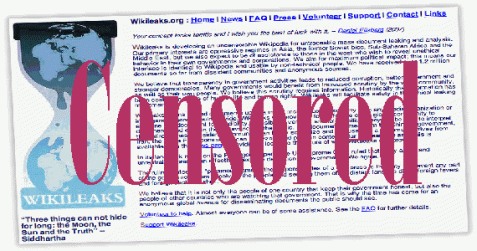
Action Alert = DEFEND WIKILEAKS!!

DEFEND WIKILEAKS -
END THE SECRET WARS

We believe that WikiLeaks and those whistleblowers who declassify documents in a time of secret war should be welcomed as defenders of democracy, not demonized as criminals.

We support their First Amendment rights and welcome their continued disobedience in response to a long train of official deception.

Our government and its allies in Afghanistan and Pakistan have stretched the labels "national security" and "secrecy" beyond all reasonable definitions, because they wish to keep the realities of these wars hidden from the American people. "National security" is becoming the last refuge of scoundrels. Only consider -

- Our government prohibited the media from photographing the returning remains of our dead soldiers, until public pressure forced a change in policy;

- The Abu Ghraib torture scandal only came to public attention when photographs were leaked by an MP;

- The war in Pakistan is shrouded in secrecy because it violates that country's sovereignty, results in the killing of innocent civilians, and is deeply unpopular;

- According to the new information from WikiLeaks, our Special Operations Task Force 373 operates outside the ISAF mandate to kidnap and kill targeted insurgents in a repeat of the discredited Phoenix program of the Vietnam era.

- Gen. Stanley McChrystal was forced to resign after a Rolling Stone reporter uncovered attitudes hostile to civilian authority;

- The same Rolling Stone article quoted a top official saying if the truth about these wars was known by the American people, they would be even more unpopular.

Given this context of cover-ups, whistleblowers have been a last resort in keeping democracy alive.

We understand the embarrassment of high officials when exposed, but it is Orwellian for the Pentagon to accuse the WikiLeaks of having "blood on their hands." We are in the tenth year of a war which has claimed over 1,100 American lives, and where Afghan and Pakistan casualties are obscured deliberately. Many of America's killed and wounded are listed as non-combat, minimizing the actual toll. WikiLeaks has been careful to delete information which might expose individuals to lethal risk. Those who really have blood on their hands are the authors of this war. We stand with those who expose them.
. . . .
WHAT YOU CAN DO:

1. End the silence in the face of government threats against WikiLeaks.

2. Circulate the petition online, in your community and organizational circles.

3. Forward the petition to decision-makers in your community.

4. Turn the petition into letters to the editor, leaflets and creative forms of public protest.

Sign the petition

here.

Oppose Afghan Funding, Support
the McGovern/
Feingold
Legislation

(HR 5015/S. 3197)

View text of the legislation here.

View list of current co-sponsors here.

Contact your representative and urge them to co-sponsor the bill here.

Rethink Afghanistan

Wathch Rethink Afghanistan's:
We're f*#!ing losing this thing.

Tom Hayden serves on the board of Brave New Foundation and contributes to its Rethink Afghanistan outreach campaign.

Just the Facts

Find out what the war is costing your community here.

Quick facts on Afghanistan

here.

Join a Local Network!

To add your name to our regional activist lists,
please write us at: contacthayden@gmail.com
with your e-mail and location.

Tuesday, July 6, 2010

The Afghan 'no exit' war

By Ivan Eland

In contrast to World War II and Desert Storm — which had clear goals, even though those of the latter were limited — the war in Afghanistan resembles the Spanish-American War and the Vietnam War.

In the former, the goal changed from defeating the Spanish in a conventional war to subduing Philippine guerrillas in order to imperially conquer the archipelago. In the latter, contrary to popular belief, Lyndon Johnson’s goal was never to win, but to alter the conditions on the battlefield to compel the enemy to negotiate.

In the Spanish-American War, America was able to take out the adversarial regime relatively easy. The hard part came in getting rid of the guerrillas, who were sure they were promised by the McKinley administration that if they helped the Americans get rid of the Spanish, the Philippines would win its independence.

The latter didn’t happen, and it took several years of brutal American counterinsurgency tactics and torture to subdue the local Thomas Jefferson wannabes.

Similarly, in Afghanistan, taking down the Taliban only required 700 U.S. Special Forces and CIA personnel calling in American air strikes to support the ground fighters of the Afghan anti-Taliban Northern Alliance. The hard part has been battling a resurgent Taliban, which uses guerrilla tactics.

In Afghanistan, as in Vietnam, proper skepticism of an outright U.S. military victory abounds, leading to an escalation aimed at gaining military advantage for ultimate negotiations with the Taliban.

Yet President Obama has given the escalation only 18 months in which to reach this goal, as well as the equally unrealistic objectives of crippling al-Qaeda and training Afghan security forces to operate on their own.

To get the U.S. military to buy into the 18-month period prior to commencement of withdrawal, Obama had to consent to the escalation of an extra 30,000 troops.

The 18-month timetable to begin withdrawal was the standard naïve liberal dogma that this would jolt the Afghan government into becoming a clean, democratic governing force that could effectively battle the Taliban.

Instead, Afghan President Hamid Karzai has made clear he doesn’t think the United States can win, is trying to cut deals with the Taliban and their patrons in the Pakistani military (also ostensibly an American ally), and has even threatened to join the Taliban if the United States keeps killing Afghan civilians.

Almost as bad, the troop surge to win military advantage for negotiations with the Taliban has been a bust. Marja has not been tamed, and the offensive in Kandahar has been significantly delayed.

But the very premise that the zealous Taliban would negotiate instead of waiting for the Americans, historically with a limited attention span, to leave resembles the same flawed assumptions the United States made about the North Vietnamese during the war in Southeast Asia.

Like the North Vietnamese, the Afghan Taliban want their country back from the foreign occupier and have a longer time horizon than the Americans.

Furthermore, Afghans have been accustomed to continuous war for more than 30 years, hate foreigners, and know that their history indicates that would-be foreign rulers can be out-waited — as they have many times before.

These factors illustrate that U.S. neoconservatives are equally naïve to believe that without the 18-month deadline, the U.S. has a prayer of success in historically unforgiving Afghanistan — however that vague term is defined.

Eighteen months is not long enough to ramp up a comprehensive counterinsurgency strategy that could win “hearts and minds,” but the aforementioned underlying realities make it unlikely that even an 18-year counterinsurgency strategy would work (the U.S. government has already spent nine years without getting it right).

Finally, the Taliban may be violent and ruthless, but in the eyes of the Pashtun people, the dominant group in Afghanistan, they are the only hope for Pashtuns.

Even though Hamid Karzai is a Pashtun, he is regarded among them as a puppet of the United States and rival Uzbek and Tajik groups. Thus is explained the curious support of many Afghans for the brutal Taliban. This major factor is often ignored in overly optimistic forecasts of the potential for U.S. pacification of Afghanistan.

The only solution is to cut the U.S. losses and leave Afghanistan for good. The good news is that removal of U.S. occupation forces from a Muslim land might actually reduce blowback anti-U.S. terrorism around the world.
http://aljazeera.com/news/articles/39/The-Afghan-no-exit-war.html

Thursday, April 15, 2010

BAD PUPPET KARZAI TOON

Image by Bendib
http://desertpeace.wordpress.com/2010/04/14/bad-karzai-toon/

Monday, March 29, 2010

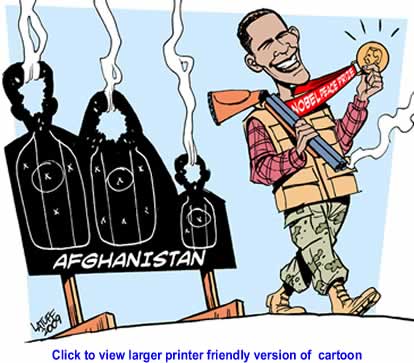
Obama goes to WAR!


http://tales-of-iraq-war.blogspot.com/

Thursday, February 4, 2010

Afghanistan and NATO: Figleaf Summit

Afghanistan and The plan voiced at the London Afghanistan conference to pay off the Taliban is belied by the plan at the Brussels NATO conference two days earlier to bomb them into submission, notes Eric Walberg

London has been the venue of a three-ring Middle East circus over the past month.

There is the ongoing Chilcot inquiry into the (il)legality of British participation in the invasion of Iraq. Two of the five committee members are Jewish — Sir Martin Gilbert a militant Zionist, and Sir Lawrence Freedman the drafter of Blair’s invasion policy. Despite the deck being stacked, witness after witness has testified the invasion was illegal, and former British prime minister Tony Blair was booed after telling the inquiry he has no regrets.

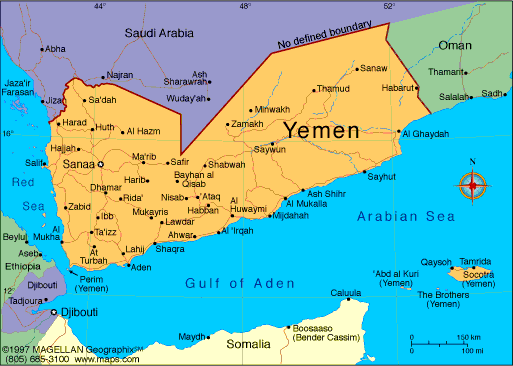
Then there was an impromptu conference on “saving” Yemen, which the five major Yemeni opposition parties denounced as “intended to save the political regime in Yemen.” Yemen is described by a British official as “Afghanistan with a sea”.

Just as farcical was last week’s summit on Afghanistan, called to “move the international effort forward in key areas of security, governance, development, and regional support.” In reality, it was a cosmetic follow-up to the war council held two days earlier at NATO headquarters in Brussels, where the NATO Military Committee met, bringing together the chiefs of defense of all 28 member states along with 35 “partners”, wannabes and observers — an astounding 63 nations.

The news from Afghanistan is uniformly chilling. US military deaths this January were more than double last year’s record figure. Insurgents are carrying out one daring attack after another across the country, prompting NATO to launch Israeli drones in the attempt to terrify Afghans into submission. A fierce eight-hour attack on UN headquarters in Helmand last week came, ironically, as Karzai and UN Special Representative Kai Eide served up olive branches to the Taliban, removing some from their terror list and offering them a half billion dollars. Eide claims negotiations have begun, though Taliban spokesmen dismiss the offers and talk of talks.

The conferees in London piously asked that the Taliban give up their links with Al-Qaeda and stop threatening the world. But the Taliban have never tried to export their beliefs. And the supposed link with Al-Qaeda is a false flag, since the Taliban and Al-Qaeda (to what extent it even exists) have never been operating together — until recently, when the NATO surge and Pakistani offensive against its own Taliban picked up steam, presumably boosting Al-Qaeda enlistment and encouraging the very cooperation that the West is supposedly against.

US Special Envoy to Afghanistan and Pakistan Richard Holbrooke understands this, as revealed by his statement to reporters on the sidelines of the London summit that more than “two-thirds of the Taliban are not extremists.” Ergo, if Obama wants to rid the world of the Al-Qaeda threat, the logical thing would be to stop invading Muslim countries and inciting the people to take up arms and work with any forces against the invaders.

Afghanistan London Conference

The Karzai regime is by now entirely threadbare. Only London summiteers give Karzai a soapbox anymore. And the only sign of democracy in Afghanistan these days are the occasional demos by Afghans hopelessly protesting the torture and murder of their loved ones by ISAF (International Security Assistance Force) troops. What is clearer each day is that the US invasion has now hardened into a civil war, with some poverty-stricken Afghans reluctantly pretending to be an army paid in dollars to face their Muslim brothers who are fighting for their country and their faith, a horrifying reality that can only mean continuing slaughter until the invaders flee.

The poor UN is flailing about helplessly in the quagmire, supporting the US in its occupation, but at the same time, warning that “widespread and systematic” secret detention of terror suspects could pave the way for charges of crimes against humanity. Western troops, notably the US and Canadian, have been arresting “suspects” and sending them to secret detention areas on military bases, often on the slightest suspicion and without the knowledge of their families. These night raids have become even more feared and hated in Afghanistan than coalition airstrikes. The scandal hit the Canadian government last month and forced the Conservatives there to shut down parliament to stave off an investigation which would most likely lead to their own demise.

At the real Afghanistan conference — the war council in Brussels, Russian Ambassador to NATO Dmitry Rogozin, with tongue bitterly in cheek, offered to rebuild the infrastructure and factories the Soviet Union built during its own ill-fated attempt to bring Afghanistan into the 20th c, undermined by US arms supplied to US-backed mujaheddin in the 1980-90s. He understandably wants this to be funded by the West, since it was responsible for the destruction in the first place.

Rogozin told Der Speigel that Russia is far more concerned about the flow of heroin that became a flood after the US invasion, rather than any possible military threat from the Taliban. “Each year, 30,000 human lives are lost in Russia because of Afghan heroin.” He did not spell this out in detail, but is no doubt aware that US forces are actually abetting the smuggling, as documented by many sources, including former British ambassador to Uzbekistan Craig Murray, who himself witnessed the pretend-border controls on the Afghanistan-Uzbekistan border in 2004. Scanners and sniffing dogs were simply bypassed by the chief smuggler — current Chief of Staff to the Commander in Chief of the Afghan Army Abdel Rashid Dostum, a native Uzbek who has close working relations with Uzbekistan President Islam Karimov. Rogozin accused NATO forces of ignoring the problem: “They think it’s not their problem, because Afghan heroin mostly goes to Central Asia and Russia.”

The proposal by British Prime Minister Gordon Brown and NATO General Secretary Fogh Rasmussen to double the Afghan Security Forces, soldiers and police to a level of 300,000 and speed up the withdrawal of foreign troops prompted a nervous Karzai to predict that foreign troops would be needed for 10-15 years.

Perhaps a few Taliban really have sat down with UN reps, possibly to draw them in with false promises. Not surprisingly, many starving young Afghans are willing to sell out their brothers to feed themselves and their families. But the many instances of Afghan police, soldiers — even translators — defecting to the Taliban, or suddenly turning on their masters and collaborators and killing them before themselves dying as martyrs or escaping to freedom should be a warning to the occupiers.

This is intuitively understood by most Westerners, whether or not they admire the fighters. Despite uniformly pro-war media in the West, a majority of Canadians and Europeans (even occasionally Americans) realise the war is pointless, and want their troops to come home immediately. Germans are 80 per cent against sending further forces. Only because German Chancellor Angel Merkel’s Christian Democrats faced a divided opposition and apathetic electorate was she able to stay on as leader and offer up her soldiers to the US in some kind of gruesome, misguided sacrificial offering for Germany’s many past sins.

The occupation of Afghanistan was not an unpremeditated blunder, just as with the occupation of Iraq or the possible occupation of Yemen. The wars are part of the extension of US power to all corners of the globe, a process that has quietly been accelerating in the past two decades, confirmed last week by US proconsul Hillary Clinton’s presence at both the Yemen and Afghanistan conferences in London, as well as their outcomes.

The current composition of ISAF reflects this consolidation, with troops from South America, Eastern Europe and the former Soviet Union, all the way to Korea, New Zealand and possibly soon India. Even Jordan, Egypt and the UAE have support personnel helping out. Consider for a moment: troops from all these countries and continents are, under US command, fighting a war in Central Asia, with the UN scurrying in behind them to give the whole operation a patina of respectability.

The fact that the mightiest war machine in history is being tripped up by a handful of ragged-trousered, determined young men is astounding. Obama’s vow to start evacuating (excuse me, withdrawing) troops by next year, despite Gates’ blustering denial and Karzai’s hopes, now hovers over this criminal adventure as a sword of Damocles.
http://intifada-palestine.com/2010/02/03/afghanistan-and-nato-figleaf-summit/

Wednesday, January 6, 2010

Yemen: Pentagon's War On The Arabian Peninsula

By Rick Rozoff
December 15, 2009

Yemen will become a battleground for a proxy war between the United States and Saudi Arabia - whose state-to-state relations are among the strongest and most durable of the entire post-World War II era - on one hand and Iran on the other.

It is perhaps impossible to determine the exact moment at which a U.S.- supported self-professed holy warrior - trained to perpetrate acts of urban terrorism and to shoot down civilian airliners - ceases to be a freedom fighter and becomes a terrorist. But a safe assumption is that it occurs when he is no longer of use to Washington. A terrorist who serves American interests is a freedom fighter; a freedom fighter who doesn't is a terrorist.

Yemenis are the latest to learn the Pentagon's and the White House's law of the jungle. Along with Iraq and Afghanistan which counterinsurgency specialist Stanley McChrystal used to perfect his techniques, Yemen is joining the ranks of other nations where the Pentagon is engaged in that variety of warfare, fraught with civilian massacres and other forms of so-called collateral damage: Colombia, Mali, Pakistan, the Philippines, Somalia and Uganda.

BBC News reported on December 14 that 70 civilians were killed when aircraft bombed a market in the village of Bani Maan in northern Yemen.

The nation's armed forces claimed responsibility for the deadly attack, but a website of the Houthi rebels against whom the bombing was ostensibly directed stated "Saudi aircraft committed a massacre against the innocent residents of Bani Maan." [1]

The Saudi regime entered the armed conflict between the (eponymous) Houthis and the Yemeni government on behalf of the latter in early November and since has been accused of launching attacks inside Yemen with tanks and warplanes. Even before the latest bombing scores of Yemenis have been killed and thousands displaced by the fighting. Saudi Arabia has also been accused of using phosphorous bombs.

Moreover, the rebel group known as Young Believers, based in the Shi'ite Muslim community of Yemen which comprises 30 percent of the country's population of 23 million, claimed on December 14 that "US fighter jets have attacked Yemen's Sa'ada Province" and "US fighter jets have launched 28 attacks on the northwestern province of Sa'ada." [2]

The previous day's edition of Britain's Daily Telegraph reported on discussions with U.S. military officials, stating "Fearful that Yemen is in danger of becoming a failed state, America has now sent a small number of special forces teams to improve training of Yemen's army in reaction to the threat."

One unnamed Pentagon official was quoted as saying "Yemen is becoming a reserve base for al-Qaeda's activities in Pakistan and Afghanistan." [3]

The conjuring up of the al-Qaeda bogey, however, is a decoy. The rebels in the north of the nation are Shi'ites and not Sunnis, much less Wahhabi Sunnis of the Saudi variety, and as such are not only not linked with any group of groups that could be categorized as al-Qaeda, but instead would be a likely target thereof.

In service to American designs in the region, the British and American press lately has been referring to Yemen as the "ancestral homeland" of Osama bin Laden. Bin Laden comes from a prominent billionaire Saudi Arabian family, of course, but as his father had been born in what is now the Republic of Yemen over a century ago the Western media are exploiting an insignificant historical accident to suggest Osama bin Laden's active role in the nation and to establish a tenuous link between the South Asian war in Afghanistan and Pakistan and Saudi and American armed intervention in a civil conflict in Yemen.

In 2002 the Pentagon dispatched an estimated 100 soldiers, by some accounts Green Beret special forces, to Yemen to train the country's military. In that instance, coming as it did two years after the suicide bombing attack against the Navy destroyer USS Cole in the southern Yemeni port of Aden, attributed to al-Qaeda, and accompanied by drone missile attacks against identified leaders of the same, Washington justified its actions as retaliation for that incident as well as the attacks in New York City and Washington, D.C. the year before.

The present context is different and a U.S.-backed counterinsurgency war in Yemen will have nothing to do with combating alleged al-Qaeda threats, but will in fact be an integral part of the strategy to expand the Afghan war into yet wider concentric circles taking in South and Central Asia, the Caucasus and the Persian Gulf, Southeast Asia and the Gulf of Aden, the Horn of Africa and the Arabian Peninsula. The eagerly awaited departure of President George W. Bush may have led to the end of the official global war on terror, now referred to as overseas contingencies operations, but nothing except the name has changed.

On December 13 the top commander of the Pentagon's Central Command in charge of the wars in Afghanistan, Iraq and Pakistan, General David Petraeus, told the Al Arabiya television network that "that U.S supports Yemen's security in the context of the military cooperation provided by America for its allies in the region" and "stressed that U.S. ships in the territorial waters of Yemen [are there] not only to control but to impede the infiltrations of weapons to Houthi rebels." [4]

To be recalled the next time the al-Qaeda/bin Laden canard is used to justify expanding U.S. military involvement on the Arabian Peninsula.

The Yemen Post of December 13 wrote that the Houthi media office "accused the U.S. of participating in the war against Houthis" and released photographs of what were identified as U.S. warplanes "involved in bombing operations in Sa'ada province [in] Northern Yemen."

The source estimated there have been twenty U.S. bombing raids coordinated with satellite surveillance. [5]

The Western press is again leading the charge in linking the Houthis, whose religious background of Zaydi Shi'ism is quite distinct from the Iranian version, to sinister machinations imputed to Tehran. Even U.S. government officials have to date acknowledged no evidence that Iran is supporting much less arming the Yemeni rebels. That will change if the script goes according to precedent as is indicated by Petraeus's comment above, and Washington will dutifully echo the Yemeni government's claim that Iran is arming its Shi'ia brethren in Yemen as it is accused of doing in Lebanon.

Yemen will become a battleground for a proxy war between the United States and Saudi Arabia - whose state-to-state relations are among the strongest and most durable of the entire post-World War II era - on one hand and Iran on the other.

In an editorial of five days ago the Tehran Times accused all parties to the Yemeni conflict - the government, the rebels and Saudi Arabia - of recklessness and issued a warning: "History provides a good example. Saudi Arabia funded extremist groups in Afghanistan and still, two decades since the withdrawal of the Soviet army from the country, the flames of war in Afghanistan are overwhelming the allies of Saudi Arabia.

"And a similar scenario is emerging in Yemen." [6]

The comparison between Yemen and Afghanistan alluded in particular to Riyadh, in the second case hand-in-glove with the United States, exporting Saudi-based Wahhabism to expand its political influence.

Saudi Arabia is attempting to promote its own version of extremism in Yemen as it did earlier in Afghanistan and Pakistan and is currently doing in Iraq. Far from the U.S. and its Western allies expressing any objection, the Saudis and their fellow Persian Gulf monarchies will be in the forefront of what is estimated to be $100 billion worth of Middle East arms purchases from the West over the next five years. "The core of this arms-buying spree will undoubtedly be the $20 billion U.S. package of weapons systems over 10 years for the six states of the Gulf Cooperation Council - Saudi Arabia, the U.A.E., Kuwait, Oman, Qatar and Bahrain." [7] Saudi Arabia is also armed with state-of-the-art British and French warplanes as well as U.S. missile defense systems.

What the earlier cited Iranian commentary warned about regarding "the flames of war" in Afghanistan is perfectly confirmed by the Commander's Initial Assessment of August 30, 2009 issued by top American and NATO military commander in Afghanistan General Stanley McChrystal and published by the Washington Post on September 21 with the redactions demanded by the Pentagon. The 66-page document served as the blueprint for President Barack Obama's December 1 announcement that 33,000 more American troops are headed to Afghanistan.

In the report McChrystal stated, "The major insurgent groups in order of their threat to the mission are: the Quetta Shura Taliban (05T), the Haqqani Network (HQN), and the Hezb-e Islami Gulbuddin (HiG)."

The last two are named after their founders and current leaders, Jalaluddin Haqqanni and Gulbuddin Hekmatyar, the Mujahideen darlings of the U.S. Central Intelligence Agency in the 1980s when the Agency's deputy director (from 1986-1989) was Robert Gates, now U.S. Secretary of Defense in charge of prosecuting the war in Afghanistan. And in Yemen.

In his 1996 book From the Shadows, Gates boasted that "CIA had important successes in covert action. Perhaps the most consequential of all was Afghanistan where CIA, with its management, funnelled billions of dollars in supplies and weapons to the mujahideen...." [8]

The New York Times in 2008 divulged these details:

"In the 1980s, Jalaluddin Haqqani was cultivated as a 'unilateral' asset of the CIA and received tens of thousands of dollars in cash for his work in fighting the Soviet Army in Afghanistan, according to an account in 'The Bin Ladens,' a recent book by Steve Coll. At that time, Haqqani helped and protected Osama bin Laden, who was building his own militia to fight the Soviet forces, Coll wrote." [9] Coll is also the author of the 2001 volume Ghost Wars: The Secret History of the CIA, Afghanistan, and Bin Laden, from the Soviet Invasion to September 10, 2001.

Haqqani's colleague Hekmatyar "received millions of dollars from the CIA through the ISI [Pakistan's Inter-Services Intelligence]. Hezb-e-Islami Gulbuddin received some of the strongest support from Pakistan and Saudi Arabia, and worked with thousands of foreign mujahideen who came to Afghanistan." [10]

This past May the (superlatively) pro-American president of Pakistan, Asif Ali Zardari, told the American NBC news network that Taliban is "part of our past and your past, and the ISI and CIA created them together....It (the Taliban) was (a) monster created by all of us...." [11]

On September 11, 2001 there were only three nations in the world that recognized Taliban rule in Afghanistan: Pakistan, Saudi Arabia and the United Arab Emirates. U.S. President George W. Bush immediately afterward singled out seven so-called states supporting terrorism for potential retaliation: Cuba, Iran, Iraq, Libya, North Korea, Sudan and Syria. Only Sudan, which expelled Osama bin Laden in 1996, had any conceivable connections to al-Qaeda. Of the nineteen accused September 11 airline hijackers, fifteen were from Saudi Arabia, two from the United Arab Emirates, one from Egypt and one from Lebanon.

Pakistan and Saudi Arabia remain highly-valued American political and military allies and the United Arab Emirates has troops serving under NATO command in Afghanistan.

It is perhaps impossible to determine the exact moment at which a U.S.-supported self-professed holy warrior - trained to perpetrate acts of urban terrorism and to shoot down civilian airliners - ceases to be a freedom fighter and becomes a terrorist. But a safe assumption is that it occurs when he is no longer of use to Washington. A terrorist who serves American interests is a freedom fighter; a freedom fighter who doesn't is a terrorist.

For decades the African National Congress of Nelson Mandela and the Palestine Liberation Organization of Yasser Arafat were at the top of the U.S. State Department's list of terrorist groups. No sooner had the Cold War ended than both Mandela and Arafat (and Sinn Fein's Gerry Adams) were invited to the White House. The first shared the Nobel Peace Prize in 1993 and the second in 1994.

If a hypothetical self-styled jihadist left Saudi Arabia or Egypt in the 1980s for Pakistan to fight against the Afghan government and its Soviet ally, he was a freedom fighter in the U.S.'s eyes. If he then went to Lebanon he was a terrorist. In the early 1990s if he arrived in Bosnia he was a freedom fighter again, but if he showed up in the Gaza Strip or the West Bank a terrorist. In the Russian North Caucasus he was a reborn freedom fighter, but if he returned to Afghanistan after 2001 a terrorist.

Depending on how the wind is blowing from Foggy Bottom, an armed Baloch separatist in Pakistan or a Kashmiri one in India is either a freedom fighter or a terrorist.

Contrariwise, in 1998 U.S. special envoy to the Balkans Robert Gelbard described the Kosovo Liberation Army (KLA) fighting the government of Yugoslavia as a terrorist organization: "I know a terrorist when I see one and these men are terrorists." [12]

The following February U.S. Secretary of State Madeleine Albright brought five members of the KLA, including its chief Hashim Thaci, to Rambouillet, France to offer an ultimatum to Yugoslavia that she knew would be rejected and lead to war. The next year she escorted Thaci on a personal tour of the United Nations Headquarters and the State Department and invited him as a guest to the Democratic Party presidential nominating convention in Los Angeles.

This November 1st Thaci, now prime minister of a pseudo-state only recognized by 63 of the world's 192 nations, hosted former U.S. President Bill Clinton for the unveiling of a statue honoring the latter's crimes. And vanity.

Washington supported armed separatists in Eritrea from the mid-1970s until 1991 in their war against the Ethiopian government.

Currently the U.S. is arming Somalia and Djibouti for war against independent Eritrea. The Pentagon has its first permanent military base in Africa in Djibouti, where it stations 2,000 troops and from where it conducts drone surveillance over Somalia. And Yemen.

In the words of Balzac's character Vautrin, "There are no such things as principles, there are only events; there are no laws, there are only circumstances...."

Yemenis are the latest to learn the Pentagon's and the White House's law of the jungle. Along with Iraq and Afghanistan which counterinsurgency specialist Stanley McChrystal used to perfect his techniques, Yemen is joining the ranks of other nations where the U.S. military is engaged in that variety of warfare, fraught with civilian massacres and other forms of so-called collateral damage: Colombia, Mali, Pakistan, the Philippines, Somalia and Uganda.

Notes

1) BBC News, December 14, 2009
2) Press TV, December 14, 2009
3) Daily Telegraph, December 13, 2009
4) Yemen Post, December 13, 2009
5) Ibid
6) Tehran Times, December 10, 2009
7) United Press International, August 25, 2009
8) BBC News, December 1, 2008
9) New York Times, September 9, 2008
10) Wikipedia
11) Press Trust of India, May 11, 2009
12) BBC News, June 28, 1998

http://revolutionmuslim.com/

Saturday, December 19, 2009

Afghan is the Empire's Graveyard


http://palestinethinktank.com/2009/11/25/cartoon-of-the-day-134/

Wednesday, December 16, 2009

Obama: A Monument to Hip-ocrisy

Barack Obama is a very handsome man. He has the charisma of a showman. He speaks very well, and what's more, he can even dance. It's not clear whether that is sufficient criteria to make one into a president, oops, not "a" president but "The President", but it certainly was enough to get one elected for the position.

And yet, Obama is nothing if not humble. He recognised that he really didn't (yet) deserve the world's most important honour, the Nobel Peace Prize, but he also recognised last week that while he is "The President", someone else is "The Boss".

What does all of this mean in the big picture? Quite a lot, actually, because whether he deserves it or not, Obama is there, in the highest echelons of power and glory, getting the greatest achievement awards for being … handsome, charismatic and cool. Since the advent of widespread mass media, style has definitely overcome substance as the top priority, the winning attribute. As a matter of fact, the soul of commerce is advertising, and Obama has been selected to represent the "American Image" that wants to be loved once again, whether or not they deserve it.


In the world of advertising, the biggest question is about appearance, finding a soundbite, a face, a slogan. Enormous resources are invested in developing a successful image. As Joseph Levine wrote "You can fool all the people all the time if the advertising is right and the budget is big enough." There's little doubt that Obama has understood this concept.

Does Obama want to fool anyone? Well, that's hard to tell. He apparently knows his market though, because they are a generation that "tweets", makes friends through "social networks", actually enjoys the deadpan face (what comic genius) of Obama's "He's The Boss" tribute. He's cool, and he's one of us, ergo, we are cool. We might even be a friend of his, on some social network. We are actually cautioned against going against him, and the mantra, "he's still new, give him time", or the comical "it's his first 100 days", being uttered long after the expiration date, were there to warn us that we better stay out of things where Obama is concerned. He might be an imperialist, but hey, he can't change things overnight… as if he would if he could?

There is a level of wishful thinking in the idol worship that has accompanied Obama since he came onto the scene. It stopped mattering what he might do, what counted was what he "was" and how that communicated great things about the American people and their advancement and true belief in achievement and equality for all: he's got it all, he's young, black, urban, well-educated, modern but also traditional, graceful but also a with that charming nervousness that makes one look like they are going to worry about your problems for you. That's what the president is supposed to do. And if you are "The President", you can be either a Father Figure or a Brother. Bush struggled to be the Father Figure, since his position as "official son" made him turn that ambition into a full time job, and… let's face it, it was not attractive and was no longer going to be a winning strategy. People only love and listen to their fathers when they are either very young or quite mature. So, Obama is our cool brother. We would share CDs with him if he lived in the same building, wouldn't we?

America is in its teens. It feels young and it likes starting over. It needs to be unconditionally loved so that it can really be free to do what it wants without being told to change. After a series of wars and a growing list of nations that can no longer tolerate the single superpower doing what it wants and damn the torpedoes, it is looking for a new girlfriend, a European one, and if possible, a Middle Eastern one. These are the places that have political history as former superpower or immense natural resources that will determine the next superpower in a not-so-distant future when resources will count more than abstract things like the deposits of the Federal Reserve. America really needs the rest of the world that counts to fall in love with it again. Fulfilling the expectations, (there was indeed a need for love) it didn't brush off the seduction, and the mass media of the international community had a huge crush in November 2008, as if the world was all of a sudden different and far better, and Obama hadn't even taken oath yet. Even those who aren't members of the club of "friends of America" were ready to at least go on a date and see how things might go. That might be a legitimate expectation, but Obama was sure to give the banks, Israel and the military industry a gigantic helping hand as his first steps. He would not dare criticise Israel during the war they waged in Gaza… as if "not being sworn in" was some kind of excuse.

Things got a little rougher with the deployment of more troops and the mass exodus in Pakistan because of American and NATO military actions, so then Obama decided to engage in his specialty, rhetoric, aka "smooth talking", and in Cairo, he fooled the Western countries totally, but not the Arabs and Muslims. Straight off the bat, he was justifying slaughtering Muslims and warning Palestinians that they had to "stop killing". And that was enough for the Israeli hasbara machine to pretend that he was a friend of Palestine, and therefore, people had to be more vigilant than before and really back Israel in this trying time. Quite a tough one to pull off, looking at everything Obama has promised, said and done, but this is how hasbara works, tell a lie and repeat it. No one ever said they weren't clever.

But, it is easy to be successful at rhetoric when standards for it are quite low, and when listeners are not really hearing what is said, but what they want to hear, that this man is really different and good. What Obama uses are code words that avoid specifics. Concepts of goodness such as "hope", "change" "belief" "courage" can really stir the spirit, but what if my idea of good is different from his? What if the idea of change that an Afghani or Iraqi has is different than the idea coming from the White House? In Obama's acceptance speech for the Nobel, he put his hands out in front of him, his modesty could not be false, he really does not deserve that award, and he knows it. His critics can see the three little letters in the word "award": right in the middle we have WAR. But Obama decided to talk about his wars, and to justify them. So, now, we have the ultimate in hypocrisy. Defending a peace prize by saying that war brings peace. That the Americans were good "then" and they are good "now". That they defend themselves and will always do so, because this is what America does for the good of the Americans and the entire world.

He mentioned the foundation of the UN. But he didn't mention the Veto power of the USA, going against the absolute majority of the nations in order to defend occupation and support the oppression of an entire people who happen to not have "a big enough budget".

If Looks Could Kill

And thus, we are all witnessing the continuation of the collective lovefest, pushed to a higher level, as no longer is Obama "capable" of imposing imperialist agendas in areas targeted for "liberation" on behalf of the grand caravan of "The Coalition of the Willing", he is actually doing precisely that. It goes beyond simply leading the world's most powerful nation and defending the US from harm, because here we have the entire narrative of the "good war", the "just war", the fight against terrorism, which Obama expresses in his acceptance speech as a few angry men who harm hundreds of innocent people. He cannot fathom that under his command, the United States does the same thing, but with total impunity. In Afghanistan at least one hundred innocent civilians were killed by a few men flying US Air Force planes, and this was not an isolated attack, it is simply one that had been reported. This act, when done by the Republicans, was immediately condemned by those who consider themselves to be "anti-war". The complaints never seemed to last longer than a few days and they had no practical efficacy whatsoever, but the feeling was that it was wrong, it was putting America in a worse position and that one should protest, not really for the Afghanis or Iraqis, but for the sake of the image of the USA. All of this has simply faded out because their man, the charming and attractive Obama is doing it, and his narrative of the Good War, they believe, is going to be enough to do the trick. Certainly, there is nothing new about the utilisation of rhetoric and image to make effective propaganda. What would really be sad is if those who identify with Obama because of his attractive image identified with all the hypocrisy he represents, and the lack of awareness that he is as imperialistic and as warmongering as any president before him, none excluded. If looks could kill, they probably will.

* Mary Rizzo is an art restorer, translator and writer living in Italy. Editor and co-founder of Palestine Think Tank, co-founder of Tlaxcala translations collective.

http://windowintopalestine.blogspot.com/

Thursday, December 10, 2009

Statement of the Islamic Emirate of Afghanistan Obama, following Bush Steps


This year, the Nobel Prize Committee in Sweden awarded Peace Prize to Obama while his being in the White House less than ten days before the nomination deadline. Ironically, the committee chose him among 205 candidates to win the prize- still less not for any concrete accomplishments but for his inspirational words. It is pity that he will now receive the prize after announcement of troops surge for Afghanistan.

This year, USA launched vast military operations in Helmand in South Afghanistan. Ten thousand American troops and almost the same number of British troops participated in the operations named Sword and Panther’s claws. They killed hundreds of innocent Afghans during the most trumpeted operations, the largest ever after the Vietnam war.

As for the Afghans, they did not expect Obama, a Nobel peace prize winner, to flare up the war in the country. Nor the Alfred Nobel would ever have agreed to give peace prize to a person who is fanning flames of war rather than spreading fraternity and peace. But despite his warmongering approach, Obama did not achieve his declared goal of wiping out the Mujahideen in Helmand or realizing the take, hold and build strategy. Contrarily, the American troops fatalities were the highest in June, July and August this year comparing to the same period last year-- the months when the operations were in full swing in Helmand.

According to a recent report from Mujahideen in Helmand province and posted at this site, the enemy has only been able to keep the districts which were earlier in their hands in north Helmand. In the south, the writ of Mujahideen was restored in Khanshin, Marji and Garam Sir districts while the enemy could build only a single military base in a desert there—the only spectacular achievement of the operations. But they are not able to procure their logistics through lands routes. They have to provide logistics by air transportations. In Nad Ali, the invading troops were forced to evacuate the base, which they had formed at the start of the offensive. In Garam Sir, they are trying to beef up their former bases. No new base has been added there.

The British soldiers occupied some areas in Babaji, Pashak and the White Mosque but they were not able to retain them for a longer period in face of the constant attacks by the Mujahideen.

When their tanks and logistical vehicles come out of their military bases for patrol and logistical supplies, they become soft targets for Mujahideen. On the other hand, the roadside bombs take a high toll of the enemy, turning them into a graveyard for the invaders. Therefore, they use transportation planes for the supply of logistics instead of using the land routes. Thus they are almost besieged in their military garrisons.

According to a recent statistics, one gallon oil costs the invading troops $400 and annual expenditure of one soldier is almost one million US dollar. They have to pay $30 billion more per year for the troops surge recently announced by Obama.

But far from receiving a lesson from the failure of their military operations in June this year, the Americans launched another operation this week. It seems, the peace prize winner Obama is trying to implement the expansionist policy left to him as a legacy by W. Bush.

The aim of the Mujahideen is to have a free and independent country and Islamic government which represents the aspirations of the Afghan people. These are natural rights of people which has nothing to do with terrorism. But the so-called advocates of democracy and human rights are not ready to give these natural rights to the Afghans and to the Mujahideen. They are bent on maintaining their bases in Afghanistan like they have been maintaining them in Japan, South Korea , Germany etc. There are now hundreds of military bases in Afghanistan built under the notorious name of so-called war on terror. Every one knows that these bases are built in Afghanistan for the achievement of colonialist goals in the region.

Washington turns down the constructive proposal of the leadership of Mujahideen who say that the Mujahideen, as a part of their policy, will ensure that the next government of the Mujahideen will not meddle in the internal affairs of other countries including the neighbours if the foreign troops pull out of Afghanistan. But still America and its Allies want to achieve their imperialistic goals under the pretext of fighting terrorism.

However, the word of terrorism is still not exactly defined. Who are the terrorists? Those who defend their country, faith, values and natural rights or those who throw deci-cutter bombs and fire Hellfire missile at wedding, funeral ceremonies and rallies.

Thousands of innocent Afghans have been killed in Nangarhar, Uruzgan, Herat, Farah, Kunduz and Paktia provinces as a result of American and NATO blind bombardment. Had they any role whatsoever in the 9/11 event? No. Of course, no.

The criminal aspect of this war is that, that the invading Americans have focused on Pashtun areas and their conduct of the war seem more like a Pashtun cleansing campaign. Still more, the word terrorism has not been defined as yet.

Or the Mujahideen who want freedom of their country terrorists or those who raid people’s house in the stillness of the night and detain innocent people, put them behind the bars and deprive them of their rights to have access to advocates and legal advisers? There are thousands of innocent Afghan prisoners who have, for years, been suffering in jails run by the Americans without knowing their fate.

On the one hand, the White House National Security Advisor James Jones admits that majority of non-Afghan Mujahideen have departed Afghanistan but simultaneously, they send more troops to Afghanistan. Against whom these troops are being deployed? Are not they deployed against the Afghans who want freedom of their country and a government based on their aspirations and religious values? Is this terrorism or natural rights of the Afghans? There are hundreds of questions in this notorious so-call war on terrorism!

Those with free conscience living any where in the world should come forward and defend their shared values of humanity which are being violated by an imperialist power insatiably extending its tentacles over countries of the world particularly over Asia.
Islamic Emirate of Afghanistan

http://revolutionmuslim.com

Saturday, November 21, 2009

US public backs Obama in Afghan war

A poll in the US has found that the majority of Americans are confident that Barack Obama's future strategy for the war in Afghanistan will be successful.

But the Washington Post-ABC News survey, which was released on Tuesday, found that the country was divided over how many extra troops should be sent to the central-Asian nation.

At a time when the US president is mulling a new strategy to win the war in Afghanistan, a total of 55 per cent of those polled said they were confident that the strategy that Obama chooses will be the right one.

The telephone poll of 1,001 adults found that 45 per cent wanted only a small increase in troop numbers, focused on training, while 46 per cent supported a large deployment to help fight Taliban and al-Qaeda fighters.

At present there are 68,000 US troops in Afghanistan, attempting to maintain stability following Washington's 2001 invasion of the country to remove the Taliban, accused of harbouring al-Qaeda operatives, from power.

Stanley McChrystal, the chief US and Nato commander in Afghanistan, has requested 40,000 extra soldiers to add to the American personnel already in the country and the 40,000 Nato-troops also there.

Afghanistan recently has seen a peak in violence since the 2001 invasion and extra soldiers are said to be needed to battle opposition fighters and train local security personnel.

On Obama's past handling of the war, 48 per cent disapproved - a rise of one per cent from last month - while 45 per cent approved.

When considering whether the benefits of the war outweighed the costs, 52 per cent said that it was not worth fighting, against 44 per cent.

At least 841 US military personnel have died in the Afghan war, according to the defence department.

Friday, November 20, 2009

Saturday, October 31, 2009