Showing posts with label Abbas. Show all posts

Friday, November 26, 2010

Yousef Abudayyeh – Zionists' Last Chance

There is not one country in the world that does not recognize that the West Bank, the Gaza Strip, the Golan Heights and a couple of villages in Southern Lebanon are occupied Arab land, taken by force by the Zionist invaders of Palestine in 1967. Since June 5, 1967 there have been countless UN Security Council and General Assembly resolutions demanding “Israel” to end its occupation and return the land to its rightful Arab owners.

Even the United States of America, the main political and financial supporter of "Israel",demanded that occupation ends.

So why is it that after more than forty-two years the occupation still exists there? Why is there even any need to enter into countless fruitless rounds of negotiations, if the end result should of them is to be the return of these occupied lands and there is no real intention of doing it? Why does the world tolerate the internationally condemned continued facts on the ground that “Israel” never stopped doing? Why would a technically rogue and very small “country” called “Israel” with only 6 million people, collected from all over the world keep on doing what it’s doing with no regard to International Law, UN demands and requests from friendly quarters?

To understand why this is taking place, one should consider the following factors and facts:

- The Zionist ideology that brought “Israel” into existence says it very clearly that this newly founded state that will be established in Palestine, which according to the Zionist leaders had no inhabitants, would become the homeland for the people – “Jews” who have no land. And to accomplish this, we all heard about the horrific massacres that took place against the Palestinian people in the 30s, 40s and 50s of the last century, carried out by Zionists who came into Palestine from Europe with the help of Britain and other powers – using the excuse of the Holocaust to justify it, as if Arabs had anything to do with it . They were armed, and were allowed to ethnically uproot the Arabs from their homes, villages and towns.

- Most people in the world are loyal to the country they were born and live in, but the loyalty of the Jewish communities worldwide is usually not to the country they were born and live in, but rather it’s for “Israel”. The reason for this is the tremendous pressure the Zionist leaders apply on these communities. Many are forced to go and serve in “Israel” and even join the “Israeli” armed forces. This loyalty question is what needs to be faced, but when it is, attacks launched against the ones voicing thisvery question begin and they are labeled as anti-Semites, a very well-designed plan of silencing that the Zionists have set in place worldwide. This plan has worked for many years, but the tide is turning, and no one can predict what will happen if the Jewish communities do not change with it.

- The unbelievable grip that the Zionists have on all aspects of our lives, everywhere. Just take the United States of America for example: The percentage of the Jewish population is less than 3.5% of the American population, but Jews are in complete control of the Media, the Financial System, the Political system and the Judicial system in the US. It is not a claim others make, it is a fact that the Jews admit is real and is a point of pride for them. This is even more true in the poor countries where the control of the world bank and world media on the daily lives of the people there is much worse and the populations have even less access to positions of power and influence. How this can happen? Are the Jewish people smarter than the rest of the population or is there something else that put them in control of all aspects of life? And for what purpose?

- For the Arab world to be conquered and its richness controlled, the West had to carve it into mini states. They installed kings, Emirs and Presidents whose main tasks in life (if they are to stay in power) are to guard the oil and other wealth for the West and especially the United States and to also hit with a strong hand any popular resistance that will challenge their mission and /or to sabotage any liberation movement that will attract attention to the occupation of Palestine, the wasting of the Arab fortunes or even demanding some basic civil rights. They were also asked that a good relationship and somewhat peaceful co-existence between them and the Zionist leaders of “Israel” be in place. Many times they are asked to broker deals, against their own people’s interest, with the Zionists so their lease on life is extended. Hosni Mubarak is but one example. His selling of the Egyptian Natural Gas to the Zionists at way below market prices, plus the coordination with “Israel” in maintaining the siege on the Gaza Strip are just the beginning of a very long list of how entrenched the US is, how subordinate the Arab leaders are to it and how demoralized the Arab masses are.

- Coming to the aid of this kind of program, the West, and especially Britain, in the early 1950s gave the Muslim Brotherhood a chance to rise and take hold, so it became the main local force against the Arab Nationalist Movement. That was a huge step that placed the struggle for liberation and freedom a bit further from reach. The Arab Nationalist Movement understood early on that to face this aggression from the West, the Arab World needs to get back together as it was before it was partitioned by Sykes-Picot. By its creating and helping to fund the Muslim Brotherhood Movement it introduced a new dimension that put Liberation and Freedom on the shelf, because the new emphasis became something else altogether. This divide and conquer rule was one of the main tools that the West used in making sure that its hold on the region continues. The introduction later on, by the West, and especially the US, of the new fascist Muslim movement, led by Osama Bin Laden and company put the aspiration of the Arab masses even further away, because now they have to fend for themselves from the new weird ideas of these groups, that required a complete cancellation of half of the society, the women, and a complete submission of the other half to the new fascists, for which liberation and freedom is not even their book. This created some sort of a completion between them and less radical Muslim groups, which further took away any talk and action of and for liberation and freedom.


When the Palestine Liberation Organization (PLO) was founded, the main purpose was to liberate Palestine and bring it back to its natural Arab Atmosphere. The Basis it used, the Nationalist Charter, which was later modified and called the PLO National Charter, is what got Palestinians from all over the world to adopt and declare the PLO to be their main representative. It is the PLO commitment to liberate Palestine and establish a democratic Arab society that rallied Arabs and Palestinians around it. Many stopped supporting the PLO when it started on its sloppy road of recognizing “Israeli” rights to exist on our Arab Land. Actually, there were many warnings early on (1967) that said it very plainly, that the leadership of the PLO will eventually become just like any other Arab leadership were it will depend for it’s very own existence on the enemies of our people. We all remember Yasser Arafat, gutting out the Charter because it was a demand from the US and “Israel” that he needed to fulfill, for them to talk to him and support him in becoming the newest Arab President. Many believe that Arafat, who was willing to go a long way in recognizing “Israel’s” existence on Palestinian Land, noticed late in the game, that the struggle with the Zionists is not about borders, but it’s rather about the very existence of the Arab Palestinians on their homeland, which “Israel” wants to end in any way. They humiliated and killed Arafat, and installed in his position Mahmood Abbas, who’s willing to do whatever the US and the Zionists want, no questions asked. It’s clear now that the PLO leadership does not represent the aspirations of the Palestinian People, and it enlists the help of our enemies to stay in power.

- With this bleak picture in favor of the Zionists and their supporters, one can see that “Israel” continues to live on very shaky grounds. The grabbing of most of the West Bank to build settlements, separation walls and more than 650 checkpoints coupled with having a Palestinian leadership that is fulfilling its demands will not help it survive. These are some of the reasons:

- “Israel” is a foreign cancerous body in the Arab World. Its collection of invaders gathered from all over the globe will never be able to survive in the region because they are foreign, arrogant, from so many different cultures with the majority of them being racists. This new law (loyalty to the Jewish state) that they are trying to implement is a clear sign of their racism. The treatment of Black and Middle Eastern Jews is also clear to all but to them.

- The Palestinians will never forget what happened to them. They can be defeated, humiliated and scattered all over the world, but they will never forget, and their kids will also never forget. It’s the Arab culture that no invader or passing of time can change.

- The Arabs are more than 350 million, and all of them, regardless of the oppression their leaders put them under, believe that Palestine is the heart of the Arab World. The Zionists can change what Palestine looks like, but Palestine will remain the heart of the Arab World, that will sooner than later get rid of its corrupt leaders, unite and liberate Palestine.

- Palestine, like of the rest of countries occupied, will be liberated. To think other than that is not reasonable as well as being racist. Many understand the nature of the struggle with the invaders and just like in previous attempts, new ones will appear and will defeat the Zionists. With all that’s happening in the Arab World, Palestine and in the world, one can be sure that liberation will become sooner than later. The only sad thing if the Zionist continue to behave the way they do, is that they will not find a place to go to and call home. Not even where they came from would want to have racist war criminal live within its borders.
http://palestinethinktank.com/2010/10/14/yousef-abudayyeh-zionists-last-chance/

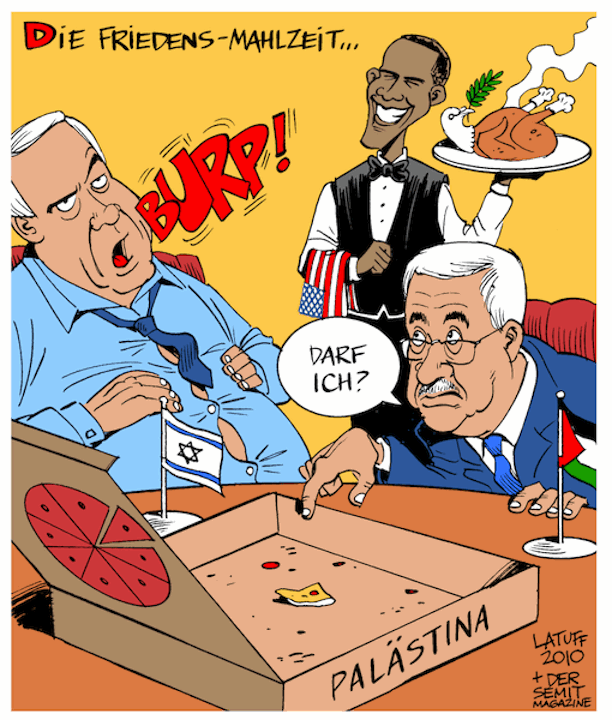
Thursday, October 7, 2010

Peace Dinner, by Carlos Latuff

http://gaza.haimbresheeth.com/wp-content/uploads/2010/09/Peace-dinner-with-Netanyahu-Abbas-and-Obama3.gif

Sunday, September 5, 2010

ABBAS: FROM WANNABE TO HASBEEN

Mahmoud Abbas, the Palestinian president, has insisted that he will withdraw from direct talks with Israel if it does not extend its freeze on settlement building when it expires on September 26.

The pledge was intended to placate widespread opposition to the resumption of negotiations from within both Hamas and Abbas’ own Fatah group. But his promises are unlikely to make a dent in the growing disillusionment with a ‘peace process’ many see as providing cover for continued Israeli expansion. And, coming after he backed down on his vow to boycott the talks without a prior Israeli commitment to extending the freeze, Abbas’ words are lacking in credibility.

It is, in fact, the words of Binyamin Netanyahu, the Israeli prime minister, that today ring louder and clearer in the ears of Palestinians. “You don’t need to worry. Nobody needs to teach me what it is to love Eretz Israel,” he told Likud party members before leaving for Washington. His use of the term ‘Eretz Israel’ – meaning the land between the Mediterranean and the River Jordan – implies that he has no intention of giving up control of the West Bank and East Jerusalem and, consequently, will not allow the establishment of a sovereign Palestinian state.

So, while Israelis may have nothing to worry about, Palestinians most certainly do and Abbas has failed to reassure even his own supporters that he will not succumb to Israeli and American pressure.

Abbas the politician

At this point it might seem tempting to say that the Palestinian president simply has to go – after all he has failed to act as a leader to a people who deserve a courageous representative. But when the Palestinians elected Abbas it was not as a revolutionary leader but as a politician suited to the post-Oslo era.

Fatah too knew what it was doing when it selected Abbas as its presidential candidate – the group needed somebody who could deal with Israel and the West while it rebuilt itself. At least that was the idea of one of the main advocates of an “Abbas presidency” in 2006. Farouk Kadoumi, the co-founder of Fatah who rejected the Oslo Accords, told me then that Fatah needed to separate the process of negotiations from the process of bolstering its organisational structure.

He believed that Abbas’ acceptability to the West would “spare Fatah a right on collision with Israel and America while giving Fatah a chance to recover from the high costs, in terms of losses of lives and leaders who ended up in Israeli jails, after the Second Intifada”.

Fatah officials close to Abbas say that when he took the decision to participate in the talks he did so because he believed the Palestinians could not afford to appear to reject the negotiations when it is Israel that is really sabotaging the process. For its part, Fatah says it has given him conditional support but no mandate to sign an agreement.

Some are calling for Hamas to be included in the talks – or even to replace the PA as the representative of the Palestinian people. And while the West’s decision to exclude Hamas is completely unacceptable, Hamas and other actors should enter negotiations only when entirely different terms have been established – terms built around Palestinian unity and consensus. For the time being, Hamas’ position is made stronger by not participating.

Most of Abbas’ opponents do not fear that he will surrender any Palestinian rights in Washington – largely because it is clear Israel will not make any offers that could feasibly be considered. But they are afraid that he might reach another interim compromise that will only consolidate Israeli political and military control over the Palestinians.

For example, it has been reported that the Americans are pushing a proposal that would see Israel extend a partial freeze on Jewish settlements while allowing the expansion of “major settlement blocs”. Such an arrangement would effectively mean accepting Israeli annexation of parts of the West Bank and East Jerusalem. This would have dangerously permanent implications and serve Netanyahu’s vision of a fragmented Palestinian state devoid of any real sovereignty.

Abbas the man

Abbas is fully aware that he goes to Washington with many Palestinians, including some of those closest to the PA, viewing him as having at best surrendered and at worst as being a traitor.

He was badly shaken when, in the wake of his initial support for a postponement of the discussion on the Goldstone report, his grandson came to him crying and explained that children at his school had called his grandfather a “traitor”.

And it is well known that Abbas has checked into a Jordanian hospital on more than one occasion suffering from exhaustion and stress brought on by a process he once had faith in but which has delivered only pain to his people.

When he tried to resign, Fatah members convinced him to stay on – largely because nobody else wants to take responsibility for the mess that the ‘peace process’ has become.

As a private person, Abbas, who is from Safad – where most of the residents were expelled in 1948 – sounds just like any other Palestinian in his anger over his dispossession, his bitterness at American bias and his hopes for self-determination. But ultimately this is not about him.

The challenges and dangers facing the Palestinians are now so huge that it is time for all of the Palestinian leaders – from the PA and the opposition – to rise up to this historic responsibility or go home.

So, for the very first time Abbas is risking it all by going to Washington. But this is also an opportunity to gain some credibility and support by sticking to his mandate and the popular consensus by saying ‘no’.

*Lamis Andoni is an analyst and commentator on Middle Eastern and Palestinian affairs.
http://desertpeace.wordpress.com/2010/09/04/abbas-from-wannabe-to-hasbeen/

Tuesday, May 4, 2010

Tariq Shadid – Proximity talks: the continuing story of the pie in the sky

Have you also grown tired of the word 'proximity talks'? Any idea what it exactly means? Proximity talks are diplomatic discussions between intermediaries on behalf of the involved parties, taking place while these are close-by, but not engaging in direct communication. This catchword has now for several months dominated news reports about Middle East politics, with a lot of to-and-fro about whether or not they will be taking place, and when. It seems that each of the involved parties have their own interest in keeping the pie in the sky termed 'peace process' alive, but the main beneficiary of this process is obviously, without the shadow of a doubt, the zionist entity known as 'Israel'.

With the Arab and American 'green light' for proximity talks, the zionists are yet again undeservedly rewarded for their tireless efforts throughout the past 17 years of the 'Oslo-era' of lying, stealing land, committing massacres, destroying Palestinian infrastructure, ethnic cleansing, and oppressing and besieging an entire population with a racist system resembling closely that of Apartheid – only much harsher, and much more deadly.

The Americans

Let's have a look at the parties that are involved in this issue, and see whether their motives for supporting these talks can be clarified. Starting with the most obvious, the Obama administration has the clear purpose of trying to maintain credibility after having made far-reaching promises, most outspokenly worded in last year's infamous Cairo speech. After at least having tried, Obama would always be able to say that he cannot be expected to succeed at something that four previous administrations before him proved to be unable to achieve. Getting two irreconcilable parties to the negotiating table, even if only 'in proximity', in the American conscience undoubtedly would count as an achievement in itself, which could then be scrapped from the to-do-list - so that difficult domestic issues could finally be given the necessary undivided attention.

It is quite likely that this is also the reason why the Americans have continuously been making contradictory promises to each side in the conflict. London-based newspaper Al Hayat reported on May 1st that chief PLO negotiator Saeb Erekat told the Arab league that Obama had promised a prolonged 'settlement freeze' in the West Bank and East Jerusalem to the Palestinians, but did this off the record in order to appease right-wing factions in Israel.

Even more strikingly, the New York Times reported that American administration officials had said that the US was pondering measures of pressure on Israel, like dropping the United States' automatic support for the zionist state in the UN. Nevertheless, the Israeli newspaper Ha'aretz quoted the State Department's deputy spokesman on May 2nd, who refused to directly comment on this news, but clearly stated that the U.S. will maintain its support for Israel at the United Nations.

Arabs and Palestinians

The Arab League, with its myriad of political and economic interests in keeping its relations with the United States in perfect shape, on May 1st gave its go-ahead to the new negotiations, reportedly 'making a consultative decision on engagement in proximity talks for four months'. What is worrying about this time period, is that the end of it practically coincides with the announced Israeli 'temporary construction freeze' which is scheduled to end towards the end of September.

Still, according to Erekat, the condition for Arab League support would be a halt of Israeli settlement construction in the West Bank – it is however unclear whether this would include East Jerusalem. I guess this means we don't only get a 'temporary freeze', but also 'temporary proximity talks' to coincide with it? The motive for the Arabs to agree on this can only be to appease the United States, since they must be as aware as anyone that nothing can or will be gained for the Arab side from these 'negotiations'.

On the Palestinian side, it is clear that the Palestinian Authority also has a strong interest in engaging in the proximity talks. It is not far-fetched to state that Abbas' decision in March to retreat from the US-brokered talks was taken with enormous reluctance, as his administration would have suffered a disastrous blow to its already fragile credibility in the Palestinian street if it had pursued these talks. After all, this refusal only came after the announcement by the Israelis to build a zionist settlement in East Jerusalem, during American Vice President Joe Biden's visit to the region. Apparently, it is assumed that waiting a while and then entering these proximity talks anyway, without any change in the situation, will be deemed acceptable to the Palestinian population. Timing is everything, right?

'Three-track strategy'

The Abbas-Fayyad strategy, as explained by Fayyad in a May Day event at the headquarters of the General Palestinian Labor Union, runs on three tracks: the political track, support for non-violent resistance, and the building of state institutions. With regard to the first, the political maneuvering of this administration during the turbulent past year through the Goldstone-debacle, the Biden-Netanyahu crisis, and the brazen Israeli infringements on East Jerusalem – even on the Al Aqsa mosque on March 16th – has clearly illustrated how desperate the PA is to appease the Americans.

In other words, the political track is to quell any significant opposition to Israeli measures of oppression, if these endanger the PA's relations with Washington. Therefore, Abbas agreeing to re-enter into 'proximity talks' came as no surprise whatsoever – what would indeed have been surprising would have been if he had continued to refuse to do so.

Fayyad's track of 'supporting non-violent resistance' can clearly be seen as demagogic rhetoric aimed at gaining more popular support among the Palestinian masses. After all, there are practically no available examples of the PA's direct involvement in any more-than-symbolic demonstrations against the occupation, while there are plenty of examples of attempts to prevent them from happening. In this past year Israelis, settlers as well as soldiers, have stepped up their direct aggression against the Palestinian civilian population through often lethal violence, raids, targeted assassinations and ruthless clampdowns on non-violent demonstrations.

However, when popular leaders of non-violent resistance, like the Stop the Wall activists, are jailed by the Israeli occupation forces, no significant voices of protest are heard from the higher levels of the Palestinian Authority. The PA's forces, in the meantime, seem to have been spending most of their active time in the Palestinian streets arresting and detaining members of Hamas. It is what the American master wants, so it is what he will get.

Then, what exactly is Fayyad-style support for non-violent resistance? It mostly seems to mean that when a Palestinian village challenges the Guinness Book of Records by making the world's largest ever musakhan (a traditional Palestinian food), he will be there for a photo-shoot of him having the first bite of it.

As for the third track, that of institution building, it is obvious that this one depends entirely on the first (political) track. In short, there seems to really be just one 'railway to nowhere', namely that of gathering money from Western donors in order to build 'state' institutions in return for Palestinian political subservience to the American-Israeli-European doctrine. Dividing it into three illusory tracks is merely a matter of applying cosmetics to try and make the strategy appeal to the people living under occupation. Only in this way, the word 'resistance' will fit into the strategy somehow, to satisfy that Palestinian spirit that continues to refuse to surrender to zionist violence and oppression.

The Israelis

Only one of the involved parties seems to be in a position to snub the world's largest superpower, the United States of America, and that is the zionist entity. In full confidence, it continues its arrogant course of voiding Palestinian land from its original inhabitants, and replacing it with Jewish settlers, while promising peace.

Whoever has not read the interview with Moshe Ya'alon, Israel's Vice Premier, in Yedioth Aharonoth on March 26, may be fooled into thinking that the pie in the sky will eventually come drifting down, and be happily shared by all those living in the Middle East. Being not only Israel's Vice Premier, but also the current Minister for Strategic Affairs and the former Chief of Staff of the Israeli Army, one should assume that he knows what he is talking about.

He spells it out quite clearly: Netanyahu's gestures, from the announcement of the two-state solution to the decision to freeze construction in the settlements, are all "maneuvers". And to illustrate it more clearly, he states: "Nobody in the forum of seven thinks that we can reach an agreement with the Palestinians."
He also explains why, when asked. "Some of what we have to do is maneuver with the American administration and the European establishment, which are also nourished by Israeli elements, which create the illusion that an agreement can be reached." And there is a very good reason for this, as he further explains: "I say that time works for those who make use of it. The founders of Zionism knew how to make use of time, and we in the government know how to make use of time … So we have to make use of time in order to keep on building."

Is there then any Israeli willingness to share, is there any readiness to withdraw from occupied Arab land? Not according to Moshe Ya'alon. "Why is it taken for granted that in order to obtain peace, we must withdraw? As far as I am concerned, there is no discussion of this at all. No discussion."

What about the crisis between Israel and the USA? "True, there is a crisis right now, but the relationship between us is deep, strategic, based on common values, goals and challenges …. This crisis is minor … We need to see what has happened here in the past seventeen years: the idea of land for peace has failed …. What, the Americans do not see it?"

Also, there is little or no ambiguity about the fact that when Israel is talking about a freeze, it has no real intention to do so – it is just maneuvering. Ya'alon explains: "We had to do a diplomatic maneuver, and we went with the lesser of the evils … immediately after the freeze, we will continue to build in Judea and Samaria as we did before … It is a distorted perspective that the settlements are an obstacle to peace."

Finally, there should be no doubt whatsoever that the expansionist plans of the zionist state, which brought it into being in the first place, and which embrace ethnic cleansing, racial superiority and land theft as their core principles, have not changed during the 62 years since the Nakba. Ya'alon states it very clearly, when asked if the settlements will ever be evacuated. "I do not accept that. What has happened to us in recent years obligates us to stop with everything connected to withdrawal." Will there be an official annexation? "We will get to that. At least in the settlement blocs."

A finger in the pie?

It is highly unlikely that the Arab League, the United States, and least of all the Palestinian Authority are unaware that this is the true position of the Israeli government. Throughout the decades, words like those of Ya'alon quoted above have been the driving force behind zionist thought, and they have not changed. The fact that the Arabs are playing along with 'proximity talks' illustrates how deeply they believe in their own weakness. It illustrates their defeated spirits, since after our long colonial history no one can any longer hide behind the excuse of naively falling into the colonizer's web of false promises by actually believing in it.

It is not in the interest of the Arab nation to engage in these proximity talks, since they seem to be clearly playing into the hands of the zionist colonizers. They are simply part of the zionist strategy, as clearly illustrated by Ya'alon, Who can deny that having gone from demanding the dismantling of the illegal settlements, as was the case before the Oslo agreements, to merely demanding a freeze in the construction of them, even if only as a 'precondition for talks', is an immense moral defeat in the face of zionist expansion? This runs contrary to the spirit of the Palestinian population, their aspirations, and their rights.

The hollow words of Fayyad could actually gain some true meaning, if the Palestinian Authority decided to make a real and credible effort to support non-violent resistance. Repairing its political ties with Hamas – which is definitely not helped by its continuous detention of its members – and doing its best to consolidate Palestinian unity is the most vital counter-strategy to foil the Israeli tactic of creating false hopes. A Fayyad-style 'three-track strategy' may sound good, and may in principle even be a good idea, but is meaningless as long as the resistance part of it is symbolism rather than real action, and as long as Palestinian unity is not incorporated into those tracks as a main priority.

Challenging the occupation by supporting the people in their struggle against it, would be a big surprise for the Israeli-American-European axis, that they would find difficult to deal with, and so would refusing to engage in proximity talks. But would Abbas and Fayyad be willing to miss out on the dollars and euros that they are supplied with for their so-called "state institution-building", for a state that will obviously never be a true state? This undoubtedly would be the price for empowering their own people – a price that they have so far not demonstrated any willingness to pay.

When you are lacking in material power, there is always one force left which will leave your adversary in search for an effective response, and that is the will to refuse. The first Intifada of 1987 baffled not only the Israeli occupiers but indeed the entire world community, merely on the basis of the power derived from the people's refusal to continue to live under occupation, and presented the zionists with the greatest challenge they have ever faced in their violent history.

But until those who are responsible for leading the Palestinian nation by virtue of their position and power, change their minds, the pie in the sky of false zionist promises will continue to hover over our heads, and create a multitude of ulcers in our digestive tracts. We all know that someday a strong wind will come and blow the whole pie away. And you certainly don't need to be a meteorologist to predict that storm – just read the words of the zionist wind makers, who are already preparing it.
http://palestinethinktank.com/

Friday, January 29, 2010

PALESTINIAN UNITY~ABBAS VS HAMAS

Palestinian Unity between Hamas and Fatah. Hamas wants unity, and says:

Dr. Mahmoud Zahhar, a political leader of the Hamas movement, stated that they would sign the Egyptian document for internal Palestinian unity should the Egyptian leadership provide guarantees to ensure a successful agreement.

Zahhar said that Hamas does not want to sign on unclear issues, and that Egypt should provide clarifications so that all aspects are durable to ensure a lasting unity deal.

He added that Hamas believes that the transitional period should be used to achieve all needed arrangements and reconciliation measures to guarantee national interests and unity.

“We are determined to achieve unity, we want to make sure the Egyptian document is clear for all of us”, Zahhar said, “We demanded Egypt to provide guarantees to implementing all reached deals”.

Zahhar also insists that Egypt invite Hamas leaders for talks on the measures to guarantee the future unity deal is solid and flawless.

And rightly so, they must be careful of signing an agreement that is unclear. The above is a fair request to iron out any misconceptions and clear up any vague areas regarding security and other things. Ok, that’s one side, now what about Fatah? Abbas is continually claiming he wants unity for the Palestinians and continually pointing the finger at Hamas as the ones against unity. So here is Abbas’ contribution towards unity for all parties:

Palestinian Security Forces arrested 14 members of the Hamas political party in the West Bank this Wednesday at dawn.

In Qalqilia, to the north of the West Bank, Mustafa Bader was apprehended. He has been repeatedly arrested by Palestinian security forces along with spending time in Israeli prison. Nael Nofal, Sa’id Jeidy, Abdul-Halim Al Basha and Freij Daoud were also detained in Qalqilia. They face arrest just one day after release from a Palestinian detention center.

In Allar near Qalqilia, security forces arrested Ahmad Taqatqa, Abada Taqatqa, Khalid Abdullah and Mujahid Shadid.

In the district of Ramallah, security forces arrested Moath Ziad Mashal, a journalist from Silwad village. Mashal has been arrested three times by the Israeli military, spending a combined total of five years in Israeli prisons. He has also been arrested once by Palestinian security forces despite his involvement with the Silwad local council.

In Hebron, security forces arrested Sheikh Mahmoud Al Hour, member of the Surif village council and Sheikh Mahmoud Al Asafra. Al Asafra serves as the Imam of Al Rahman Mosque in Beit Kahil.

Near the city of Jenin, security forces arrested Mohammad Fares Abu Obeid from Al Yamoun village.

The statement issued by Hamas also alleged that Fateh security forces still hold Hamas party members in detention, despite a Palestinian court order demanding their immediate release.

I think we can all see the real problems with “unity.” Perhaps when Abbas and his cohorts begin to respect the democratic mandate of all parties, including Hamas who won a majority in a free and democratic election. Then we may see some unity.
http://irish4palestine.blogspot.com/2010/01/palestinian-unityabbas-vs-hamas.html