Депутат израильского парламента от правой партии «Ихуд Леуми» Арье Эльдад заявил, что президент Ирана Махмуд Ахмадинежад после визита в Ливан «не должен вернуться живым в Тегеран».
Эльдад призвал командование армии Израиля убить иранского президента, как только тот попадет в пределы досягаемости израильского оружия в ходе посещения Южного Ливана, сообщает Newsru.co.il.
Напомним, президент Ирана прибыл с официальным двухдневным визитом в Ливан сегодня утром. В первый день, как ожидается, Ахмадинежад проведет переговоры с руководством Ливана, в том числе с президентом Мишелем Сулейманом и премьер-министром Саадом Харири. Также он встретится с лидерами движения сопротивления «Хезболла».
Как сообщает ливанская газета «Аль-Манар», на четверг, 14 октября, запланирована поездка Ахмадинежада в расположенные на юге страны, неподалеку от ливано-израильской границы, города Бинт-Джубайль и Марун ар-Рас, которые понесли наибольшие потери от израильской военной атаки на Ливан в 2006 году.
Соединенные Штаты и Израиль активно возражали против визита Ахмадинежада в Ливан и пытались оказать соответствующее давление на Бейрут. В свою очередь, президент Ливана Мишель Сулейман заявил тогда, что Израиль не имеет права возражать против приезда Ахмадинежада в страну.
http://www.islamnews.ru/news-27178.html
Thursday, October 14, 2010
Wednesday, October 13, 2010
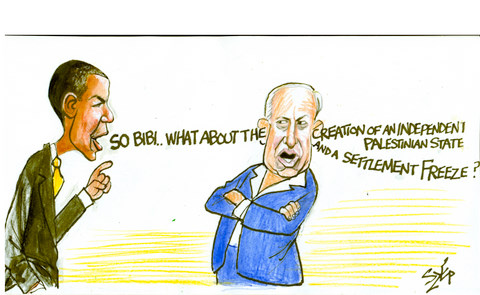
http://www.google.com/imgres?imgurl=http://images.huffingtonpost.com/2009-06-08-ScannedImage63.jpg&imgrefurl=http://www.huffingtonpost.com/the-blog/2009/06/09/&usg=__Hv_PBqZCbkqyD6DJqA3eEXVe17I=&h=295&w=480&sz=51&hl=en&start=6&sig2=kbYkGiE_KGesi3XoMDg5zw&zoom=1&um=1&itbs=1&tbnid=wgn3MiTNfjVuwM:&tbnh=79&tbnw=129&prev=/images%3Fq%3Dobama%2Bnetanyahu%2Bcartoon%26um%3D1%26hl%3Den%26sa%3DN%26tbs%3Disch:1&ei=-kW7TJegEI6VswbAhdynDQ
Tuesday, October 12, 2010
Paul McGeough – Controlling the narrative in Israel and Palestine
Tooling around suburban Washington earlier this week, the car radio shrieked – on just a single word, it seemed. National Public Radio was reporting the uncertain fate of this latest round of Middle East peace talks, in light of last Sunday's expiration of what has been billed as a moratorium on Israeli settlement expansion on Palestinian land.
But in quoting the president of France, the reporter did not use the word 'settlement.' Instead, she attributed to Nicolas Sarkozy the dreaded C-word – 'colonies.' Not quite as jaunty as 'settlements', is it?
If 'settlement' connotes opening up an unclaimed frontier – think fabled Jaffa orange, the taming of the wilds and something found; then 'colony' is about dispossession, the planting of foreigners. More something lost than found.
Playing on many levels, the Middle East is the constant, treadmill-struggle of our time. Right now, we see it at its most theatrical – with both sides warily and wearily hauled to a conference table under Washington's chairmanship. At the end of May we saw it as its most violent – when Israeli commandos attacked a civilian, humanitarian convoy in international waters …killing nine and wounding more than 50, before dragging 700 activists into Israeli waters and then to Israel itself, where, absurdly, they were charged with entering Israel illegally. And there was more blood-letting last month – Hamas gunmen killed four Israeli settlers near Hebron, on the West Bank.
Within the dynamic of this conflict, the leadership on all sides – and in this I include Washington – has an enduring capacity to fail to surprise us. But here I want to look at a genuine element of surprise – the seeming surrender, or loss of the strategic high ground by a key player in a critical dimension of the conflict.
Arguably, engagement takes place at three levels. There are two – weapons and diplomacy – in which Israel has been ascendant since, oh, I would say about 1948. But there is a third dimension, one that sways the diplomacy; and which is influenced by resort to weapons. This is the contest for control of the narrative of the conflict.
Across the decades, Israelis have told the story of their enterprise brilliantly. Palestinians, by contrast, have told the story of dispossession terribly.
In story-telling, words can be bullets. Sure, events happen and as Israelis are wont to say, facts are created on the ground. But the words chosen by participants and observers shape the narrative as it resonates in the region and around the world. In this context, Sarkozy's use of the word 'colony' was a small but significant victory for Palestinians and their supporters who only recently decided to inject the more hard-edged word 'colonies' into debate, instead of the less-specific term, 'settlements.'
I have long believed that with its supremacy in weapons and diplomacy, Israel has this conflict stitched up. It has become an exercise in crisis management, not conflict resolution – in which the US and frequently enough, the Palestinian leadership, also are complicit.
The wrong of the occupation has become the status quo. How else do we interpret Israeli Foreign Minister Avigdor Lieberman's take on the renewed peace talks, which he shared a few days ago with the UN General Assembly, telling that gathering in New York that rather than a final settlement, the talks should focus on some sort of long-term, interim arrangement. "Something that could take a few decades," he said.
How else do we interpret the snouts-in-the-trough corruption of the Fatah cronies, their squandering of the meagre resources of their people at the same time as they enjoy their Israeli-sanctioned special privileges? How else are we to see the callous indifference of the leadership of the world in its abandonment of the civilian population of Palestine? The rights of East Timorese and Bosnians mattered – but those of longer-suffering Palestinians don't?
Early this year it seemed that Israel's grip on the story was loosening. Had events caused the narrative pendulum, the impact of the story as it was heard beyond the Middle East, to swing towards the Palestinian side of the ledger? Even before the debacle of the flotilla, Israeli bungling, as measured by rising diplomatic criticism in the West, had dulled the luster of a PR machine that historically had shaped the exploits of Mossad and other agencies, as nerve-tingling embroidery in a national narrative that left little room for failure. In a hostile corner of the world, that legend was the deterrent.
This is where my mind was at, when I wondered about the Free Gaza Flotilla as a challenge for Israel's PR machine.
As an effort to upend the mythology of the Exodus, the flotilla might be a good framework in which to explore the extent to which Israeli mistakes were creating an opening for the Palestinian story to resonate more effectively.
I proposed to my editors at The Sydney Morning Herald that I join the flotilla as a professional observer – in much the same way as I have embedded in the past with US and Australian troops in Afghanistan and Iraq or spent time with insurgents in those conflicts – to better understand the dynamic of the crises. The editors agreed – and they assigned my photographer colleague Kate Geraghty to join me.
We'll come back to the flotilla in a bit. Suffice to say, I thought I was going for a quiet sail … a meditation in the Med, if you will, on the mythology of conflict. Not in my wildest speculation could I have anticipated Israel's response to the flotilla, either premeditated or as a knee-jerk response upon concluding they had been lured into a trap. We hopped between the boats and in a piece I filed from the Mavi Marmara in the hours before the commando assault, I found myself stumped. Yes, I could detect the outline of a head-on-collision between the governments of Turkey and Israel, but not for a second did I envisage the decks of the old ferry awash with Turkish – and in the case of a dual citizen – American blood.
Israel's mythology is built on the likes of the stunning success of the Six Day War. And on daring, edge-of-the-seat ventures like the 1976 raid on Entebbe Airport in Uganda. Remember their abduction, halfway around the world of Adolf Eichmann? And the surgical strike on Saddam Hussein's nuclear facility?
More recently Israel has achieved some of its tactical objectives. But these days, each outing seemingly incurs greater strategic or diplomatic cost. Whether it was its 2006 assault on Lebanon or its 2008 invasion of Gaza, its assassination in January of a Hamas operative in Dubai or its May attack on the Gaza flotilla, usually stout allies and, in the case of Lebanon, domestic boards of inquiry, have felt obliged to criticize.
In Gaza, Israel was accused of war crimes in the controversial Goldstone Report. In Dubai, it incurred the wrath of governments around the world, including Australia, over the abuse of those country's passports as cover for almost 30 members of the Mossad hit team – who were held to international ridicule in the release by the Dubai authorities of CCTV footage of their Inspector Clouseau antics.
And amidst waves of international criticism for its attack on the Gaza flotilla, the first of a series of investigations – released last week by the UN Human Rights Council – found the interception of the flotilla to be unlawful; that some of the deaths likely were "extra-legal, arbitrary and summary executions"; that some of the treatment of the hundreds of prisoners probably amounted to torture; and that Israel's treatment of the civilian population of Gaza is a blight on humanity.
In the weeks after the attack on the flotilla, the chief of Mossad, Meir Dagan, told the Knesset: "Israel is gradually turning from an asset to the United States to a burden."
This was an analyst's call that coupled naturally with a disquieting moment of another kind for Israel early this year – the impact of which has yet to reveal itself. The setting was an appearance in March before a Senate committee by General David Petraeus, at which he revealed a new line of Washington thought on this conflict. As the then chief of the US Central Command, Petraeus brought along a considered 12,000-word document, in which he framed the Israel-Palestine conflict as a "root cause of instability" and an "obstacle to peace" that played into the hands of Iran and al-Qaeda.
Ditching a cornerstone of neoconservative dogma, Petraeus charged that perceived US favouritism for Israel fomented anti-American sentiment across the region. "The enduring hostilities between Israel and some of its neighbours present distinct challenges to our ability to advance our interests," he said. "Arab anger over the Palestinian question limits the strength and depth of US participation with governments and peoples."
The general was articulating a Washington view that would have been impossible under George W. Bush: that is, the security of Israel and an urgent need to resolve the Israel-Palestine crisis are distinctly separate, core-issues of US national interests. It follows that Washington can be rock-solid on the former at the same time as it could demand action on the latter – thereby robbing Israel of its default argument that its security must always comes first.
Behind these headline events, other developments reveal elements of the historic Israeli story playing out abroad for Palestinians; and the plight of occupation garnering sympathy – or perhaps just less hostility.
In the 1960s and 70s, it was a rite of passage from many non-Jewish students from around the world to spend time on a kibbutz. Today, the young 'internationals,' as they are called still come to the Holy Land, but a good number of them are to be found in the West Bank, helping Palestinians to replant damaged orchards and olive groves or offering themselves as human shields against harassment by Jewish settlers, as Palestinian villagers harvest their crops.
This is part of a growing campaign of Palestinian civil disobedience. First in five and then 12 and now 16 villages, locals have taken to weekly protests against aspects of the Israeli occupation – often with back-up from young internationals and young Israelis who oppose the occupation. I urge you all to see the recently released film, Budrus – a remarkable account of members of Fatah and Hamas and Israeli sympathisers coming together, non-violently, in a West Bank village to force the rerouting of the wall.
And near Bethlehem, Daoud Nassar draws thousands of international visitors each year to a 40ha farm which he runs as a centre of non-violence – despite being choked on all sides by Israeli settlements, the inhabitants of which harass him at the same time as Israeli authorities mire him in a years-long legal campaign to strip his family of their land. Visitors to the farm are greeted by a great boulder bearing Nasser's message to Israelis – "we refuse to be enemies."
After five years, an international BDS campaign – boycott, divestment and sanctions – is becoming more than an irritant for Israel. Financial institutions in Scandinavia, Germany and elsewhere have succumbed to lobbying to divest from companies with ties to Israel. And there has been a spate of big-name tour cancellations – Meg Ryan, Elvis Costello, Gil Scott-Heron and the Pixies.
The EU now insists that the precise origin of produce and products from Jewish settlements in the Occupied Territories be identified on their labels and most recently, the Dutch association of municipalities cancelled a visit to the Netherlands by a group of Israeli community leaders – because several of the Israeli delegates were from West Bank settlements.
The flotilla story is a contemporary echo of the Exodus, when underdog Jewish immigrants faced heavy-handed British opposition to their deliberately illegal landings in Palestine in the 1940s. Told as a potted history on the on-line Jewish Virtual Library, the role reversal is all too apparent: "On July 18, near the coast of Palestine but outside territorial waters, the British rammed the ship and boarded it, while the [Jewish] immigrants put up a desperate defense," goes this account. "Two immigrants and a crewman were killed in the battle, and 30 were wounded." Sounds like?
But the Exodus was a pre-satellite, pre-digital, pre-internet and pre-24/7 news event. Fixed cameras on the Mavi Marmara streamed live footage to websites run by groups behind the flotilla and to Turkish TV channels. Just about everyone on board the boats had a digital device – stills and/or video cameras; phones and the like. The urgency with which the Israeli commandos set about confiscating what became a mountain of everything that might capture images or transmit data was revealing of Israel's determination to control the narrative of their assault on the flotilla. The closest the UN Human Rights Council's account of the attack comes to as laugh-line, is the circumstances of a witness who "isolated and beaten, described the surreal experience of sitting handcuffed on a large heap of laptops and electronic devices and being 'serenaded' by mobile phones reconnecting to the network as the [captured] ship approached Ashdod."
As masked commandos came over the side of the boat to which Geraghty and I had transferred in the hours before the attack, she was zapped with a Taser gun. The satellite phone on which I was reporting the attack to the Herald in Sydney was snatched from my hand. Geraghty's cameras also were seized – along with two satellite terminals and the laptops which we had mounted on the boat's fly-bridge.
Of all the captured data, only a tiny portion of selectively edited material that might be construed to support the Israeli account of the attack was released – branded as 'captured footage.'
Israeli Defense Minister Ehud Barak defended the conduct of his commandos, claiming that in the Middle East you cannot afford to show weakness. It needs to be stated here that precisely what happened on the Mavi Marmara is highly contested. There is footage of metal bars being cut and seemingly wielded as weapons, of chairs and other objects being hurled over the sides at Israeli Zodiacs and of fire-hoses being used as crude water-cannons. But there is no visual evidence to support Israeli claims that the activists on the Mavi Marmara had their own guns; or that they captured Israeli weapons and used them against the boarding parties. All such Israeli charges are flatly denied by flotilla organizers and by activists who were close to the action. In the same vein, there is footage of what appears to be Israeli commandos shooting an activist at near point-blank range and sickening autopsy accounts of head and other high-on-the-body wounding – the result of a resort to live ammunition which Israel justifies after-the-fact, claiming there was a genuine threat to the lives of its commandos.
But … what is conceded by a senior Israeli figure is that there was no evaluation of the wisdom of attempting to board the ship after the first show of activist resistance – a pause that might have saved Israel from the criticism still being heaped upon it. Acknowledging that Israeli commanders should have rethought tactics, the retired military man who first investigated the Israeli forces' handling of the flotilla – Major General Giora Eiland – told the BBC's Panorama program: "Certain mistakes were made by the Israeli armed forces – both by the intelligence and by the commanders of the navy. There was an underestimation of the potential resistance on the ship."
And that's the thing – had the Israeli's pulled off a clean capture of the Mavi Marmara, the world would be thinking 'Entebbe.' Instead there are nine new graves in Turkish cemeteries and John J. Mearsheimer is writing of the IDF in The American Conservative as 'the gang that cannot shoot straight.'
One of the earliest stated objectives of the sending boats to Gaza came from Michael Shaik, the Australian activist who came up with the idea. As he explains it, he wanted to reveal the inherent violence of an Israeli occupation that all too often leaches from the conflict narrative because of foreign revulsion at the Palestinian resort to suicide and rocket attacks. The issue came up in an email exchange in the weeks after the flotilla, between myself and Huwaida Arraf, the remarkable young Palestinian-American lawyer who heads the Free Gaza Movement, a woman who might well be representative of an emerging new generation of Palestinian leadership . Here's what she told me as I quizzed her on the tactics of non-violence – and excuse me if I quote her at length.
"Israel uses so much violence against Palestinians. But when Palestinians use any kind of violent tactics to defend or to fight back, we are vilified. We are always told that we should be non-violent, but the violence of the occupier is not acknowledged or condemned.
"[But there's a] mistaken notion that 'non-violent' resistance means passive resistance. I don't believe in being passive. I believe in fighting – strategically. Israel is stronger than we are militarily, and so I don't want to engage them in armed conflict. I want to use the strengths that we have, and weaken their sources of power. This means, using demonstrations, direct action, civil disobedience, boycotts and encouraging divestment and sanctions to hit at Israel's legitimacy and its ability to rule.
"I strongly believe that unarmed resistance is more threatening to Israel's colonial project than our armed resistance. Unfortunately, Israel has been controlling the narrative and has turned us into terrorists that want to destroy the Jews. Israel uses armed resistance by Palestinians to promote that notion. Each time we fire a rocket, we are feeding the story that Israel wants to tell, and allowing Israel the 'excuse' to further oppress us. In other words, using violent means of resistance plays into the hands of Israeli leaders. When we use various unarmed tactics, we can more effectively attack Israel's control of the narrative, undermining the legitimacy that Israel tries so hard to maintain in the international community, and thereby we can weaken Israel's sources of power."
Despite a shocked, appalled reaction around the world, there was a surge of support by Israelis for their government – in a poll taken a week after the attack, support reached 78 per cent. But if the Israelis could not see the good sense in leaving the flotilla alone, then Hamas could. After a six year period in which there had been just a single suicide-bomb attack, but in which thousands of erratic rockets were fired into Israel, Hamas acknowledged that there was more to be gained in setting up Israel as a target of international criticism for its own actions, than as a target of rockets launched by Hamas and the other factions. "When we use violence, we help Israel win international support," Aziz Dweik, a Hamas MP in the West Bank was quoted in The Wall Street Journal. "The Gaza flotilla has done more for Gaza than 10,000 rockets."
And this takes us to another element of the Israeli bungle – its writing of the narrative headline to tell against itself; the proverbial self-inflicted wound. The world had virtually ignored the siege of Gaza which, as David Shulman put it in The New York Review of Books in June, "is meant to isolate and punish – and in the most optimistic Israeli scenario, to bring down – the Hamas government." But Western capitals could not remain silent about the blockade after the flotilla – "The status quo we have is inherently unstable," Barack Obama said. Britain's new Prime Minister David Cameron was more pointed, touching another strand of Israel's historic narrative by referring to Gaza as a 'prison camp.' The groans in Jerusalem could be heard, as he tut-tutted: "Friends of Israel … should be saying to the Israelis that the blockade actually strengthens Hamas' grip on the economy and on Gaza and it's in [the Israelis'] own interests to lift it, and to allow these vital supplies to get through."
Cornered by its own actions, Israel was forced to concede the screamingly obvious – the siege was not working. In this, the Israeli investigator Giora Eiland conceded that the flotilla organizers had won. "Unfortunately they managed to achieve exactly what they wanted," he told the BBC. "Unfortunately it was quite successful."
But for Gazans, things changed only at the margins. While some additional goods were allowed in, the rate at which trucks were allowed to enter Gaza was still significantly less that the estimated 500 a day that entered the strip before the onset of the siege; and Israel rejected an offer by the European Union to monitor the arrival of goods in Gaza – as a response to Israeli claims that the intent of the blockade was to guard against the smuggling of weapons to Hamas.
All of this, then, takes us to the wider architecture of the narrative in this conflict – how things are not quite as they seem.
Backed by Washington, Israel still believes it is entitled to select the Palestinian leadership, to choose its partners in peace, as it calls them in narrative-speak. So we need to back in 2006, when Palestinians voted to sweep the remnants of Yasser Arafat's secular Fatah movement from office and to install an Islamist Hamas administration. Utterly wrong-footed and forgetting the years during which they had left Fatah to the mercy of Hamas, Israel and the West said "NO – we want Fatah." And then, it seemed, only up to a point. They still cut the ground from under the current Fatah leader and PA president Mahmoud Abbas, obstinately refusing to put on the table the kind of deal that might swing popular Palestinian support away from Hamas to Fatah.
But please do not confuse the current Palestinian leadership – groomed and shaped as it is by Israel and Washington – as even a distant relation to the democracy cure-all they claim is so vital for the region.
The 2006 Palestinian election ought to have been celebrated by all sides. A cathartic moment for Palestinians, the poll was a more consistent expression of the will of the people than most other elections in the region – and deemed to be free and fair by an army of international observers. But because they voted for Hamas, the entire Palestinian population was sin-binned – denied international funding. Half of their elected MPs were rounded up and jailed by Israel, which then embarked on the lock-down of Gaza which over time has been tightened to make the strip one of the world's biggest and, as the locals see it, the world's meanest prisons.
Four years after an election outcome that might have been embraced by Washington as the Middle East democracy of its dreams, we now have a once-elected Palestinian president whose term has expired but who remains in office by self-appointment. He in turn, has appointed as an unelected prime minister, a man whose Third Way party won just 2.4 per cent of the vote in 2006. The Palestinian parliament – a rarity in the region – has been neutered. In less than a year three tiers of Palestinian elections have been cancelled – presidential, parliamentary and local councils.
Like the tin-pot dictators of the region, the Palestinian president and his prime minister rule by decree. And they have at their disposal a foreign-funded and trained security force which, like its counterparts in the region, resorts to torture as is roots out political opposition, rounding up suspects by the hundreds and busting gatherings it worries might dare to criticize. Hamas – designated as a terrorist orgainsation by Israel, the US and Europe – has been driven underground in the West Bank, under the weight of an unrelenting assault by Israeli forces and Abbas' security apparatus – units of which are required to humiliate themselves before their own people, by disappearing from the streets when Israeli forces choose to mount an operation on their Palestinian turf.
It is hardly surprising that for many Palestinians, this amounts to collaboration with the occupiers –further undermining Abbas and his Prime Minister Salam Fayad, at the same time as Israel and the West go through the motions of propping up the Palestinian leadership. This is especially so when Palestinians read in the most recent annual report of the Shin Bet, Israel's domestic intelligence agency, that combined Palestinian-Israeli operations have reduced attacks on Israelis to their lowest since 2000. A reporter from the Israeli daily Yedioth Ahronoth was present at a joint Israeli-Palestinian security meeting in 2008, when the head of the Palestinian delegation told his Israeli counterparts: "We have a common enemy – we are taking care of every Hamas institution in accordance with your instructions."
Not quite, says Hamas. In claiming responsibility for the death of the settlers near Hebron late in August, the movement explained that the attack was not so much a bid to undermine the peace talks, as much as it was to demonstrate that the Israeli and PA security machines had not bottled-up Hamas as well as they liked to believe.
Prime Minister Fayed continues to have difficulty garnering popular support, but he is sticking to a plan to knock Palestinian institutions into shape by next year, when he says he will simply declare an independent Palestinian state. What will Washington and the world do when he does? Fayed is opening new schools, planting trees and collecting issuing parking tickets. He cracks down on some of the Fatah freebies – the cars and the cell phones. To some Palestinians, all this might be just another half-way house – perhaps like Israeli Prime Minister Benjamin Netanyahu's 'economic peace.'
But to the World Bank it sounds like a plan – in a statement last week, it enthused: "If the Palestinian Authority maintains its current performance in institution-building and delivery of public services, it is well-positioned for the establishment of a state at any point in the near future."
That the Palestinian Authority has morphed to become another Western-friendly autocracy which has been known to dictate the sermons to be read by imams at Friday prayers, was confirmed by a European official who in August told The Economist: "We prefer division [among Palestinians] and no elections, to reconciliation [between Fatah and Hamas] and elections."
To shoehorn it into the narrative, the security agencies on which the PA leadership depends is dressed up a local law-and-order exercise – beat cops and that kind of thing. But it is an American construct the No 1 priority for which is the elimination of Hamas – in the last three years the US State Department has allocated $US392 million to the service and it has its hand out for another $US150 next year.
The Obama White House these days substitutes a kind of fawning for statecraft in its dealing with difficult leaders. Remember its treatment of the Afghan president earlier this year? After wiping the floor with Hamid Karzai's coat of many colours, accusing him of ineptness and corruption, they brought Karzai to Washington for a week of feting – seemingly in the belief that the Afghan president would forget that Washington had loudly told the world that he is an imposter and a crook.
It was the same with Netanyahu when he was called to DC for a kiss-and-make-up after the flotilla debacle, and after Washington's public fury over the embarrassment caused by Israel's announcement of settlement expansion during a visit to Israel by Vice President Joe Biden. A big-time fawner, Biden declared on arriving in Jerusalem in April: "It's great to be home."
But fast-forward to Netanyahu's visit to DC in July and The Washington Post's Dana Milbank is having a field day, arguing that the White House might as well have hung out the white flag of surrender.
"Four months ago," he wrote, "the Obama administration made a politically perilous decision to condemn Israel over a controversial new settlement. The Israel lobby reared up, Netanyahu denounced the administration's actions, Republican leaders sided with Netanyahu, and Democrats ran for cover.
"So on Tuesday, Obama, routed and humiliated by his Israeli counterpart, invited Netanyahu back to the White House for what might be called the Oil of Olay Summit: It was all about saving face.
"The president, beaming in the Oval Office with a dour Netanyahu at his side, gushed about the "extraordinary friendship between our two countries." He performed the Full Monty of pro-Israel pandering: "The bond between the United States and Israel is unbreakable" . . . "I commended Prime Minister Netanyahu" . . . "Our two countries are working cooperatively" . . . "unwavering in our commitment" . . . "our relationship has broadened" . . . "continuing to improve" . . . "We are committed to that special bond, and we are going to do what's required to back that up," Milbank wrote.
But just as we should not expect Karzai to change his ways any time soon, why should we believe that Netanyahu has abandoned his "economic peace" sop to Palestinians, simply because he has agreed to take part in the current talks? Remember all the bluster by Ariel Sharon on 'disengaging' from Gaza in 2005 – only for his long-time advisor and confidante Dov Weisglass to put us straight just six months later, when he explained to the Israeli daily Haaretz that the so-called disengagement was a policy feint – a "bottle of formaldehyde," he said, to take George W. Bush's Road Map peace-proposal off the table.
And this week, Osamah Khalil, of the California-based Palestine Policy Network, pulled out this gem, on then Prime Minister Yitzak Shamir's thinking when he agreed to the talks that created the Oslo Accords – "I would have carried on autonomy talks for ten years and meanwhile we would have reached a half-million people in Judea and Samaria."
Bear in mind that notionally at least, the Oslo years were the most hopeful in recent decades, before considering this assessment by Jessica Montell, executive director of B'Tselem, the Israeli watch group, and ask yourself why should Palestinians take heart from another round of talks.
Montell writes: "Since the first negotiations began in Madrid in 1991, the West Bank settlement population has tripled. The settlers are dispersed among over 121 settlements and about 100 outposts …their regional councils encompass vast swathes of land – fully 42 per cent of the West Bank is under settlement control."
Much is made too, of the coalition Netanyahu heads, as though his reliance on settler and other hard-core, right-wing elements of the Israeli establishment somehow imposed new limits on any chance of a peaceable settlement of the conflict. Why?
Since 1948, a constant in Israeli-Palestinian relations has been Israel's coveting of Palestinian land – remember David Ben Gurion's admonition to comrades that they not draw boundaries to their new state lest they deny themselves an opportunity to push eastward towards the Jordan River.
Take a helicopter-view of history and the bludgeon of reality emerges. It is this – it does not matter which party or coalition of parties is in power in Israel; whether the Israeli military, settlers or peace movement is ascendant; whether Democrats or Republicans are in the White House; whether Fatah rules in the Occupied Territories or has been routed by Hamas; it makes no difference whether there is a cold peace or a hot war; an intifada or a Oslo-induced new spring; it does not matter whether Areas A is the square root of Areas B and C; or whether the Arab world is spoiling for war or suing for peace. The outcome always is the same – while it goes through the motions of talking about returning the Occupied Territories, Israel takes more and more Palestinian land and the rest of the world pretty well looks the other way.
How can any Palestinian believe in a two-state solution when one of those potential states is shrunk, square metre by square metre? As Josh Ruebner, a Jew who heads the US Campaign to End the Occupation wrote in USA Today of the renewed talks: "Palestinians paradoxically will be expected to negotiate statehood with Israel while Israel – with the full support of the United States in the form of $US3 billion per year in military aid – continues to gobble up the territory designated for a Palestinian state."
If Hamas is such a fundamentalist threat to Israel, the region and the world, then an imperative at any point in the last decade would have been an honorable deal with Fatah, a settlement that would allow Palestinians to see the successors of Yasser Arafat as leaders worthy of their respect and loyalty. As it is, these latest talks are set to fail, further diminishing Abbas and Fatah in the eyes or Palestinians and thereby creating new political and emotional space in which Hamas will say, "We told you so."
Outsiders can see it all – Israelis have difficulty.
I was struck by a piece in The Jerusalem Post at the end of July, in which the prominent Israeli journalist David Horovitz interviewed the departing British ambassador to Tel Aviv, Sir Tom Phillips. The ambassador tells it straight – Israel has made a hash of Gaza; on his visits home to Britain he is conscious of a drift in popular opinion away from Israel; Israel cannot keep several million people under occupation – without giving them full civil, human and other rights. Then the ambassador poses an awkward question: "What does Israel want? Is Israel so drawn…to the biblical homeland – East Jerusalem, Judea and Samaria – that it cannot renounce them, even if renouncing them is the only way to achieve sustainable long-term life for the Jewish people?"
Horovitz is affronted – the ambassador, for whom he appears to have great affection, just doesn't get it. Phillips, he writes, does not appreciate the devastating impact on the Israeli psyche of the Second Intifada; the need for the wall or barrier; the so-called Gaza disengagement and Netanyahu's half-baked settlement freeze. He writes: "[Phillips] evidently believes we risk making a frightful mess of things … he is far from convinced that we are ready to relinquish 'Fortress Israel'."
When Horovitz pleads the Jewish fear of terrorism and the 'deligitmisation' of Israel in the Palestinian media, the Ambassador gives the reporter a verbal whack as he acknowledges the cause of Palestinian unhappiness – "hey, they're an occupied people."
A few weeks later, there were more signs of Israeli frustration in a Jerusalem Post commentary which began: "Israel has lost the plot. To be precise, we have lost our plot. We are like tragic characters trying to find the story line in an absurd existentialist play. We have forgotten our narrative. Whether from self-imposed amnesia or a wistful yearning for 'normality,' we are no longer able to articulate our remarkable story to ourselves or to the world."
The call to arms was taken up by Dr Dvir Abramovich, director of the Centre for Jewish History and Culture at the University of Melbourne. For Abramovich the trigger was a piece published last month by Time magazine, in which reporter Karl Vick wrote that Israelis were getting on with their lives, seemingly not rating the existential crisis as highly as they might. "They are otherwise engaged," Vick writes. "They are making money; they are enjoying the last rays of summer."
It was the line about making money that infuriated Abramovich – "shameful and offensive… Israel bashing… old-age anti-Semitic stereotypes…. Shakespeare's Shylock…a pound of flesh … anti-Jewish libels."
That Abramovich failed to mention the words 'occupation' or 'settlements' was no surprise. But what did surprise was the reader response to smh.com.au's publication of the piece. When I checked-in, 60 readers had responded – just five of them supported Abramovich.
There is no peace process. As Chas Freeman, formerly US ambassador to Saudi Arabia, puts it, the process is a hand-maiden of Israeli expansion, rather than a driver for peace. What we have is much twisting of the narrative as all sides attempt to bend it around their take on events. Freeman sought to cut through all that twisting in an address to the staff of the Norwegian Ministry of Foreign Affairs in September.
Outlining the Israeli dependence on Washington, he told his audience: "Ironically, Palestinians too have developed a dependency relationship with America. This has locked them into a political framework over which Israel exercises decisive influence – they have been powerless to end occupation, pogroms, ethnic cleansing and other humiliations by Jewish soldiers and settlers. Nor have they been able to prevent their progressive confinement in checkpoint-encircled ghettos on the West Bank and the great open-air prison of Gaza."
Of the process itself, Freeman was withering – "The perpetual processing of peace without the requirement to produce it has been especially appreciated by Israeli leaders. It has enabled them to behave like magicians, riveting foreign attention on meaningless distractions as they systematically removed Palestinians from their homes, settled half-a-million or more Jews in newly vacated areas of the Occupied Territories and annexed a widening swathe of land to a Jerusalem they insist belongs only to Israel."
All of that requires deft spinning. A master in the field is Israel's Ambassador to Washington – Michael Oren. A fixture on the air in the aftermath of the Gaza flotilla, Oren's late night appearance on the satirical Steve Colbert Show coincided with the career-suicide of the 80-something journalist Helen Thomas, who was driven from the White House press room and her job as a columnist for Hearst Newspapers, when she was quoted saying that the Jews in Palestine should "go home" to Poland and Germany.
Oren was on the Colbert set to talk about the flotilla. But he preened as his host segued to the Thomas issue which, at the time prompted many senior media types in the US to disown a colleague who for decades had held a front-row seat in the White House press room. Clearly Oren believed he was about to be offered a free-kick as Colbert launched into his 'I repudiate Helen Thomas' shtick: "… she's a friend, but go back to Poland, go back to Germany? That's ridiculous – Israel is for Israelis," … and here a pregnant pause which was followed by a fading of the ambassador's smile, as Colbert continued: "If anything, the Palestinians should go back to where they came from. Do you agree, sir?"
http://palestinethinktank.com/2010/10/06/paul-mcgeough-controlling-the-narrative-in-israel-and-palestine/
But in quoting the president of France, the reporter did not use the word 'settlement.' Instead, she attributed to Nicolas Sarkozy the dreaded C-word – 'colonies.' Not quite as jaunty as 'settlements', is it?
If 'settlement' connotes opening up an unclaimed frontier – think fabled Jaffa orange, the taming of the wilds and something found; then 'colony' is about dispossession, the planting of foreigners. More something lost than found.
Playing on many levels, the Middle East is the constant, treadmill-struggle of our time. Right now, we see it at its most theatrical – with both sides warily and wearily hauled to a conference table under Washington's chairmanship. At the end of May we saw it as its most violent – when Israeli commandos attacked a civilian, humanitarian convoy in international waters …killing nine and wounding more than 50, before dragging 700 activists into Israeli waters and then to Israel itself, where, absurdly, they were charged with entering Israel illegally. And there was more blood-letting last month – Hamas gunmen killed four Israeli settlers near Hebron, on the West Bank.
Within the dynamic of this conflict, the leadership on all sides – and in this I include Washington – has an enduring capacity to fail to surprise us. But here I want to look at a genuine element of surprise – the seeming surrender, or loss of the strategic high ground by a key player in a critical dimension of the conflict.
Arguably, engagement takes place at three levels. There are two – weapons and diplomacy – in which Israel has been ascendant since, oh, I would say about 1948. But there is a third dimension, one that sways the diplomacy; and which is influenced by resort to weapons. This is the contest for control of the narrative of the conflict.
Across the decades, Israelis have told the story of their enterprise brilliantly. Palestinians, by contrast, have told the story of dispossession terribly.
In story-telling, words can be bullets. Sure, events happen and as Israelis are wont to say, facts are created on the ground. But the words chosen by participants and observers shape the narrative as it resonates in the region and around the world. In this context, Sarkozy's use of the word 'colony' was a small but significant victory for Palestinians and their supporters who only recently decided to inject the more hard-edged word 'colonies' into debate, instead of the less-specific term, 'settlements.'
I have long believed that with its supremacy in weapons and diplomacy, Israel has this conflict stitched up. It has become an exercise in crisis management, not conflict resolution – in which the US and frequently enough, the Palestinian leadership, also are complicit.
The wrong of the occupation has become the status quo. How else do we interpret Israeli Foreign Minister Avigdor Lieberman's take on the renewed peace talks, which he shared a few days ago with the UN General Assembly, telling that gathering in New York that rather than a final settlement, the talks should focus on some sort of long-term, interim arrangement. "Something that could take a few decades," he said.
How else do we interpret the snouts-in-the-trough corruption of the Fatah cronies, their squandering of the meagre resources of their people at the same time as they enjoy their Israeli-sanctioned special privileges? How else are we to see the callous indifference of the leadership of the world in its abandonment of the civilian population of Palestine? The rights of East Timorese and Bosnians mattered – but those of longer-suffering Palestinians don't?
Early this year it seemed that Israel's grip on the story was loosening. Had events caused the narrative pendulum, the impact of the story as it was heard beyond the Middle East, to swing towards the Palestinian side of the ledger? Even before the debacle of the flotilla, Israeli bungling, as measured by rising diplomatic criticism in the West, had dulled the luster of a PR machine that historically had shaped the exploits of Mossad and other agencies, as nerve-tingling embroidery in a national narrative that left little room for failure. In a hostile corner of the world, that legend was the deterrent.
This is where my mind was at, when I wondered about the Free Gaza Flotilla as a challenge for Israel's PR machine.
As an effort to upend the mythology of the Exodus, the flotilla might be a good framework in which to explore the extent to which Israeli mistakes were creating an opening for the Palestinian story to resonate more effectively.
I proposed to my editors at The Sydney Morning Herald that I join the flotilla as a professional observer – in much the same way as I have embedded in the past with US and Australian troops in Afghanistan and Iraq or spent time with insurgents in those conflicts – to better understand the dynamic of the crises. The editors agreed – and they assigned my photographer colleague Kate Geraghty to join me.
We'll come back to the flotilla in a bit. Suffice to say, I thought I was going for a quiet sail … a meditation in the Med, if you will, on the mythology of conflict. Not in my wildest speculation could I have anticipated Israel's response to the flotilla, either premeditated or as a knee-jerk response upon concluding they had been lured into a trap. We hopped between the boats and in a piece I filed from the Mavi Marmara in the hours before the commando assault, I found myself stumped. Yes, I could detect the outline of a head-on-collision between the governments of Turkey and Israel, but not for a second did I envisage the decks of the old ferry awash with Turkish – and in the case of a dual citizen – American blood.
Israel's mythology is built on the likes of the stunning success of the Six Day War. And on daring, edge-of-the-seat ventures like the 1976 raid on Entebbe Airport in Uganda. Remember their abduction, halfway around the world of Adolf Eichmann? And the surgical strike on Saddam Hussein's nuclear facility?
More recently Israel has achieved some of its tactical objectives. But these days, each outing seemingly incurs greater strategic or diplomatic cost. Whether it was its 2006 assault on Lebanon or its 2008 invasion of Gaza, its assassination in January of a Hamas operative in Dubai or its May attack on the Gaza flotilla, usually stout allies and, in the case of Lebanon, domestic boards of inquiry, have felt obliged to criticize.
In Gaza, Israel was accused of war crimes in the controversial Goldstone Report. In Dubai, it incurred the wrath of governments around the world, including Australia, over the abuse of those country's passports as cover for almost 30 members of the Mossad hit team – who were held to international ridicule in the release by the Dubai authorities of CCTV footage of their Inspector Clouseau antics.
And amidst waves of international criticism for its attack on the Gaza flotilla, the first of a series of investigations – released last week by the UN Human Rights Council – found the interception of the flotilla to be unlawful; that some of the deaths likely were "extra-legal, arbitrary and summary executions"; that some of the treatment of the hundreds of prisoners probably amounted to torture; and that Israel's treatment of the civilian population of Gaza is a blight on humanity.
In the weeks after the attack on the flotilla, the chief of Mossad, Meir Dagan, told the Knesset: "Israel is gradually turning from an asset to the United States to a burden."
This was an analyst's call that coupled naturally with a disquieting moment of another kind for Israel early this year – the impact of which has yet to reveal itself. The setting was an appearance in March before a Senate committee by General David Petraeus, at which he revealed a new line of Washington thought on this conflict. As the then chief of the US Central Command, Petraeus brought along a considered 12,000-word document, in which he framed the Israel-Palestine conflict as a "root cause of instability" and an "obstacle to peace" that played into the hands of Iran and al-Qaeda.
Ditching a cornerstone of neoconservative dogma, Petraeus charged that perceived US favouritism for Israel fomented anti-American sentiment across the region. "The enduring hostilities between Israel and some of its neighbours present distinct challenges to our ability to advance our interests," he said. "Arab anger over the Palestinian question limits the strength and depth of US participation with governments and peoples."
The general was articulating a Washington view that would have been impossible under George W. Bush: that is, the security of Israel and an urgent need to resolve the Israel-Palestine crisis are distinctly separate, core-issues of US national interests. It follows that Washington can be rock-solid on the former at the same time as it could demand action on the latter – thereby robbing Israel of its default argument that its security must always comes first.
Behind these headline events, other developments reveal elements of the historic Israeli story playing out abroad for Palestinians; and the plight of occupation garnering sympathy – or perhaps just less hostility.
In the 1960s and 70s, it was a rite of passage from many non-Jewish students from around the world to spend time on a kibbutz. Today, the young 'internationals,' as they are called still come to the Holy Land, but a good number of them are to be found in the West Bank, helping Palestinians to replant damaged orchards and olive groves or offering themselves as human shields against harassment by Jewish settlers, as Palestinian villagers harvest their crops.
This is part of a growing campaign of Palestinian civil disobedience. First in five and then 12 and now 16 villages, locals have taken to weekly protests against aspects of the Israeli occupation – often with back-up from young internationals and young Israelis who oppose the occupation. I urge you all to see the recently released film, Budrus – a remarkable account of members of Fatah and Hamas and Israeli sympathisers coming together, non-violently, in a West Bank village to force the rerouting of the wall.
And near Bethlehem, Daoud Nassar draws thousands of international visitors each year to a 40ha farm which he runs as a centre of non-violence – despite being choked on all sides by Israeli settlements, the inhabitants of which harass him at the same time as Israeli authorities mire him in a years-long legal campaign to strip his family of their land. Visitors to the farm are greeted by a great boulder bearing Nasser's message to Israelis – "we refuse to be enemies."
After five years, an international BDS campaign – boycott, divestment and sanctions – is becoming more than an irritant for Israel. Financial institutions in Scandinavia, Germany and elsewhere have succumbed to lobbying to divest from companies with ties to Israel. And there has been a spate of big-name tour cancellations – Meg Ryan, Elvis Costello, Gil Scott-Heron and the Pixies.
The EU now insists that the precise origin of produce and products from Jewish settlements in the Occupied Territories be identified on their labels and most recently, the Dutch association of municipalities cancelled a visit to the Netherlands by a group of Israeli community leaders – because several of the Israeli delegates were from West Bank settlements.
The flotilla story is a contemporary echo of the Exodus, when underdog Jewish immigrants faced heavy-handed British opposition to their deliberately illegal landings in Palestine in the 1940s. Told as a potted history on the on-line Jewish Virtual Library, the role reversal is all too apparent: "On July 18, near the coast of Palestine but outside territorial waters, the British rammed the ship and boarded it, while the [Jewish] immigrants put up a desperate defense," goes this account. "Two immigrants and a crewman were killed in the battle, and 30 were wounded." Sounds like?
But the Exodus was a pre-satellite, pre-digital, pre-internet and pre-24/7 news event. Fixed cameras on the Mavi Marmara streamed live footage to websites run by groups behind the flotilla and to Turkish TV channels. Just about everyone on board the boats had a digital device – stills and/or video cameras; phones and the like. The urgency with which the Israeli commandos set about confiscating what became a mountain of everything that might capture images or transmit data was revealing of Israel's determination to control the narrative of their assault on the flotilla. The closest the UN Human Rights Council's account of the attack comes to as laugh-line, is the circumstances of a witness who "isolated and beaten, described the surreal experience of sitting handcuffed on a large heap of laptops and electronic devices and being 'serenaded' by mobile phones reconnecting to the network as the [captured] ship approached Ashdod."
As masked commandos came over the side of the boat to which Geraghty and I had transferred in the hours before the attack, she was zapped with a Taser gun. The satellite phone on which I was reporting the attack to the Herald in Sydney was snatched from my hand. Geraghty's cameras also were seized – along with two satellite terminals and the laptops which we had mounted on the boat's fly-bridge.
Of all the captured data, only a tiny portion of selectively edited material that might be construed to support the Israeli account of the attack was released – branded as 'captured footage.'
Israeli Defense Minister Ehud Barak defended the conduct of his commandos, claiming that in the Middle East you cannot afford to show weakness. It needs to be stated here that precisely what happened on the Mavi Marmara is highly contested. There is footage of metal bars being cut and seemingly wielded as weapons, of chairs and other objects being hurled over the sides at Israeli Zodiacs and of fire-hoses being used as crude water-cannons. But there is no visual evidence to support Israeli claims that the activists on the Mavi Marmara had their own guns; or that they captured Israeli weapons and used them against the boarding parties. All such Israeli charges are flatly denied by flotilla organizers and by activists who were close to the action. In the same vein, there is footage of what appears to be Israeli commandos shooting an activist at near point-blank range and sickening autopsy accounts of head and other high-on-the-body wounding – the result of a resort to live ammunition which Israel justifies after-the-fact, claiming there was a genuine threat to the lives of its commandos.
But … what is conceded by a senior Israeli figure is that there was no evaluation of the wisdom of attempting to board the ship after the first show of activist resistance – a pause that might have saved Israel from the criticism still being heaped upon it. Acknowledging that Israeli commanders should have rethought tactics, the retired military man who first investigated the Israeli forces' handling of the flotilla – Major General Giora Eiland – told the BBC's Panorama program: "Certain mistakes were made by the Israeli armed forces – both by the intelligence and by the commanders of the navy. There was an underestimation of the potential resistance on the ship."
And that's the thing – had the Israeli's pulled off a clean capture of the Mavi Marmara, the world would be thinking 'Entebbe.' Instead there are nine new graves in Turkish cemeteries and John J. Mearsheimer is writing of the IDF in The American Conservative as 'the gang that cannot shoot straight.'
One of the earliest stated objectives of the sending boats to Gaza came from Michael Shaik, the Australian activist who came up with the idea. As he explains it, he wanted to reveal the inherent violence of an Israeli occupation that all too often leaches from the conflict narrative because of foreign revulsion at the Palestinian resort to suicide and rocket attacks. The issue came up in an email exchange in the weeks after the flotilla, between myself and Huwaida Arraf, the remarkable young Palestinian-American lawyer who heads the Free Gaza Movement, a woman who might well be representative of an emerging new generation of Palestinian leadership . Here's what she told me as I quizzed her on the tactics of non-violence – and excuse me if I quote her at length.
"Israel uses so much violence against Palestinians. But when Palestinians use any kind of violent tactics to defend or to fight back, we are vilified. We are always told that we should be non-violent, but the violence of the occupier is not acknowledged or condemned.
"[But there's a] mistaken notion that 'non-violent' resistance means passive resistance. I don't believe in being passive. I believe in fighting – strategically. Israel is stronger than we are militarily, and so I don't want to engage them in armed conflict. I want to use the strengths that we have, and weaken their sources of power. This means, using demonstrations, direct action, civil disobedience, boycotts and encouraging divestment and sanctions to hit at Israel's legitimacy and its ability to rule.
"I strongly believe that unarmed resistance is more threatening to Israel's colonial project than our armed resistance. Unfortunately, Israel has been controlling the narrative and has turned us into terrorists that want to destroy the Jews. Israel uses armed resistance by Palestinians to promote that notion. Each time we fire a rocket, we are feeding the story that Israel wants to tell, and allowing Israel the 'excuse' to further oppress us. In other words, using violent means of resistance plays into the hands of Israeli leaders. When we use various unarmed tactics, we can more effectively attack Israel's control of the narrative, undermining the legitimacy that Israel tries so hard to maintain in the international community, and thereby we can weaken Israel's sources of power."
Despite a shocked, appalled reaction around the world, there was a surge of support by Israelis for their government – in a poll taken a week after the attack, support reached 78 per cent. But if the Israelis could not see the good sense in leaving the flotilla alone, then Hamas could. After a six year period in which there had been just a single suicide-bomb attack, but in which thousands of erratic rockets were fired into Israel, Hamas acknowledged that there was more to be gained in setting up Israel as a target of international criticism for its own actions, than as a target of rockets launched by Hamas and the other factions. "When we use violence, we help Israel win international support," Aziz Dweik, a Hamas MP in the West Bank was quoted in The Wall Street Journal. "The Gaza flotilla has done more for Gaza than 10,000 rockets."
And this takes us to another element of the Israeli bungle – its writing of the narrative headline to tell against itself; the proverbial self-inflicted wound. The world had virtually ignored the siege of Gaza which, as David Shulman put it in The New York Review of Books in June, "is meant to isolate and punish – and in the most optimistic Israeli scenario, to bring down – the Hamas government." But Western capitals could not remain silent about the blockade after the flotilla – "The status quo we have is inherently unstable," Barack Obama said. Britain's new Prime Minister David Cameron was more pointed, touching another strand of Israel's historic narrative by referring to Gaza as a 'prison camp.' The groans in Jerusalem could be heard, as he tut-tutted: "Friends of Israel … should be saying to the Israelis that the blockade actually strengthens Hamas' grip on the economy and on Gaza and it's in [the Israelis'] own interests to lift it, and to allow these vital supplies to get through."
Cornered by its own actions, Israel was forced to concede the screamingly obvious – the siege was not working. In this, the Israeli investigator Giora Eiland conceded that the flotilla organizers had won. "Unfortunately they managed to achieve exactly what they wanted," he told the BBC. "Unfortunately it was quite successful."
But for Gazans, things changed only at the margins. While some additional goods were allowed in, the rate at which trucks were allowed to enter Gaza was still significantly less that the estimated 500 a day that entered the strip before the onset of the siege; and Israel rejected an offer by the European Union to monitor the arrival of goods in Gaza – as a response to Israeli claims that the intent of the blockade was to guard against the smuggling of weapons to Hamas.
All of this, then, takes us to the wider architecture of the narrative in this conflict – how things are not quite as they seem.
Backed by Washington, Israel still believes it is entitled to select the Palestinian leadership, to choose its partners in peace, as it calls them in narrative-speak. So we need to back in 2006, when Palestinians voted to sweep the remnants of Yasser Arafat's secular Fatah movement from office and to install an Islamist Hamas administration. Utterly wrong-footed and forgetting the years during which they had left Fatah to the mercy of Hamas, Israel and the West said "NO – we want Fatah." And then, it seemed, only up to a point. They still cut the ground from under the current Fatah leader and PA president Mahmoud Abbas, obstinately refusing to put on the table the kind of deal that might swing popular Palestinian support away from Hamas to Fatah.
But please do not confuse the current Palestinian leadership – groomed and shaped as it is by Israel and Washington – as even a distant relation to the democracy cure-all they claim is so vital for the region.
The 2006 Palestinian election ought to have been celebrated by all sides. A cathartic moment for Palestinians, the poll was a more consistent expression of the will of the people than most other elections in the region – and deemed to be free and fair by an army of international observers. But because they voted for Hamas, the entire Palestinian population was sin-binned – denied international funding. Half of their elected MPs were rounded up and jailed by Israel, which then embarked on the lock-down of Gaza which over time has been tightened to make the strip one of the world's biggest and, as the locals see it, the world's meanest prisons.
Four years after an election outcome that might have been embraced by Washington as the Middle East democracy of its dreams, we now have a once-elected Palestinian president whose term has expired but who remains in office by self-appointment. He in turn, has appointed as an unelected prime minister, a man whose Third Way party won just 2.4 per cent of the vote in 2006. The Palestinian parliament – a rarity in the region – has been neutered. In less than a year three tiers of Palestinian elections have been cancelled – presidential, parliamentary and local councils.
Like the tin-pot dictators of the region, the Palestinian president and his prime minister rule by decree. And they have at their disposal a foreign-funded and trained security force which, like its counterparts in the region, resorts to torture as is roots out political opposition, rounding up suspects by the hundreds and busting gatherings it worries might dare to criticize. Hamas – designated as a terrorist orgainsation by Israel, the US and Europe – has been driven underground in the West Bank, under the weight of an unrelenting assault by Israeli forces and Abbas' security apparatus – units of which are required to humiliate themselves before their own people, by disappearing from the streets when Israeli forces choose to mount an operation on their Palestinian turf.
It is hardly surprising that for many Palestinians, this amounts to collaboration with the occupiers –further undermining Abbas and his Prime Minister Salam Fayad, at the same time as Israel and the West go through the motions of propping up the Palestinian leadership. This is especially so when Palestinians read in the most recent annual report of the Shin Bet, Israel's domestic intelligence agency, that combined Palestinian-Israeli operations have reduced attacks on Israelis to their lowest since 2000. A reporter from the Israeli daily Yedioth Ahronoth was present at a joint Israeli-Palestinian security meeting in 2008, when the head of the Palestinian delegation told his Israeli counterparts: "We have a common enemy – we are taking care of every Hamas institution in accordance with your instructions."
Not quite, says Hamas. In claiming responsibility for the death of the settlers near Hebron late in August, the movement explained that the attack was not so much a bid to undermine the peace talks, as much as it was to demonstrate that the Israeli and PA security machines had not bottled-up Hamas as well as they liked to believe.
Prime Minister Fayed continues to have difficulty garnering popular support, but he is sticking to a plan to knock Palestinian institutions into shape by next year, when he says he will simply declare an independent Palestinian state. What will Washington and the world do when he does? Fayed is opening new schools, planting trees and collecting issuing parking tickets. He cracks down on some of the Fatah freebies – the cars and the cell phones. To some Palestinians, all this might be just another half-way house – perhaps like Israeli Prime Minister Benjamin Netanyahu's 'economic peace.'
But to the World Bank it sounds like a plan – in a statement last week, it enthused: "If the Palestinian Authority maintains its current performance in institution-building and delivery of public services, it is well-positioned for the establishment of a state at any point in the near future."
That the Palestinian Authority has morphed to become another Western-friendly autocracy which has been known to dictate the sermons to be read by imams at Friday prayers, was confirmed by a European official who in August told The Economist: "We prefer division [among Palestinians] and no elections, to reconciliation [between Fatah and Hamas] and elections."
To shoehorn it into the narrative, the security agencies on which the PA leadership depends is dressed up a local law-and-order exercise – beat cops and that kind of thing. But it is an American construct the No 1 priority for which is the elimination of Hamas – in the last three years the US State Department has allocated $US392 million to the service and it has its hand out for another $US150 next year.
The Obama White House these days substitutes a kind of fawning for statecraft in its dealing with difficult leaders. Remember its treatment of the Afghan president earlier this year? After wiping the floor with Hamid Karzai's coat of many colours, accusing him of ineptness and corruption, they brought Karzai to Washington for a week of feting – seemingly in the belief that the Afghan president would forget that Washington had loudly told the world that he is an imposter and a crook.
It was the same with Netanyahu when he was called to DC for a kiss-and-make-up after the flotilla debacle, and after Washington's public fury over the embarrassment caused by Israel's announcement of settlement expansion during a visit to Israel by Vice President Joe Biden. A big-time fawner, Biden declared on arriving in Jerusalem in April: "It's great to be home."
But fast-forward to Netanyahu's visit to DC in July and The Washington Post's Dana Milbank is having a field day, arguing that the White House might as well have hung out the white flag of surrender.
"Four months ago," he wrote, "the Obama administration made a politically perilous decision to condemn Israel over a controversial new settlement. The Israel lobby reared up, Netanyahu denounced the administration's actions, Republican leaders sided with Netanyahu, and Democrats ran for cover.
"So on Tuesday, Obama, routed and humiliated by his Israeli counterpart, invited Netanyahu back to the White House for what might be called the Oil of Olay Summit: It was all about saving face.
"The president, beaming in the Oval Office with a dour Netanyahu at his side, gushed about the "extraordinary friendship between our two countries." He performed the Full Monty of pro-Israel pandering: "The bond between the United States and Israel is unbreakable" . . . "I commended Prime Minister Netanyahu" . . . "Our two countries are working cooperatively" . . . "unwavering in our commitment" . . . "our relationship has broadened" . . . "continuing to improve" . . . "We are committed to that special bond, and we are going to do what's required to back that up," Milbank wrote.
But just as we should not expect Karzai to change his ways any time soon, why should we believe that Netanyahu has abandoned his "economic peace" sop to Palestinians, simply because he has agreed to take part in the current talks? Remember all the bluster by Ariel Sharon on 'disengaging' from Gaza in 2005 – only for his long-time advisor and confidante Dov Weisglass to put us straight just six months later, when he explained to the Israeli daily Haaretz that the so-called disengagement was a policy feint – a "bottle of formaldehyde," he said, to take George W. Bush's Road Map peace-proposal off the table.
And this week, Osamah Khalil, of the California-based Palestine Policy Network, pulled out this gem, on then Prime Minister Yitzak Shamir's thinking when he agreed to the talks that created the Oslo Accords – "I would have carried on autonomy talks for ten years and meanwhile we would have reached a half-million people in Judea and Samaria."
Bear in mind that notionally at least, the Oslo years were the most hopeful in recent decades, before considering this assessment by Jessica Montell, executive director of B'Tselem, the Israeli watch group, and ask yourself why should Palestinians take heart from another round of talks.
Montell writes: "Since the first negotiations began in Madrid in 1991, the West Bank settlement population has tripled. The settlers are dispersed among over 121 settlements and about 100 outposts …their regional councils encompass vast swathes of land – fully 42 per cent of the West Bank is under settlement control."
Much is made too, of the coalition Netanyahu heads, as though his reliance on settler and other hard-core, right-wing elements of the Israeli establishment somehow imposed new limits on any chance of a peaceable settlement of the conflict. Why?
Since 1948, a constant in Israeli-Palestinian relations has been Israel's coveting of Palestinian land – remember David Ben Gurion's admonition to comrades that they not draw boundaries to their new state lest they deny themselves an opportunity to push eastward towards the Jordan River.
Take a helicopter-view of history and the bludgeon of reality emerges. It is this – it does not matter which party or coalition of parties is in power in Israel; whether the Israeli military, settlers or peace movement is ascendant; whether Democrats or Republicans are in the White House; whether Fatah rules in the Occupied Territories or has been routed by Hamas; it makes no difference whether there is a cold peace or a hot war; an intifada or a Oslo-induced new spring; it does not matter whether Areas A is the square root of Areas B and C; or whether the Arab world is spoiling for war or suing for peace. The outcome always is the same – while it goes through the motions of talking about returning the Occupied Territories, Israel takes more and more Palestinian land and the rest of the world pretty well looks the other way.
How can any Palestinian believe in a two-state solution when one of those potential states is shrunk, square metre by square metre? As Josh Ruebner, a Jew who heads the US Campaign to End the Occupation wrote in USA Today of the renewed talks: "Palestinians paradoxically will be expected to negotiate statehood with Israel while Israel – with the full support of the United States in the form of $US3 billion per year in military aid – continues to gobble up the territory designated for a Palestinian state."
If Hamas is such a fundamentalist threat to Israel, the region and the world, then an imperative at any point in the last decade would have been an honorable deal with Fatah, a settlement that would allow Palestinians to see the successors of Yasser Arafat as leaders worthy of their respect and loyalty. As it is, these latest talks are set to fail, further diminishing Abbas and Fatah in the eyes or Palestinians and thereby creating new political and emotional space in which Hamas will say, "We told you so."
Outsiders can see it all – Israelis have difficulty.
I was struck by a piece in The Jerusalem Post at the end of July, in which the prominent Israeli journalist David Horovitz interviewed the departing British ambassador to Tel Aviv, Sir Tom Phillips. The ambassador tells it straight – Israel has made a hash of Gaza; on his visits home to Britain he is conscious of a drift in popular opinion away from Israel; Israel cannot keep several million people under occupation – without giving them full civil, human and other rights. Then the ambassador poses an awkward question: "What does Israel want? Is Israel so drawn…to the biblical homeland – East Jerusalem, Judea and Samaria – that it cannot renounce them, even if renouncing them is the only way to achieve sustainable long-term life for the Jewish people?"
Horovitz is affronted – the ambassador, for whom he appears to have great affection, just doesn't get it. Phillips, he writes, does not appreciate the devastating impact on the Israeli psyche of the Second Intifada; the need for the wall or barrier; the so-called Gaza disengagement and Netanyahu's half-baked settlement freeze. He writes: "[Phillips] evidently believes we risk making a frightful mess of things … he is far from convinced that we are ready to relinquish 'Fortress Israel'."
When Horovitz pleads the Jewish fear of terrorism and the 'deligitmisation' of Israel in the Palestinian media, the Ambassador gives the reporter a verbal whack as he acknowledges the cause of Palestinian unhappiness – "hey, they're an occupied people."
A few weeks later, there were more signs of Israeli frustration in a Jerusalem Post commentary which began: "Israel has lost the plot. To be precise, we have lost our plot. We are like tragic characters trying to find the story line in an absurd existentialist play. We have forgotten our narrative. Whether from self-imposed amnesia or a wistful yearning for 'normality,' we are no longer able to articulate our remarkable story to ourselves or to the world."
The call to arms was taken up by Dr Dvir Abramovich, director of the Centre for Jewish History and Culture at the University of Melbourne. For Abramovich the trigger was a piece published last month by Time magazine, in which reporter Karl Vick wrote that Israelis were getting on with their lives, seemingly not rating the existential crisis as highly as they might. "They are otherwise engaged," Vick writes. "They are making money; they are enjoying the last rays of summer."
It was the line about making money that infuriated Abramovich – "shameful and offensive… Israel bashing… old-age anti-Semitic stereotypes…. Shakespeare's Shylock…a pound of flesh … anti-Jewish libels."
That Abramovich failed to mention the words 'occupation' or 'settlements' was no surprise. But what did surprise was the reader response to smh.com.au's publication of the piece. When I checked-in, 60 readers had responded – just five of them supported Abramovich.
There is no peace process. As Chas Freeman, formerly US ambassador to Saudi Arabia, puts it, the process is a hand-maiden of Israeli expansion, rather than a driver for peace. What we have is much twisting of the narrative as all sides attempt to bend it around their take on events. Freeman sought to cut through all that twisting in an address to the staff of the Norwegian Ministry of Foreign Affairs in September.
Outlining the Israeli dependence on Washington, he told his audience: "Ironically, Palestinians too have developed a dependency relationship with America. This has locked them into a political framework over which Israel exercises decisive influence – they have been powerless to end occupation, pogroms, ethnic cleansing and other humiliations by Jewish soldiers and settlers. Nor have they been able to prevent their progressive confinement in checkpoint-encircled ghettos on the West Bank and the great open-air prison of Gaza."
Of the process itself, Freeman was withering – "The perpetual processing of peace without the requirement to produce it has been especially appreciated by Israeli leaders. It has enabled them to behave like magicians, riveting foreign attention on meaningless distractions as they systematically removed Palestinians from their homes, settled half-a-million or more Jews in newly vacated areas of the Occupied Territories and annexed a widening swathe of land to a Jerusalem they insist belongs only to Israel."
All of that requires deft spinning. A master in the field is Israel's Ambassador to Washington – Michael Oren. A fixture on the air in the aftermath of the Gaza flotilla, Oren's late night appearance on the satirical Steve Colbert Show coincided with the career-suicide of the 80-something journalist Helen Thomas, who was driven from the White House press room and her job as a columnist for Hearst Newspapers, when she was quoted saying that the Jews in Palestine should "go home" to Poland and Germany.
Oren was on the Colbert set to talk about the flotilla. But he preened as his host segued to the Thomas issue which, at the time prompted many senior media types in the US to disown a colleague who for decades had held a front-row seat in the White House press room. Clearly Oren believed he was about to be offered a free-kick as Colbert launched into his 'I repudiate Helen Thomas' shtick: "… she's a friend, but go back to Poland, go back to Germany? That's ridiculous – Israel is for Israelis," … and here a pregnant pause which was followed by a fading of the ambassador's smile, as Colbert continued: "If anything, the Palestinians should go back to where they came from. Do you agree, sir?"
http://palestinethinktank.com/2010/10/06/paul-mcgeough-controlling-the-narrative-in-israel-and-palestine/
Monday, October 11, 2010
Sunday, October 10, 2010
Zionist settlers damage olive trees using chemicals
RAMALLAH, (PIC)-- Zionist settlers destroyed tens of fruitful olive trees in Al-Mughir town, northeast of Ramallah, on Friday after spraying them with a chemical material.
Local sources said that the settlers spoiled 55 olive trees using a white chemical material unknown to locals, adding that the material dries the trees and slowly kills them.
They noted that farmers could not reach the area, which is adjacent to a Zionist settlement, fearing attacks by those settlers.
In another location, Zionist settlers attacked tents pitched by shepherds in the Jordan Valley and damaged drinking water ponds for cattle, witnesses reported.
They noted that the settlers infiltrated into the area under the cover of darkness on Friday night, adding that shepherds were not present at time of the attack.
http://www.palestine-info.co.uk/en/
Local sources said that the settlers spoiled 55 olive trees using a white chemical material unknown to locals, adding that the material dries the trees and slowly kills them.
They noted that farmers could not reach the area, which is adjacent to a Zionist settlement, fearing attacks by those settlers.
In another location, Zionist settlers attacked tents pitched by shepherds in the Jordan Valley and damaged drinking water ponds for cattle, witnesses reported.
They noted that the settlers infiltrated into the area under the cover of darkness on Friday night, adding that shepherds were not present at time of the attack.
http://www.palestine-info.co.uk/en/
ПРОВОКАЦИИ ПРОТИВ МЕЧЕТЕЙ ПРОДОЛЖАЮТСЯ ДАЖЕ В МОСКВЕ
Мусульман, пришедших 8 октября к московской Соборной мечети, возмутили действия сотрудников милиции у Соборной мечети перед пятничной молитвой, заявляют в Совете муфтиев России. Стражи порядка перекрыли дороги к мечети, по которым уже много лет верующие собираются на молитву, так что пришедшие были оттеснены к трамвайным путям, сообщает "Эхо Москвы".
Фронтовиков, ветеранов вынудили проходить к Соборной мечети обходными путями. Так описывают в Совете муфтиев России сложившуюся накануне ситуацию возле Московской Соборной мечети. Прихожан, как сообщается на сайте Совета, лишили даже привычных мест для моления на примыкающих к мечети тротуарах и они были вынуждены занять проезжую часть улицы.
Больше всех этими обстоятельствами были возмущены старики, рассказал "Эху Москвы" первый заместитель председателя Совета муфтиев России Дамир Гизатуллин. Назревавшую вспышку недовольства, которая могла перерости в противостояние мусульман с правоохранительными органами, удалось погасить имаму и сотрудникам мечети, добавляют в Совете муфтиев.
Все заслоны были открыты по окончании молитвы, но никаких объяснений или извинений со стороны милиции не последовало. Более того, по данным руководства Совета, никаких мероприятий в расположенном рядом спорткомплексе в тот вечер не проходило.
Сообщалось, что подходы к мечети верующим заблокировали бойцы московского ОМОНа.
http://muslims-org.blogspot.com/2010/10/blog-post_7044.html
Фронтовиков, ветеранов вынудили проходить к Соборной мечети обходными путями. Так описывают в Совете муфтиев России сложившуюся накануне ситуацию возле Московской Соборной мечети. Прихожан, как сообщается на сайте Совета, лишили даже привычных мест для моления на примыкающих к мечети тротуарах и они были вынуждены занять проезжую часть улицы.
Больше всех этими обстоятельствами были возмущены старики, рассказал "Эху Москвы" первый заместитель председателя Совета муфтиев России Дамир Гизатуллин. Назревавшую вспышку недовольства, которая могла перерости в противостояние мусульман с правоохранительными органами, удалось погасить имаму и сотрудникам мечети, добавляют в Совете муфтиев.
Все заслоны были открыты по окончании молитвы, но никаких объяснений или извинений со стороны милиции не последовало. Более того, по данным руководства Совета, никаких мероприятий в расположенном рядом спорткомплексе в тот вечер не проходило.
Сообщалось, что подходы к мечети верующим заблокировали бойцы московского ОМОНа.
http://muslims-org.blogspot.com/2010/10/blog-post_7044.html
Saturday, October 9, 2010
Canada's War on Islam: The Case of Mahboob and Momin Khawaja
Canada, like other Western countries and Israel, is partnered in America's War on Islam – a post-9/11 "war on terror" scheme to vilify Muslims as culturally inferior gun-toting terrorists for political advantage. As a result, thousands of innocent victims have been lawlessly persecuted, bogusly charged, imprisoned, tortured, and in some cases extrajudicially murdered in cold blood.
Two previous articles, among many others, explained what all Muslims face.
Mahboob Khawaja, his son Momin and family, are Pakistani Canadians, bogusly targeted for alleged involvement in terrorism.
Dr. Khawaja is an "academic specializing in Strategic Studies with special interests in Western-Islamic Civilizations, Change and Conflict Resolution." His books include "Muslims and the West: Quest for Change and Conflict Resolution," as well as many published articles, his latest titled "Fallacy of the 'War on Terrorism.' " Accurately described as a "self-defeating," inhumane, "cynical framework of greed and tyranny," it shamelessly perceives Muslims "as the culprits waging war against the Christian West."
In fact, the opposite is true. It's been longstanding, then intensified post-9/11 globally, claiming millions of innocent victims, thousands as political prisoners, Canada as culpable as America.
Mahboob explained how he and his family were persecuted, saying:
"It was a combined (American/Canadian/UK) project, my wife and children arrested at gunpoint in Ottawa while I was working in a university in Saudi Arabia. My family home was attacked by 50 – 60 armed (Royal Canadian Mounted Police – RCMP) without any formal search warrant, looking for a bomb," but found nothing.
In fact, Mahboob's door was blown open. Masked RCMP burst in, telling his family to get down on the floor, then asking "Is your house booby-trapped? Where are the explosives?" Of course, there were none nor any booby or other traps.
"Simultaneously, I was arrested in Arabia and jailed for two weeks. The Saudi Intelligence showed me the formal Canadian request, but (Security) Minister (Anne McClellan) and the Government in Ottawa denied" sending it. "The documentary evidence," however, refutes "this public lying." No matter. The damage was done. Canadian and global media reports destroyed his "professional career as a professor in global politics," as well as his son, Momin's, as a software developer.
Government-sponsored media ads and reports vilified him, his wife and children as "terrorists," the same fate as for hundreds of others bogusly portrayed, their lives grievously impaired as a result. A family friend and president of the regional Canada-Pakistan Association, Qamar Masood, believed at the time it was a case of mistaken identity. Importantly, "Just imagine how they're going to live through this ordeal," he said. "And after that, living in a neighborhood with so many eyes looking at them, it's very hard," because of the entire cross they'll forever have to bear.
Mahboob's son, Momin, was falsely accused of a UK bomb plot, a March 31, 2004 Canadian Broadcasting Company (CBC) report saying he "became the first person charged under Canada's (2001 Anti-Terrorism Act on March 30) when police accused him of terrorist activity in Canada and in England."
Though acquitted on that charge, he was held without trial for over four years, then convicted on October 29, 2008, and sentenced on March 12, 2009, after a bench trial, to ten and a half years (over and above time served) for donating $859 to an Afghan refugee charity, and two other changes, including:
* "making a device" that, in fact, "was to stop cell phone signals in mosques, academic institutions, hospitals," and other facilities from being identified; and
* "attending some (alleged) unknown camp during a visit to Pakistan," the same bogus charge against other innocent victims traveling abroad to Muslim countries, some to visit families, then linking their visits to terror plots or training for involvement in future ones.
Despite the gross injustice, the CBC reported on April 14, 2009 that Canada's federal government appealed the sentence for a longer one, possibly for life on least one of the charges. At trial, "The Crown had sought two life sentences plus an additional sentence of 44 – 58 years," while the defense argued for seven and a half years with "double credit for time already served."
However, Judge Douglas Rutherford called Momin "a willing and eager participant" in a terror plot, despite no evidence whatever for proof. Nonetheless, he accused him of "assist(ing alleged terror plotters) in many ways," adding that "It matters not whether any terrorist activity was actually carried out," stopping short of questioning if any were, in fact, planned.
Surprisingly, he said authorities hadn't proved beyond a reasonable doubt that Momin had any direct knowledge, let alone involvement, an admission that should have mandated acquittal, yet he cowardly refused to release him.
Mahboob said these issues are being appealed, but after six years, Momin is still imprisoned, victimized by Canadian state terrorism like thousands of others in America and globally. In earlier writing, he explained how Canadian Intelligence Agencies and their complicit media terrorize innocent civilians. More on that below.
First, on March 12, 2009, the BBC updated earlier Momin reports, headlining its account "Khawaja: The Canadian connection," saying:
He conspired with four other men "jailed for life in April 2007 for a UK bomb plot linked to al-Qaeda, receiv(ing) a sentence of 10 years and six months" for his alleged role.
A software developer, he "worked in the technical support department of the Canadian Department of Foreign Affairs and had a good knowledge of electronics. Of Pakistani origin, he became fascinated by radical Islamist politics, and its focus on conflicts in the Muslim world." He allegedly "traveled to Pakistan in 2003 and met members of a loose network of jihadi sympathizers – men who believed that violence was legitimate."
These and other charges were alleged at trial, the BBC, like Canadian and US media, accepting them on faith – no matter that they're entirely bogus and should have been thrown out because no credible evidence was presented, only the usual unsubstantiated government version of events, some based on secret evidence unavailable to counsel.
Yet BBC accused Momin of terrorism, saying he returned to Britain "intent on building a bomb," his role being "to help to build the detonator." In fact, a sting, a setup, targeted him at a claimed Heathrow Airport meeting with Omar Khyam, the accused "ringleader." MI5 and London police allegedly monitored it. UK authorities informed Canada's RCMP who arrested Momin on March 29, 2004, claiming they "found documents and papers sympathetic to violent jihadi courses of action" in his home, besides whatever information UK authorities provided, all of it contrived and bogus.
As a result, on October 29, 2008, an Judge Douglas Rutherford "ruled that (Momin) had knowingly participated in the (alleged) foiled plot against several British targets, including a shopping center, nightclub and the gas work." Though bogusly charged and convicted, he's now imprisoned and falsely branded a terrorist, an accusation that will haunt him forever.
An earlier article discussed the bogus London terror plot.
It explained the following, a technique used repeatedly in Britain, Canada, America, and elsewhere. A government cooperator was paid to entrap and testify against targeted Muslims. The so-called London plot (called the Fertilizer Case) used Juniad Babar, a dubious character nicknamed "Supergrass" by Britain's media.
In 2004, he agreed to cooperate with FBI agents after being indicted in June. He then pled guilty to four counts of conspiring to and providing and attempting to provide material support or resources to terrorists. A fifth count involved providing funds, goods, or services to benefit Al-Qaeda. In return for a reduced sentence, he copped a plea, requiring him to provide "substantial assistance," including entrapping and testifying against targeted Muslims, ones authorities want to frame and convict.
London's Fertilizer Case involved a half-ton of ammonium nitrate, allegedly to blow up a London shopping center, nightclub and other targets – bogus charges that nonetheless got targeted "bombers" convicted and imprisoned, including Momin, even though there was no plot and no crime. In his case, "two hired agents of the Canadian intelligence services (charged him) with two counts of 'bomb making' (involvement) in (Britain)," where the other alleged plotters were brought to trial, not him.
Writing earlier about media complicity with authorities, Mahboob quoted British author Adam Curtis saying, "international terrorism is a fantasy that has been exaggerated and distorted by politicians" for political advantage. It's "a dark illusion that has spread unquestioned through governments around the world, the security services and the international media."
To advance American, UK, Canadian, and Israeli imperialism, their "ruling elite(s) invested heavily to institutionalize animosity towards Muslims and the Arabs. The new 21st century colonial masters view humanity in numbers and digits, not as living moral beings with rights and dignity."
In America, extremist neo-cons "use racism and religious fanaticism to fuel hatred towards Muslims and Islam, and engulf the world with horror of military conquests (and occupations) to further the dictum of" global dominance.
In America, Britain, Canada, Israel, and other Western states, Muslims are treated like sub-humans, vilified as dangerous villains unfit to co-exist with superior Judeo-Christians, a subtle and overt government/media spread message. As a result, nominal democracies act tyrannically, serving privileged elites, not popular interests, and needing enemies to justify expansionist policies, including imperial wars and state-sponsored terrorism to further them.
In an earlier article, Mahboob asked:
"What did Canada achieve (by) destabiliz(ing) the Khawaja family, drain(ing)-out their human energies in arrest, torture and (persecuting them for years) as 'Muslim terrorists'…?" The "demonstrable record (shows) Canada had no incidents of extremism or terrorism at all," putting a lie to government accusations based on an alleged plot that never existed. Authorities even claimed they never raided the Khawaja home even though family members were terrorized and arrested. Possessions were seized, damage done, and hundreds of neighbors saw it.
The plain truth is that Western nations face no Islamic threat. Claiming one is a US-concocted lie. Authorities and media reports viciously spread it to justify state-sponsored terrorism against innocent victims like Mahboob and his family, including son Momin, now imprisoned for being Muslim at the wrong time in Canada.
* Stephen Lendman
http://sabbah.biz/mt/archives/2010/10/08/canadas-war-islam-mahboob-momin-khawaja/
Two previous articles, among many others, explained what all Muslims face.
Mahboob Khawaja, his son Momin and family, are Pakistani Canadians, bogusly targeted for alleged involvement in terrorism.
Dr. Khawaja is an "academic specializing in Strategic Studies with special interests in Western-Islamic Civilizations, Change and Conflict Resolution." His books include "Muslims and the West: Quest for Change and Conflict Resolution," as well as many published articles, his latest titled "Fallacy of the 'War on Terrorism.' " Accurately described as a "self-defeating," inhumane, "cynical framework of greed and tyranny," it shamelessly perceives Muslims "as the culprits waging war against the Christian West."
In fact, the opposite is true. It's been longstanding, then intensified post-9/11 globally, claiming millions of innocent victims, thousands as political prisoners, Canada as culpable as America.
Mahboob explained how he and his family were persecuted, saying:
"It was a combined (American/Canadian/UK) project, my wife and children arrested at gunpoint in Ottawa while I was working in a university in Saudi Arabia. My family home was attacked by 50 – 60 armed (Royal Canadian Mounted Police – RCMP) without any formal search warrant, looking for a bomb," but found nothing.
In fact, Mahboob's door was blown open. Masked RCMP burst in, telling his family to get down on the floor, then asking "Is your house booby-trapped? Where are the explosives?" Of course, there were none nor any booby or other traps.
"Simultaneously, I was arrested in Arabia and jailed for two weeks. The Saudi Intelligence showed me the formal Canadian request, but (Security) Minister (Anne McClellan) and the Government in Ottawa denied" sending it. "The documentary evidence," however, refutes "this public lying." No matter. The damage was done. Canadian and global media reports destroyed his "professional career as a professor in global politics," as well as his son, Momin's, as a software developer.
Government-sponsored media ads and reports vilified him, his wife and children as "terrorists," the same fate as for hundreds of others bogusly portrayed, their lives grievously impaired as a result. A family friend and president of the regional Canada-Pakistan Association, Qamar Masood, believed at the time it was a case of mistaken identity. Importantly, "Just imagine how they're going to live through this ordeal," he said. "And after that, living in a neighborhood with so many eyes looking at them, it's very hard," because of the entire cross they'll forever have to bear.
Mahboob's son, Momin, was falsely accused of a UK bomb plot, a March 31, 2004 Canadian Broadcasting Company (CBC) report saying he "became the first person charged under Canada's (2001 Anti-Terrorism Act on March 30) when police accused him of terrorist activity in Canada and in England."
Though acquitted on that charge, he was held without trial for over four years, then convicted on October 29, 2008, and sentenced on March 12, 2009, after a bench trial, to ten and a half years (over and above time served) for donating $859 to an Afghan refugee charity, and two other changes, including:
* "making a device" that, in fact, "was to stop cell phone signals in mosques, academic institutions, hospitals," and other facilities from being identified; and
* "attending some (alleged) unknown camp during a visit to Pakistan," the same bogus charge against other innocent victims traveling abroad to Muslim countries, some to visit families, then linking their visits to terror plots or training for involvement in future ones.
Despite the gross injustice, the CBC reported on April 14, 2009 that Canada's federal government appealed the sentence for a longer one, possibly for life on least one of the charges. At trial, "The Crown had sought two life sentences plus an additional sentence of 44 – 58 years," while the defense argued for seven and a half years with "double credit for time already served."
However, Judge Douglas Rutherford called Momin "a willing and eager participant" in a terror plot, despite no evidence whatever for proof. Nonetheless, he accused him of "assist(ing alleged terror plotters) in many ways," adding that "It matters not whether any terrorist activity was actually carried out," stopping short of questioning if any were, in fact, planned.
Surprisingly, he said authorities hadn't proved beyond a reasonable doubt that Momin had any direct knowledge, let alone involvement, an admission that should have mandated acquittal, yet he cowardly refused to release him.
Mahboob said these issues are being appealed, but after six years, Momin is still imprisoned, victimized by Canadian state terrorism like thousands of others in America and globally. In earlier writing, he explained how Canadian Intelligence Agencies and their complicit media terrorize innocent civilians. More on that below.
First, on March 12, 2009, the BBC updated earlier Momin reports, headlining its account "Khawaja: The Canadian connection," saying:
He conspired with four other men "jailed for life in April 2007 for a UK bomb plot linked to al-Qaeda, receiv(ing) a sentence of 10 years and six months" for his alleged role.
A software developer, he "worked in the technical support department of the Canadian Department of Foreign Affairs and had a good knowledge of electronics. Of Pakistani origin, he became fascinated by radical Islamist politics, and its focus on conflicts in the Muslim world." He allegedly "traveled to Pakistan in 2003 and met members of a loose network of jihadi sympathizers – men who believed that violence was legitimate."
These and other charges were alleged at trial, the BBC, like Canadian and US media, accepting them on faith – no matter that they're entirely bogus and should have been thrown out because no credible evidence was presented, only the usual unsubstantiated government version of events, some based on secret evidence unavailable to counsel.
Yet BBC accused Momin of terrorism, saying he returned to Britain "intent on building a bomb," his role being "to help to build the detonator." In fact, a sting, a setup, targeted him at a claimed Heathrow Airport meeting with Omar Khyam, the accused "ringleader." MI5 and London police allegedly monitored it. UK authorities informed Canada's RCMP who arrested Momin on March 29, 2004, claiming they "found documents and papers sympathetic to violent jihadi courses of action" in his home, besides whatever information UK authorities provided, all of it contrived and bogus.
As a result, on October 29, 2008, an Judge Douglas Rutherford "ruled that (Momin) had knowingly participated in the (alleged) foiled plot against several British targets, including a shopping center, nightclub and the gas work." Though bogusly charged and convicted, he's now imprisoned and falsely branded a terrorist, an accusation that will haunt him forever.
An earlier article discussed the bogus London terror plot.
It explained the following, a technique used repeatedly in Britain, Canada, America, and elsewhere. A government cooperator was paid to entrap and testify against targeted Muslims. The so-called London plot (called the Fertilizer Case) used Juniad Babar, a dubious character nicknamed "Supergrass" by Britain's media.
In 2004, he agreed to cooperate with FBI agents after being indicted in June. He then pled guilty to four counts of conspiring to and providing and attempting to provide material support or resources to terrorists. A fifth count involved providing funds, goods, or services to benefit Al-Qaeda. In return for a reduced sentence, he copped a plea, requiring him to provide "substantial assistance," including entrapping and testifying against targeted Muslims, ones authorities want to frame and convict.
London's Fertilizer Case involved a half-ton of ammonium nitrate, allegedly to blow up a London shopping center, nightclub and other targets – bogus charges that nonetheless got targeted "bombers" convicted and imprisoned, including Momin, even though there was no plot and no crime. In his case, "two hired agents of the Canadian intelligence services (charged him) with two counts of 'bomb making' (involvement) in (Britain)," where the other alleged plotters were brought to trial, not him.
Writing earlier about media complicity with authorities, Mahboob quoted British author Adam Curtis saying, "international terrorism is a fantasy that has been exaggerated and distorted by politicians" for political advantage. It's "a dark illusion that has spread unquestioned through governments around the world, the security services and the international media."
To advance American, UK, Canadian, and Israeli imperialism, their "ruling elite(s) invested heavily to institutionalize animosity towards Muslims and the Arabs. The new 21st century colonial masters view humanity in numbers and digits, not as living moral beings with rights and dignity."
In America, extremist neo-cons "use racism and religious fanaticism to fuel hatred towards Muslims and Islam, and engulf the world with horror of military conquests (and occupations) to further the dictum of" global dominance.
In America, Britain, Canada, Israel, and other Western states, Muslims are treated like sub-humans, vilified as dangerous villains unfit to co-exist with superior Judeo-Christians, a subtle and overt government/media spread message. As a result, nominal democracies act tyrannically, serving privileged elites, not popular interests, and needing enemies to justify expansionist policies, including imperial wars and state-sponsored terrorism to further them.
In an earlier article, Mahboob asked:
"What did Canada achieve (by) destabiliz(ing) the Khawaja family, drain(ing)-out their human energies in arrest, torture and (persecuting them for years) as 'Muslim terrorists'…?" The "demonstrable record (shows) Canada had no incidents of extremism or terrorism at all," putting a lie to government accusations based on an alleged plot that never existed. Authorities even claimed they never raided the Khawaja home even though family members were terrorized and arrested. Possessions were seized, damage done, and hundreds of neighbors saw it.
The plain truth is that Western nations face no Islamic threat. Claiming one is a US-concocted lie. Authorities and media reports viciously spread it to justify state-sponsored terrorism against innocent victims like Mahboob and his family, including son Momin, now imprisoned for being Muslim at the wrong time in Canada.
* Stephen Lendman
http://sabbah.biz/mt/archives/2010/10/08/canadas-war-islam-mahboob-momin-khawaja/
Friday, October 8, 2010
В Турции запретили выгонять студенток за хиджаб
Совет по высшему образованию Турции издал постановление, запрещающее выгонять студенток из учебных аудиторий за ношение головного платка. Преподаватели, которые позволят себе подобные действия, будут привлечены к ответственности.
Постановление последовало вслед за жалобой со стороны студентки медицинского факультета Стамбульского университета, которую преподаватель выгнал с занятие только за то, что она была в полностью закрывающем волосы платке.
Республиканская партия Турции выразила несогласие с указом образовательного органа, заявив, что он "противоречит конституции". В целом в стране некоторые университеты восприняли эту инициативу с одобрением, другие же отказались ей подчиняться, объясняя это все тем же "противоречием конституции".
Корреспондент "Аль-Джазиры" отмечает, что указ вызвал широкую дискуссию в академических, политических и законодательных кругах.
Ранее правительство Турции предложило внести поправки в конституцию, чтобы устранить существующие противоречия, и принять новые законы, разрешающие девушкам и женщинам посещать занятия в платках, в соответствии с турецкими традициями. Однако Народно-республиканская партия выступила против, и сейчас обвиняет Совет по высшему образованию в "подыгрывании правительству".
Напомним, турецкая конституция запрещает студенткам находиться в учебных заведениях в платках, так как это "противоречит светскому характеру общества". Но в то же время конституция запрещает препятствовать любому человеку в праве получать образование. И принимая новое постановление, Совет по высшему образованию Турции учитывал прежде всего именно право всех граждан страны на образование, передает "Аль-Джазира".
http://www.islamnews.ru/news-27026.html
Постановление последовало вслед за жалобой со стороны студентки медицинского факультета Стамбульского университета, которую преподаватель выгнал с занятие только за то, что она была в полностью закрывающем волосы платке.
Республиканская партия Турции выразила несогласие с указом образовательного органа, заявив, что он "противоречит конституции". В целом в стране некоторые университеты восприняли эту инициативу с одобрением, другие же отказались ей подчиняться, объясняя это все тем же "противоречием конституции".
Корреспондент "Аль-Джазиры" отмечает, что указ вызвал широкую дискуссию в академических, политических и законодательных кругах.
Ранее правительство Турции предложило внести поправки в конституцию, чтобы устранить существующие противоречия, и принять новые законы, разрешающие девушкам и женщинам посещать занятия в платках, в соответствии с турецкими традициями. Однако Народно-республиканская партия выступила против, и сейчас обвиняет Совет по высшему образованию в "подыгрывании правительству".
Напомним, турецкая конституция запрещает студенткам находиться в учебных заведениях в платках, так как это "противоречит светскому характеру общества". Но в то же время конституция запрещает препятствовать любому человеку в праве получать образование. И принимая новое постановление, Совет по высшему образованию Турции учитывал прежде всего именно право всех граждан страны на образование, передает "Аль-Джазира".
http://www.islamnews.ru/news-27026.html
Thursday, October 7, 2010
Peace Dinner, by Carlos Latuff
http://gaza.haimbresheeth.com/wp-content/uploads/2010/09/Peace-dinner-with-Netanyahu-Abbas-and-Obama3.gif
Француз, уволенный за отказ сменить мусульманское имя, обратился в суд
19-летний юноша подал на своего бывшего работодателя в суд, обвинив его в расизме. Потерпевший утверждает, что его уволили только за то, что он отказался говорить клиентам, что его зовут Александр, а не Мухаммад.
Выпускнику школы предстояло пройти месячную производственную практику в качестве агента по маркетингу в одной из занимающихся доставкой продуктов компаний города Турне, на севере Франции. Однако до работы его не допустили, когда он заявил, что не будет говорить людям неправду, и станет называть свое настоящее имя.
Работа вчерашнего школьника заключалась в том, чтобы звонить клиентам и сообщать им о специальных предложениях компании. Очевидно, в ее руководстве сочли, что имя Мухаммад кого-то может и отпугнуть, передает İslamNews со ссылкой на радио «France Info».
Согласно постановлению Кассационного суда Франции – высшего судебного органа страны – от 2009 года, принуждение сотрудников изменению имен в связи с их национальностью или расовой принадлежностью является актом дискриминации.
http://ansar.ru/world/2010/10/07/7392
Выпускнику школы предстояло пройти месячную производственную практику в качестве агента по маркетингу в одной из занимающихся доставкой продуктов компаний города Турне, на севере Франции. Однако до работы его не допустили, когда он заявил, что не будет говорить людям неправду, и станет называть свое настоящее имя.
Работа вчерашнего школьника заключалась в том, чтобы звонить клиентам и сообщать им о специальных предложениях компании. Очевидно, в ее руководстве сочли, что имя Мухаммад кого-то может и отпугнуть, передает İslamNews со ссылкой на радио «France Info».
Согласно постановлению Кассационного суда Франции – высшего судебного органа страны – от 2009 года, принуждение сотрудников изменению имен в связи с их национальностью или расовой принадлежностью является актом дискриминации.
http://ansar.ru/world/2010/10/07/7392
Subscribe to:
Posts (Atom)