Thursday, February 25, 2010

"Starway to Heaven"

Eugenio Merino's sculpture "Starway to Heaven" caused a stir in Madrid.
http://palestinethinktank.com/

LIVING UNDER ISRAEL’S JEWISH LAW

Rabbi Abraham Kook, the religious mentor of the settler movement, taught that “the difference between a Jewish soul and souls of non-Jews — all of them in all different levels — is greater and deeper than the difference between a human soul and the souls of cattle.” (Reuters Photo)

Remarks by the Israeli Minister of Interior Yaakov Neeman suggesting that the Jewish religious law (Halacha) should be adopted as the “law of the land” in the Jewish state has drawn strong reactions from both Jews and non-Jews.

“Step by step, we will bestow upon the citizens of Israel the laws of the Torah and we will turn Halacha into the binding law of the nation,” Neeman told Rabbis at a Jewish law convention in occupied Jerusalem in December 2009.

“We must bring back the heritage of our fathers to the nation of Israel,” he said. “The torah has the complete solution to all of the questions we are dealing with.”

Neeman’s statements were met applauds from participants who included high-ranking Rabbis, as well as representatives of religious parties.

However, for non-Jews, who now constitute nearly 50 percent of the total population in occupied Palestine, Neeman’s remarks are a serious cause for concern since Halacha, at least according to the Orthodox Jewish interpretation, does not recognize the full humanity of non-Jews.

Hence, non-Jews living under Halacha must accept to live under a perpetual state of inferiority, if not persecution.

Lesser in Every Aspect

According to Orthodox Judaism, a non-Jew (goy) is inferior to a Jew in every conceivable aspect. This inferiority is absolute, inherent, intrinsic, and not subject to any related or unrelated factors.

Rabbi Abraham Kook, the religious mentor of the settler movement, taught that “the difference between a Jewish soul and souls of non-Jews — all of them in all different levels — is greater and deeper than the difference between a human soul and the souls of cattle.”

The teachings of Kook are based on the Lurianic Cabala (Jewish mysticism), which teaches the absolute superiority of the Jewish soul and body over the non-Jewish soul and body. This means, according to one Rabbi who is member of the Chabadi Lubovitcher sect, that “every simple cell in a Jewish body entails divinity and is part of God.”

In 2003, Rabbi Saadya Grama of the Beth Medrash Govoha, the renowned Talmudic school of Lakewood, NJ, published a book in which he claimed that Gentiles were completely evil and that Jews constituted a separate, genetically superior species.

The book published under the Hebrew Title “Romemut Yisrael Ufarsahat Hagalut” quoted numerous classical Jewish sources to prove Jewish superiority over the rest of humankind.

The difference between Jews and gentiles, he argued, is not religious, historical, cultural, or political. It is rather racial, genetic, and scientifically unalterable. The one groups is at its very root and by natural constitution “totally evil” while the other is “totally good”

“Jewish successes in the world are completely contingent upon the failure of all other peoples. Only when the gentiles face total catastrophe, Jews do experience good fortune.”

“The Jews themselves brought about their own destruction during the Holocaust, since they arrogantly endeavored to overcome their very essence, dictated by divine law.”

While castigated by many Jewish figures, religious and secular, for its brazen racism, Grama’s thesis is not really in conflict with the Rabbis of Gush Emunim (the settler camp) and the rest of the National religious movement in Israel today.

He readily applies Torah passages against idolaters, other pagans to Christianity and Islam, and other monotheists who worship the God of Abraham, the very God proclaimed by the Torah.

He also ignores extensive Rabbinic deliberations during the medieval period, which concluded that both Islam and Christianity as “licit, monotheistic faiths.”

Hence, Muslims and Christians could not be lumped in one category with the idol-worshipers of earlier times.

Sub-human Slaves

If gentiles (goyem) are inherently inferior to Jews, and if their very humanity is presumed to be denied, it is axiomatically inferred from this that these gentiles have inherently lesser rights than Jews do.

Indeed, some Talmudic references do refer to gentiles as “animals walking on two feet instead of four”.

Even today, some Rabbis, such as David Batsri, invoke the “bestiality” of non-Jews, claiming that the Creator created them with two legs instead of four in deference to Jews, because it is not appropriate that Jews be served with four-legged animals.

It is true that this view is not shared by all Rabbis, especially the enlightened ones. However, it is also true that some prominent sages holding both Halachic and historical weight are among the main advocates of this pure racism.

For example, according to the code of Maimonides (Rambam): “A Jew who killed a non-Jew is exempt from human judgment, and has not violated the prohibition of murder.”

This code is implicitly practiced by Jewish settler judges when dealing with Jews convicted of killing Palestinians, which explains the extremely light punishments meted out to the perpetrators, especially in comparison to Arabs convicted of the same felony.

It also explains why Israelis in general and religious settlers in particularly dwell so much upon “shedding Jewish blood” while never showing the slightest concern about Arabs killed by Jews.

Following the 1994 massacre of dozens of Arab worshipers at the Ibrahimi Mosque at the hands of an American-born Jewish terrorists, Moshe Levinger, a settler leader in the City of Al-Khalil (Hebron) was quoted as saying : “I am not only sorry for dead Arabs, but also for dead flies.”

The application of Jewish law in occupied Palestine (Israel plus the West Bank and Al-Quds) would mean that Palestinians who do not convert to Judaism (at the hands of an Orthodox Rabbi) would have to be treated as “residents alien”.

According to Maimonides, a gentile permitted to reside in the land of Israel, “must accept to pay taxes and to suffer the humiliation of servitude.”

Such gentiles, some modern Rabbis insist, “must be held down and not raise their heads against Jews. Non-Jews must not be appointed to any office or position of power over Jews. If they refuse to live a life of inferiority, then this will signify rebellion and the unavoidable necessity of Jewish warfare against their very presence in the land of Israel.”

Chutzpah

This inferiority accorded to non-Jews, which is summarized by the phrase “water carriers and wood-hewers”, is actually an award for the submissiveness of the pacified and subjugated gentiles.

As to “restive” gentiles in the land of Israel, like those demanding equal human and civil rights as citizens, their punishment is usually expulsion or outright extermination.

According to Shulhan Aruch, widely viewed as the most authoritative legalistic source of Jewish religious law, the murder of a Jew is a capital offence and one of the three most heinous sins (the other two being idolatry and adultery).

Jewish religious courts are commanded to mercilessly punish anyone guilty of killing a Jew. However, a Jew who murders a gentile, even deliberately, is guilty of committing a sin against the “laws of heaven” and ought to be published by God rather than man.

However, a gentile murderer living under Jewish jurisdiction must be executed, regardless of whether the victim is Jewish or gentile.

However, if the victim is gentile and the murderer is a Jew who had converted to Judaism, he is not to be punished.

Maimonides also rules that while Jews are forbidden to save the lives of non-Jews in peacetime, they are also forbidden to murder them outright.

“As for gentiles with whom we are not at war, their death must not be caused, but it is forbidden to save them if they are at the point of death; if, for example, one of them is seen falling into the sea, he should not be rescued, for it is written. Neither shall thou stand against the blood of thy fellow, but a gentile is not your fellow.”

Bluntly, anti-gentile codes are also proscribed against non-Jews living under Jewish (religious) rule. This covers the entire penal code. For example, there is an obvious discrimination against non-Jewish citizens in applying punishment for rape and adultery.

According to Israel Shahak’s classical book “Jewish History, Jewish Religion: The Weight of Three Thousand Years,” Halacha presumes that all gentiles are promiscuous and presumed not to have paternity.”

For an example, a sexual intercourse between a gentile and a married Jewish woman is a capital offense for both parties, which is punishable by death for both.

However, a sexual intercourse between a Jewish male and a gentile woman — it does not matter if she is married or not since the concept of marriage doesn’t apply to gentiles — is not viewed as gravely as the Talmud equates such intercourse with an intercourse with animals.

A Biblical verse states: “For she doted upon their paramours, whose flesh is as the flesh of asses, and whose issue is like the issue of horses.” [King James Bible, the Book of the Prophet Ezekiel 23:20]. That verse is presumably applied to non-Jews”

In this case, death is proscribed for the gentile woman, while the Jew, even if it is a case of rape, is given a much lighter punishment, like flogging.
http://desertpeace.wordpress.com/2010/02/24/living-under-israels-jewish-law/

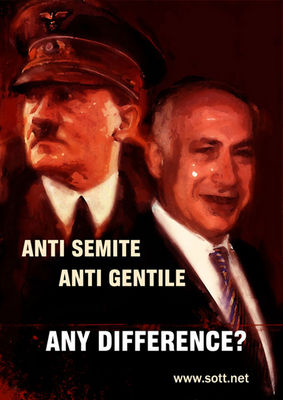
Zionism and Nazism: is there a difference that makes a difference?

Roger Tucker argues that Zionism and Nazism are "identical manifestations of the same basic pathology" and that they are "equally dangerous to the well being of humanity". He says that although Zionism ultimately cannot sustain itself, to be complacent would risk inflicting "immense harm" on humanity.

This disarmingly simple formula, Zionism equals Nazism, is analogous to the famous assertions of Galileo and Copernicus - demonstrable but so heretical in their contemporary context as to unleash a deafening chorus of outrage from defenders of the conventional wisdom. Speaking truth to power is always a very risky business but it has its compensations: if you live long enough you can enjoy the fleeting pleasure of vindication and the comforting thought that no matter how bad things may seem at the time, they do have a way of working themselves out.

Nazism - a definition

In Part I of this series, "'Us'" versus "'them'": on the meaning of fascism" I laid out the basic argument for classifying Zionism as a form of fascism. This brief essay takes the next logical step, equating Zionism with Nazism. It is meant for readers who have developed at least some measure of immunity to the omnipresent, ubiquitous and extraordinarily effective propaganda effort underway for as long as almost all of us have been alive. We will proceed in the same fashion, drawing on the Wikipedia definitions and then looking at the current usage in order to deconstruct the deceptions of the Zionists.

According to Wikipedia,

Nazism, known officially in German as National Socialism, is the totalitarian ideology and practices of the Nazi Party or National Socialist German Workers' Party under Adolf Hitler, and the policies adopted by the dictatorial government of Nazi Germany from 1933 to 1945... In the 1930s, Nazism was not a monolithic movement, but rather a (mainly German) combination of various ideologies and philosophies which centred around nationalism, anti-communism, traditionalism and the importance of the ethnostate. Groups such as Strasserism and Black Front were part of the early Nazi movement. Their motivations were triggered over anger about the Treaty of Versailles, and what they considered to have been a Jewish/communist conspiracy to humiliate Germany at the end of World War I. Germany's post-war ills were critical to the formation of the ideology and its criticisms of the post-war Weimar Republic...

OK, all well and good. Note that the principal ideological elements of Nazi thought were "nationalism, anti-communism, traditionalism and the importance of the ethnostate". The rest of the definition elaborates on the importance of a sense of victimhood. Also note the elision of "Jewish/communist conspiracy". As people are increasingly coming to understand, Hitler's primary animus was not against Jews as such, but Bolshevism, which indeed was largely a Jewish endeavour.

Zionism - a self-serving Zionst definition

Wikipedia says:

Zionism is the international political movement that originally supported the re-establishment of a homeland for the Jewish people in the Land of Israel, the historical homeland of the Jews. Since the establishment of the State of Israel, the Zionist movement continues primarily to support it. Zionism is based on historical ties and religious traditions linking the Jewish people to the Land of Israel. Almost two millennia after the Jewish diaspora, the modern Zionist movement, beginning in the late 19th century, was mainly founded by secular Jews, largely as a response by Ashkenazi Jews to anti-Semitism across Europe, especially in Russia...

In this definition we are confronted with the inescapable imprint of Zionist propaganda that is characteristic of any Wikipedia pages having to do with Zionism or Israel. Notice the favourite rhetorical tactic of begging the question. We are asked to blindly accept as axiomatic the highly dubious proposition of "the re-establishment of a homeland for the Jewish people in the Land of Israel". These are the key points of the mythology exploded by the Israeli historian Shlomo Sand in his recent best-seller When and how was the Jewish people invented. And never mind that it was years after the founding of Zionism by Theodor Hertzl that the main goal of creating a homeland for "the Jews" zeroed in on Palestine as the location for a Jewish state. In any case, we can accept the Wikipedia definition as at least accurately representing the Zionist belief system.

In terms of current usage, Nazism is a thoroughly discredited ideology that has become virtually synonymous with political evil in much the same way as the more general category of fascism. As the well known formula has it, history is written by the winners. It is largely forgotten that there was considerable support for the Nazis in both the US and in Britain, articulated by numerous highly regarded people like Henry Ford and Charles Lindbergh. It could have gone either way. As for what Zionism means nowadays, it is the expression of an historical aberration, the political Zionism of people like Vladimir Zabotinsky - the source and continuing gold standard of Middle Eastern terrorism - quite the opposite of the idealistic philosophy of the cultural or spiritual Zionists who were dominant in the movement prior to the rise of the Nazis, whom the political Zionists admired and collaborated with.

We are currently experiencing a similar phenomenon - the battle between the Zio-Nazis and the anti-Zionists. It is essentially the same battle, fought out by two different protagonists, but the principles involved are the same. For the sake of simplicity it can reasonably be viewed as the age old struggle between good and evil. The differences are even starker, as this is clearly a conflict between the forces of money and power versus ordinary people, between a purely utilitarian, amoral materialism versus a sense of what is truly sacred, between imperialism and those less powerful, between colonialism and "the natives," between truth and falsehood, and so on and so forth. And due to the Zionization of the Western world, it is playing out as the West against the rest of the world. It is an epic confrontation and it is not hyperbole to say that once again the fate of mankind lies in the balance.

Zionism and Nazism - differences and similarities

What, then, are the differences and similarities between Zionism and Nazism? If we go back to the definition of Nazism we see four characteristics mentioned. One of them was a reference to a transient political ideology, communism, while the other three are historical constants. Throwing out "anti-communism" we are left with the essential elements. When we look at Zionism in terms of what it actually is rather than some devious, self-serving Zionist definition we find "nationalism, traditionalism and the importance of the ethnostate". We also find the essential elements of fascism in general, the arrogance of group ego and the assertion of an a priori privilege that trumps any such fripperies as civil rights, human rights, international law or even common human decency. Coercion and force majeure are the means and virtual enslavement or extermination of the "others" (the goyim - gentiles) are the ends. Characteristically, we also find the common element of a sense of infinite entitlement based on perceived prior victimhood.

As for any arguments based on the obvious or perceived differences between Zionism and Nazism, we can easily dismiss them as superficialities, rather than any differences that make a difference. Substantively, they are identical manifestations of the same basic pathology and they are equally dangerous to the well being of humanity. We can comfort ourselves with the knowledge that the bullies never win in the end, because underneath the bluster they are abject cowards and cowardice can't sustain itself in the long term. But that doesn't mean we can just sit back and wait for them to meet their inevitable fate - as we have seen, they are capable of doing immense harm in the meantime.

All of the great wisdom traditions are in agreement that we are human beings first and anything else is at best a secondary characteristic. As long as there remains any confusion about this, various forms of fascism will arise and bedevil us. As long as we identify ourselves primarily in some tribal fashion, whether it's based on nationality, ethnicity, religion, gender or any parochial and exclusionary manner, then confusion and conflict will reign supreme. We shall indeed overcome, if we last that long, but only when it is universally understood that We refers to all of us. In the meantime, silence is complicity.

If it looks like a duck and walks like a duck, you better duck!
http://windowintopalestine.blogspot.com/

Sunday, February 21, 2010

Мусульманские трущобы Подмосковья

В епосредственной близости от Москвы 3000 мусульман из Центральной Азии живут в нечеловеческих условиях, страдая от холода, недоедания и болезней. Но об их страданиях в столице либо не знают, либо не хотят знать.

Поселок Челобитьево расположен в 200 метрах от МКАД, на задворках мытищенской ярмарки. Некоторые местные жители на своих участках построили общежития для мигрантов, работающих на ярмарке. Но многие из приезжих не имели возможности снимать даже такое, барачного типа, жилье. Оставшиеся на улице люди стали сами возводить себе в чистом поле домики, а скорее хижины из досок, фанеры, обломков мебели и всего, что попалось под руку. В этих домиках живут целыми семьями с маленькими детьми, по 10 человек в 1 комнате. Топят буржуйкой. Воды, канализации и прочих удобств там, разумеется, нет.

Жители поселка скинулись на электрический генератор, но и его, пользуясь бесправием мигрантов, отобрали милиционеры. По свидетельству обитателей лачуг, с целью перепродажи.

Одним из первых в поле возвела свою хижину семья Фирузы, которая сейчас является старостой поселка. Она родом из Оша, Киргизии. Фируза с мужем приехали в Россию на заработки 12 лет назад. Шесть лет назад они с мужем лишились жилья и вместе с 3 детьми, в том числе новорожденной дочерью, ночевали на Казанском вокзале.

Не имея другой возможности обзавестись крышей над головой, они попросили у местной пожилой жительницы разрешения поселиться на ее заброшенном земельном участке. Она разрешила им это сделать бесплатно. Фируза с мужем построили свой дом сами из подручных материалов.

Мужу удалось найти работу на одной из московских строек, но там с ним произошел несчастный случай: он упал с крыши и покалечился. Два года женщина ухаживала за больным супругом, пока не нашла возможность отправить его на родину, в Таджикистан. Сама она не могла вернуться: на родине у них с мужем нет ни дома, ни квартиры, да и средств к существованию тоже.

Сейчас Фируза одна воспитывает 3 детей. Старшему 17, среднему 16, младшей дочери 6 лет.

Дети нигде не учатся. Старший сын перебивается случайными заработками, продавая поддоны на местном рынке. Фируза надеется отдать свою дочь учиться в 1-й класс. Вместе с Фирузой и ее детьми в хижине, которую можно назвать самой благоустроенной в поселке, живут племянницы и просто знакомые девушки из Средней Азии, одна из них ждет ребенка.

«Мы не просим милостыню. Нам бы работу по нашим силам, а силы у нас еще есть. Мы сами готовы помогать всем, кто нуждается в помощи. Как возник этот поселок? Приходили люди, которые лишились работы и крова, сначала жили у нас, потом строились сами».


Я поинтересовался, бывали ли в поселке представители власти Москвы или Подмосковья. На что сопровождавший его в этой поездке правозащитник Бахром Хамроев, который регулярно привозит сюда журналистов и материальную помощь от частных лиц, сказал: «Конечно! Милиция каждый вечер совершает рейды, с целью пополнения своего бюджета. Причем наличие паспорта и регистрации обходится дороже, чем отсутствие всяческих документов. Если у человека есть паспорт, то с него требуют 1500 руб., а если нет, только 500 руб. Поэтому даже те жители поселка, у которых есть документы, договорились их не показывать. Представителей органов опеки или управления социальной защиты здесь вообще не было никогда».

В ответ на вопрос, знают ли об их судьбе и помогали ли им какие-нибудь мусульманские структуры, Фируза сказала:

«Некоторые наши ребята регулярно посещают пятничный намаз. Они обращались за помощью в главную московскую мечеть, чтобы в мечети хотя бы сделали объявление об их сложном положении, но мечетинские чиновники просителям ответили: «Мы таких услуг не оказываем, мы не помогаем нуждающимся».

«Помощь, - продолжает женщина, - организуют только отдельные мусульмане. Вот недавно приходили ребята с мытищенской ярмарки, которые устроили для нас угощение в кафе поселка Челобитьево и прочитали лекцию об Исламе. У меня самой есть большое желание обучить Исламу девушек, живущих со мной. К сожалению, я не слишком грамотна и не могу это сделать, но сама стараюсь совершать намаз. Год назад несколько религиозных ребят сколотили мечеть, где проводили коллективный намаз. Но после рейда ОМОНа ребята были вынуждены покинуть поселок. А мечеть вскоре сожгли».

«Да, несколько месяцев назад сюда приходили омоновцы, - подтвердил Б. Хамроев. - Причем они проверяли дома местных жителей и общежития, а потом добрались до самодельного поселка. Вели они себя, как на «зачистке» в горячей точке. Войдя в самодельный поселок, они застали в мечети несколько молящихся и жестоко избили их. На этом месте были лужи крови. Я сам приезжал сюда с Гейдаром Джемалем и видел остатки кровавого побоища».

Что касается официального муфтията, позиционирующего себя как высший орган уммы России, то, по мнению Бахрома Хамроева, он отличается от милиции только тем, что рейдов не проводит. То есть, от него нет ни вреда, ни пользы, ну и на этом спасибо. Бахром напомнил, что когда «официальные духовные лица» выполняют политический заказ и призывают мусульман голосовать на выборах за нужного кандидата, они обращаются к ним как к «братьям», но на самом деле они никогда не интересуются истинным положением, мыслями и чувствами мусульман, будь они гражданами России или негражданами.

Фируза сетует, что в фанерных домиках зимой люди часто болеют, лечиться возможности нет, так как в поликлиниках требуют по 2–3 тысячи рублей за прием, а им даже 300–400 рублей на лекарства трудно найти. «Нам тяжело, но мы все помогаем друг другу. Ведь мы же люди. Мы понимаем, что после нас останутся только наши добрые дела, а деньги останутся в этом мире», - говорит Фируза.

Распрощавшись с Фирузой, мы прошли дальше по поселку. В доме Алика из Таджикистана в это время проходила благотворительная акция. Алик, который сам живет в доме из фанеры, угощал горячей едой нескольких людей без определенного места жительства, в том числе 75 летнего старика из Таджикистана.


Алик рассказал, что к ним прибиваются и русскоговорящие бомжи. В поселке они чувствуют себя комфортно, так как там есть самодельная баня и жители готовят горячую пищу. Вот только от водки подмосковные бомжи не всегда отказываются, а большинство среднеазиатов, живущих здесь, алкоголь не употребляют.

Если в доме Алика мы застали пожилого человека, то у его соседки из Душанбеы увидели 7-дневного мальчика, которому в этот вечер собирались прочитать азан и наречь именем Бабур.

Мы посетили поселок в будний день. Большинство работоспособных взрослых находились на заработках, поэтому кроме стариков и женщин с детьми мы могли увидеть только мальчишек школьного возраста, которые нигде не учатся и единственным развлечением которых являются старые полуржавые велосипеды.

После невеселой «экскурсии» мы поднялись в поселок Челобитьево и зашли в кафе, где смогли совершить намаз. Бабуру Рахмоналиеву, арендующему кафе у местного жителя, повезло больше, чем обитателям фанерных домиков. Он может жить на своем рабочем месте, в кафе, где есть свет, вода из колонки и хорошая печка.

Бабур приехал из Киргизии, города Сузака, Джалалабадской области. Там он был сотрудником правозащитной организации «Справедливость». Однако статус правозащитника не помог ему избавиться от преследований киргизской службы безопасности и милиции.

Все дело в том, что Бабур был до этого осужден, ему подбросили наркотики и боеприпасы. Однако истинной причиной были его симпатии тем, кого в Киргизии называют экстремистами. Как поясняет сам Бабур, он всегда стремился к справедливости, всегда говорил правду. А это не может понравиться тем, кто привык к слепому чинопочитанию.

Говоря о судьбе тех людей, которые вынуждены перебиваться в России заработками, терпеть унижения ради куска хлеба, Бабур уверен, что обрести достоинство и выйти из постоянной нужды им поможет только соблюдение принципов Ислама во всех делах.

Уезжали из Челобитьева мы с тяжелым сердцем. Капиталистическая экономическая система, которая 20 лет навязывается в бывшем Союзе, смотрит на человека только как на средство получения материальной выгоды. Помнится, что в эпоху перестройки, когда советские люди возмущались равнодушием американцев к своим бездомным, пропагандисты капитализма отвечали им, мол, это у них свобода личности так проявляется. Хочет человек жить в картонной коробке, пусть живет, как же можно ущемлять его право на это.

Рассуждения современных россиян, к сожалению, теперь мало отличаются от взглядов «классического капитализма». Но ведь мусульмане, невзирая на навязываемые чуждые им системы жизни, всегда ставили милосердие и взаимопомощь в первый ряд своих благих дел.

Сколько произносится красивых слов о мусульманской благотворительности со стороны людей, которые сами себя гордо именуют «высшим мусульманским духовенством»? Но когда их просят о помощи бедные люди, помощи не деньгами, а хотя бы добрым словом, они отвечают: «Мы услуг помощи нуждающимся не оказываем!» Это лишний раз доказывает, что объединения «высших мусульманских духовных лиц» не являются ни представительным органом уммы, ни даже защитниками и выразителями интересов мусульман. Только сами мусульмане, добровольно следуя заветам своей религии, могут образовать те объединения, которые действительно будут заботиться об интересах всей уммы, в том числе и людей, попавших в трудную жизненную ситуацию.

Рустам Джалилов
«IslamNews»

Российский ученый доказывает важность хиджаба для здоровья мужчин

Предписания внешнего и внутреннего хиджаба в Исламе получили научное подтверждение. Российский физиолог доказывает, что в большинстве мужских болезней виноваты женщины, которые выбирают слишком легкомысленный стиль в одежде и поведении. Из-за этого, по мнению ученого, западная цивилизация постепенно превращается в общество сексуально неудовлетворенных, а как следствие - неуспешных и физически нездоровых мужчин.

Американцы недавно обнародовали результаты проводимого на протяжении 30 лет исследования. Оказалось, что у 80% людей старше 60 лет, умерших по разным причинам, кроме остальных болезней, был еще и рак предстательной железы. А каждый третий американец и европеец старше 30 лет сейчас уже жалуется на проблемы с потенцией или предстательной железой. При этом совсем другая картина на мусульманском Востоке.

У жителей арабских стран самые низкие показатели заболеваемости раком простаты. Ученые думали, что это зависит от климата или особенностей питания, и тщательно изучали рацион мусульман: нет ли в нем каких-то продуктов, обладающих профилактическим действием. Не оказалось. Разгадка же лежит на поверхности, передает «Ислам для всех».

«Дело в том, что с момента сексуальной революции женщины развитых государств взяли моду ходить по улицам полуголыми, а восточные красавицы продолжают кутаться в халат и закрывать лицо паранджой», - объяснил ситуацию старший научный сотрудник Российского института культурологии РАН академик Леонид Китаев-Смык. - Мужчина не может удовлетворять все желания, которые у него возникнут на улице! Всюду голые части тела - мини юбки, прозрачные маечки. Современная мода автоматически порождает у мужчин вожделение».

«В современном мире 70% случаев импотенции являются естественной защитной реакцией организма на стресс от постоянного нереализованного возбуждения. Только слишком затянувшейся реакцией», - разъяснил ученый.

По его словам, женщины роют могилу мужскому здоровью своими обнаженными ногами и глубокими вырезами. «Каждая красавица, отправляясь на свидание в топике, делает всего одного счастливцем, а десятерых по дороге – инвалидами», - подчеркнул Китаев-Смык. Стриптизерш же, по его мнению, вообще можно назвать «оружием массового поражения», уже превратившим западную цивилизацию в общество с физически нездоровыми мужчинами.
http://www.islam.ru/rus/2010-02-19/#31175

Saturday, February 20, 2010

The Brave Eleven and Peaceful Resistance

Eleven students who study at University of California, Irvine interrupted the Israeli ambassador Michael Oren while he was giving a speech about Israel’s policy at the university. The result was that they were immediately taken out of the hall, charged with disrupting the peace, and might face suspension or expulsion from the university.

The United States and Europe witnessed many demonstrations and protest since the last war on Gaza. Most of the incidents occurred when Israeli officials were invited to make a speech about Israel’s policy and justification for its hostility against Palestinians. Most of the demonstrations were faced with excessive force by the authorities and the protestors were punished for expressing their opinion.

These eleven students like many others felt that they want to express their feelings about the killing of the children and the continuous occupation of the Palestinian territories which happens to be the last in the world. Their expression was refused and their presence was not welcomed. They were called terrorists and they were obliged not to say what they wanted the world to hear. Not only that they were prevented from freedom of expression but also they might face suspension from their university because they were charged with disrupting the peace.

This did not happen only at UCI but in many other places where minorities are not welcomed, any sign of Islam is considered terrorism, and those who defend the Palestinian case are considered disrupting and violent. I wonder why Israel was not brought up in discussion of peace and hostility. Israel continues to violate the International Law every day by continuing its occupation in the Palestinian territories and the Arab lands, imprisons thousands of Palestinians, uses apartheid policy in East Jerusalem, and minds any kind of political settlement by continuing to refuse any Palestinian demand regarding the settlements, the occupied lands, Jerusalem, and the prisoners.

Not only that the makers of the International law refuse to bring to justice those who violate it, but also refuse to hear those who only want to demonstrate against the violators. Freedom of expression turned into a subject which is flexible. In other words it lost any kind of freedom in it and became a right which only certain people can enjoy.

These eleven students and every other student and human who wants to express his/her opinion should enjoy this right not because of the side which they defend but in order to assure that everyone’s voice is heard and freedom exists.

I do believe that peaceful resistance which doesn’t take place only in the West Bank and Nilin, but in the whole world is the only way which will make the world understand that justice must be made and that occupation must end. The obstacles which this kind of resistance finds in its way will only make it stronger and make more people know about facts which some try to hide for a long time. These facts became clear today…these facts assure that there is a people called Palestinian, and there is a land which this people has the right to live in and that occupation must end.
http://www.middleastpost.com/1657/brave-eleven-peaceful-resistance/#more-1657

MELBOURNE. 27 Feb 3.00pm


http://australiansforpalestine.com/

Possible Consequences for the Israeli Mossad

Now that the latest atrocity of Israel has badly blown back, with the pictures of 11 death squad assassins published worldwide, 2 names of Palestinians connected to the PA published, 6 more suspects in Dubai, knowledge that the whole crime was coordinated from Austria, consequences are inevitable. These are not consequences under national or international law, but the kinds of consequences which are due when mafia thugs or secret agents are burnt, and which seldom come to the knowledge of the public.

* Will the mossad get rid of the elements of the death squad after the assassination of Mahmoud Mabhouh in Dubai?
* How will the mossad deal with their problems?
* What would they use to get rid of the elements which participated in the assassination of al-Mabhouh?
* Will it be a mass culling, will they be killed in a soft and merciful way, or will it be a messy butchery?
* Will the bodies of these people be disposed by them, dropping them from airplanes into the ocean, or will they become part of the fundaments of yet to be built bridges?
Whatever happens, the Dubai 11 and all other people who participated in any capacity in this botched assassination must count on being killed if they do not surrender to or are not captured by the security forces of another nation. Regardless of what intentions the mossad has towards these elements, they are finished, and, even if the manage to evade capture, their refuge in Israel will be only temporary at best, until the pertinent decisions are taken.

Interpol on Thursday issued arrest notices for 11 suspects – six listed with British passports, three Irish, one French and one German – wanted by Dubai for the killing.

Now that they have been put on the wanted list of Interpol, that their faces are known, and that Dubai has stated that their retina prints taken at Dubai airport and other details will be published, they represent a giant liability to the Zionist regime of Israel. They are publicly known carriers of secrets, presumably in the know of many terrorist deeds of the mossad around the world. Their disposal will become an inevitable consequence, even a priority, to protect the secrets of global terrorism practiced by the mossad.
Meanwhile, the Dubai Police continues revealing new information relating to the murder of Mabhouh. They stated that the British, French, German and Irish authorities expressed during contacts with Dubai officials their strong displeasure because of the fact that the passports of their nations were used to enter Dubai and perpetrate this crime. Experts of the Dubai Police said that "the technology of recording retina prints at the airport will help to identify the perpetrators of the crime in Dubai, as it is difficult to hide or falsify this imprint, even if the person has surgery to change their face". The videotape distributed by the Dubai Police about the perpetrators of the al- Mabhouh murder shows that all of them passed through the airport, which uses records retina prints.

Palestinians elements supporting Mosssad

* Why did the Dubai Police not show the photos of the two Palestinians who were arrested in the wake of the assassination of Mahmoud al-Mabhouh in Dubai?
* Why did the police not publish the names of the Palestinian suspects?
* Is it because they are elements connected to the Palestinian National Authority?

Last week, the Dubai police stated that had they had arrested two Palestinians among 18 Dahlan_1suspects in the al-Mabhouh assassination, but they have not yet identified the two Palestinians or revealed their pictures.

Instead, the leader of Hamas, Mohammad Nazzal, announced the names of Palestinian detainees who were involved in the assassination of al-Mabhouh besides the Israeli death squad. He named them as Ahmed Hassanein, a former member of the Palestinian Intelligence Service, and Anwar Shuhaiber, a former officer in the Palestinian Preventive Security Forces. Both are former members of the PA security forces with links to Mohammed Dahlan of Fatah. Hamas claims that the senior Fatah official visited Dubai after these elements were arrested in order to try to persuade the Dubai authorities to release their operatives.

The Palestinian detainees are suspected of providing the mossad death squad with logistical aid, including renting cars and hotel rooms for them. According the Chief of the Dubai police, the Palestinians met the commander of the mossad death squad in a shopping center.

The spokesman of the Jordanian government, Nabil al-Sharif, revealed last Monday that Jordanian authorities handed these two Palestinians to the Dubai authorities. The detainees were caught by the airport security after their arrival at Amman airport.

Meanwhile, Mahmoud al-Zahar called on the West to forbid Israel from using their land to enter Arab countries and kill Palestinians. He said: "If the West allows the Zionist enemy to turn its land into land where Palestinian Muslims are murdered, or leave from it to Arab countries to assassinate our people, then we will confront them as God compels us too: 'One evil for another'", he said at a sermon in a Gaza mosque Friday.

While all the consequences and the scandal in the wake of this crime are still developing, it is noteworthy to mention that the Reut Institute, an extremist think tank which advises the Israeli regime, has recently released two the executive summaries of two reports (see here) and (here) which deal with the increasing "deligitmization" which the zionist entity suffers (which of course can't be explained). It is funny to note that among their "policy options" they write

"18 – Relationship-based diplomacy with elites and 'influentials' – An effective barrier against delegitimization is a network of personal relationships. Working within identified hubs, Israel should aspire to maintain thousands of personal relationships with political, financial, cultural, media, and security-related elites and influentials."

Now that Israel is successfully in the process of affirming its image of an obnoxious cry-baby and leg-humping hyena, a liability to anybody who has anything to do with them, one can't help but smirking while asking where these thousands of "personal relationships" are to come if not from among people who are ignorant of their own best interests.

Kawther Salam
http://palestinethinktank.com/2010/02/20/possible-consequences-for-the-israeli-mossad/

Cartoon of the day

by Carlos Latuff
http://palestinethinktank.com/2010/02/20/cartoon-of-the-day-150/

ROY: Gaza – treading on shards

by Sara Roy - The Nation
“Do you know what it’s like living in Gaza?” a friend of mine asked. “It is like walking on broken glass tearing at your feet.”

On January 21, fifty-four House Democrats signed a letter to President Obama asking him to dramatically ease, if not end, the siege of Gaza. They wrote:

The people of Gaza have suffered enormously since the blockade imposed by Israel and Egypt following Hamas’s coup, and particularly following Operation Cast Lead…. The unabated suffering of Gazan civilians highlights the urgency of reaching a resolution to the Israeli-Palestinian conflict, and we ask you to press for immediate relief for the citizens of Gaza as an urgent component of your broader Middle East peace efforts…. Despite ad hoc easing of the blockade, there has been no significant improvement in the quantity and scope of goods allowed into Gaza…. The crisis has devastated livelihoods, entrenched a poverty rate of over 70%, increased dependence on erratic international aid, allowed the deterioration of public infrastructure, and led to the marked decline of the accessibility of essential services.

This letter is remarkable not only because it directly challenges the policy of the Israel lobby–a challenge no doubt borne of the extreme crisis confronting Palestinians, in which the United States has played an extremely damaging role–but also because it links Israeli security to Palestinian well-being. The letter concludes, “The people of Gaza, along with all the peoples of the region, must see that the United States is dedicated to addressing the legitimate security needs of the State of Israel and to ensuring that the legitimate needs of the Palestinian population are met.”

I was last in Gaza in August, my first trip since Israel’s war on the territory one year ago. I was overwhelmed by what I saw in a place I have known intimately for nearly a quarter of a century: a land ripped apart and scarred, the lives of its people blighted. Gaza is decaying under the weight of continued devastation, unable to function normally. The resulting void is filled with vacancy and despair that subdues even those acts of resilience and optimism that still find some expression. What struck me most was the innocence of these people, over half of them children, and the indecency and criminality of their continued punishment.

The decline and disablement of Gaza’s economy and society have been deliberate, the result of state policy–consciously planned, implemented and enforced. Although Israel bears the greatest responsibility, the United States and the European Union, among others, are also culpable, as is the Palestinian Authority (PA) in the West Bank. All are complicit in the ruination of this gentle place. And just as Gaza’s demise has been consciously orchestrated, so have the obstacles preventing its recovery.

Gaza has a long history of subjection that assumed new dimensions after Hamas’s January 2006 electoral victory. Immediately after those elections, Israel and certain donor countries suspended contacts with the PA, which was soon followed by the suspension of direct aid and the subsequent imposition of an international financial boycott of the PA. By this time Israel had already been withholding monthly tax revenues and custom duties collected on behalf of the Authority, had effectively ended Gazan employment inside Israel and had drastically reduced Gaza’s external trade.

With escalating Palestinian-Israeli violence, which led to the killing of two Israeli soldiers and the kidnapping of Cpl. Gilad Shalit in June 2006, Israel sealed Gaza’s borders, allowing for the entry of humanitarian goods only, which marked the beginning of the siege, now in its fourth year. Shalit’s abduction precipitated a massive Israeli military assault against Gaza at the end of June, known as Operation Summer Rains, which initially targeted Gaza’s infrastructure and later focused on destabilizing the Hamas-led government through intensified strikes on PA ministries and further reductions in fuel, electricity, water delivery and sewage treatment. This near daily ground operation did not end until October 2006.

In June 2007, after Hamas’s seizure of power in the Strip (which followed months of internecine violence and an attempted coup by Fatah against Hamas) and the dissolution of the national unity government, the PA effectively split in two: a de facto Hamas-led government–rejected by Israel and the West–was formed in Gaza, and the officially recognized government headed by President Mahmoud Abbas was established in the West Bank. The boycott was lifted against the West Bank PA but was intensified against Gaza.

Adding to Gaza’s misery was the decision by the Israeli security cabinet on September 19, 2007, to declare the Strip an “enemy entity” controlled by a “terrorist organization.” After this decision Israel imposed further sanctions that include an almost complete ban on trade and no freedom of movement for the majority of Gazans, including the labor force. In the fall of 2008 a ban on fuel imports into Gaza was imposed. These policies have contributed to transforming Gazans from a people with political and national rights into a humanitarian problem–paupers and charity cases who are now the responsibility of the international community.

Not only have key international donors, most critically the United States and European Union, participated in the sanctions regime against Gaza, they have privileged the West Bank in their programmatic work. Donor strategies now support and strengthen the fragmentation and isolation of the West Bank and Gaza Strip–an Israeli policy goal of the Oslo process–and divide Palestinians into two distinct entities, offering largesse to one side while criminalizing and depriving the other. This behavior among key donor countries reflects a critical shift in their approach to the Palestinian-Israeli conflict from one that opposes Israeli occupation to one that, in effect, recognizes it. This can be seen in their largely unchallenged acceptance of Israel’s settlement policy and the deepening separation of the West Bank and Gaza and isolation of the latter. This shift in donor thinking can also be seen in their unwillingness to confront Israel’s de facto annexation of Palestinian lands and Israel’s reshaping of the conflict to center on Gaza alone, which is now identified solely with Hamas and therefore as alien.

Hence, within the annexation (West Bank)/alien (Gaza Strip) paradigm, any resistance by Palestinians, be they in the West Bank or Gaza, to Israel’s repressive occupation, including attempts at meaningful economic empowerment, are now considered by Israel and certain donors to be illegitimate and unlawful. This is the context in which the sanctions regime against Gaza has been justified, a regime that has not mitigated since the end of the war. Normal trade (upon which Gaza’s tiny economy is desperately dependent) continues to be prohibited; traditional imports and exports have almost disappeared from Gaza. In fact, with certain limited exceptions, no construction materials or raw materials have been allowed to enter the Strip since June 14, 2007. Indeed, according to Amnesty International, only forty-one truckloads of construction materials were allowed to enter Gaza between the end of the Israeli offensive in mid-January 2009 and December 2009, although Gaza’s industrial sector presently requires 55,000 truckloads of raw materials for needed reconstruction. Furthermore, in the year since they were banned, imports of diesel and petrol from Israel into Gaza for private or commercial use were allowed in small amounts only four times (although the United Nations Relief and Works Agency, UNRWA, periodically receives diesel and petrol supplies). By this past August, 90 percent of Gaza’s total population was subject to scheduled electricity cuts of four to eight hours per day, while the remaining 10 percent had no access to any electricity, a reality that has remained largely unchanged.

Gaza’s protracted blockade has resulted in the near total collapse of the private sector. At least 95 percent of Gaza’s industrial establishments (3,750 enterprises) were either forced to close or were destroyed over the past four years, resulting in a loss of between 100,000 and 120,000 jobs. The remaining 5 percent operate at 20-50 percent of their capacity. The vast restrictions on trade have also contributed to the continued erosion of Gaza’s agricultural sector, which was exacerbated by the destruction of 5,000 acres of agricultural land and 305 agricultural wells during the war. These losses also include the destruction of 140,965 olive trees, 136,217 citrus trees, 22,745 fruit trees, 10,365 date trees and 8,822 other trees.

Lands previously irrigated are now dry, while effluent from sewage seeps into the groundwater and the sea, making much of the land unusable. Many attempts by Gazan farmers to replant over the past year have failed because of the depletion and contamination of the water and the high level of nitrates in the soil. Gaza’s agricultural sector has been further undermined by the buffer zone imposed by Israel on Gaza’s northern and eastern perimeters (and by Egypt on Gaza’s southern border), which contains some of the Strip’s most fertile land. The zone is officially 300 meters wide and 55 kilometers long, but according to the UN, farmers entering within 1,000 meters of the border have sometimes been fired upon by the IDF. Approximately 30-40 percent of Gaza’s total agricultural land is contained in the buffer zone. This has effectively forced the collapse of Gaza’s agricultural sector.

These profound distortions in Gaza’s economy and society will–even under the best of conditions–take decades to reverse. The economy is now largely dependent on public-sector employment, relief aid and smuggling, illustrating the growing informalization of the economy. Even before the war, the World Bank had already observed a redistribution of wealth from the formal private sector toward black market operators.

There are many illustrations, but one that is particularly startling concerns changes in the banking sector. A few days after Gaza was declared an enemy entity, Israel’s banks announced their intention to end all direct transactions with Gaza-based banks and deal only with their parent institutions in Ramallah, in the West Bank. Accordingly, the Ramallah-based banks became responsible for currency transfers to their branches in the Gaza Strip. However, Israeli regulations prohibit the transfer of large amounts of currency without the approval of the Defense Ministry and other Israeli security forces. Consequently, over the past two years Gaza’s banking sector has had serious problems in meeting the cash demands of its customers. This in turn has given rise to an informal banking sector, which is now controlled largely by people affiliated with the Hamas-led government, making Hamas Gaza’s key financial middleman. Consequently, moneychangers, who can easily generate capital, are now arguably stronger than the formal banking system in Gaza, which cannot.

Another example of Gaza’s growing economic informality is the tunnel economy, which emerged long ago in response to the siege, providing a vital lifeline for an imprisoned population. According to local economists, around two-thirds of economic activity in Gaza is presently devoted just to smuggling goods into (but not out of) Gaza. Even this lifeline may soon be diminished, as Egypt, apparently assisted by US government engineers, has begun building an impenetrable underground steel wall along its border with Gaza in an attempt to reduce smuggling and control the movement of people. At its completion the wall will be six to seven miles long and fifty-five feet deep.

The tunnels, which Israel tolerates in order to keep the siege intact, have also become an important source of income for the Hamas government and its affiliated enterprises, effectively weakening traditional and formal businesses and the rehabilitation of a viable business sector. In this way, the siege on Gaza has led to the slow but steady replacement of the formal business sector by a new, largely black-market sector that rejects registration, regulation or transparency and, tragically, has a vested interest in maintaining the status quo.

At least two new economic classes have emerged in Gaza, a phenomenon with precedents in the Oslo period: one has grown extremely wealthy from the black-market tunnel economy; the other consists of certain public-sector employees who are paid not to work (for the Hamas government) by the Palestinian Authority in the West Bank. Hence, not only have many Gazan workers been forced to stop producing by external pressures, there is now a category of people who are being rewarded for their lack of productivity–a stark illustration of Gaza’s increasingly distorted reality. This in turn has led to economic disparities between the haves and have-nots that are enormous and visible, as seen in the almost perverse consumerism in restaurants and shops that are the domain of the wealthy.

Gaza’s economy is largely devoid of productive activity in favor of a desperate kind of consumption among the poor and the rich, but it is the former who are unable to meet their needs. Billions in international aid pledges have yet to materialize, so the overwhelming majority of Gazans remain impoverished. The combination of a withering private sector and stagnating economy has led to high unemployment, which ranges from 31.6 percent in Gaza City to 44.1 percent in Khan Younis. According to the Palestinian Chamber of Commerce, the de facto unemployment rate is closer to 65 percent. At least 75 percent of Gaza’s 1.5 million people now require humanitarian aid to meet their basic food needs, compared with around 30 percent ten years ago. The UN further reports that the number of Gazans living in abject poverty–meaning those who are totally unable to feed their families–has tripled to 300,000, or approximately 20 percent of the population.

Access to adequate amounts of food continues to be a critical problem, and appears to have grown more acute after the cessation of hostilities a year ago. Internal data from September 2009 through the beginning of January 2010, for example, reveal that Israel allows Gazans no more (and at times less) than 25 percent of needed food supplies, with levels having fallen as low as 16 percent. During the last two weeks of January, these levels declined even more. Between January 16 and January 29 an average of 24.5 trucks of food and supplies per day entered Gaza, or 171.5 trucks per week. Given that Gaza requires 400 trucks of food alone daily to sustain the population, Israel allowed in no more than 6 percent of needed food supplies during this two-week period. Because Gaza needs approximately 240,000 truckloads of food and supplies per year to “meet the needs of the population and the reconstruction effort,” according to the Palestinian Federation of Industries, current levels are, in a word, obscene. According to the Food and Agriculture Organization and World Food Program, “The evidence shows that the population is being sustained at the most basic or minimum humanitarian standard.” This has likely contributed to the prevalence of stunting (low height for age), an indicator of chronic malnutrition, which has been pronounced among Gaza’s children younger than 5, increasing from 8.2 percent in 1996 to 13.2 percent in 2006.

Gaza’s agony does not end there. According to Amnesty International, 90-95 percent of the water supplied by Gaza’s aquifer is “unfit for drinking.” The majority of Gaza’s groundwater supplies are contaminated with nitrates well above the acceptable WHO standard–in some areas six times that standard–or too salinated to use. Gaza no longer has any source of regular clean water. According to one donor account, “Nowhere else in the world has such a large number of people been exposed to such high levels of nitrates for such a long period of time. There is no precedent, and no studies to help us understand what happens to people over the course of years of nitrate poisoning,” which is especially threatening to children. According to Desmond Travers, a co-author of the Goldstone Report, “If these issues are not addressed, Gaza may not even be habitable by World Health Organization norms.”

It is possible that high nitrate levels have contributed to some shocking changes in the infant mortality rate (IMR) among Palestinians in the Gaza Strip and West Bank. IMR, widely used as an indicator of population health, has stalled among Palestinians since the 1990s and now shows signs of increasing. This is because the leading causes of infant mortality have changed from infectious and diarrheal diseases to prematurity, low birth weight and congenital malformations. These trends are alarming (and rare in the region), because infant mortality rates have been declining in almost all developing countries, including Iraq.

The people of Gaza know they have been abandoned. Some told me the only time they felt hope was when they were being bombed, because at least then the world was paying attention. Gaza is now a place where poverty masquerades as livelihood and charity as business. Yet, despite attempts by Israel and the West to caricature Gaza as a terrorist haven, Gazans still resist. Perhaps what they resist most is surrender: not to Israel, not to Hamas, but to hate. So many people still speak of peace, of wanting to resolve the conflict and live a normal life. Yet, in Gaza today, this is not a reason for optimism but despair.
http://australiansforpalestine.com/roy-gaza-treading-on-shards#more-18107